
[论文解读] Nerfbusters: Removing Ghostly Artifacts from Casually Captured NeRFs
该论文提出Nerfbusters,一种基于3D扩散的新型方法,通过使用学习到的局部3D几何先验和一种新颖的基于密度的分数蒸馏采样(DSDS)损失,有效消除随意拍摄NeRF中的鬼影伪影并提升场景几何质量。在包含双相机轨迹的新野外数据集上评估,Nerfbusters显著优于手工设计的正则化方法,在具有挑战性的新视角合成场景中大幅减少漂浮物并增强表面一致性。
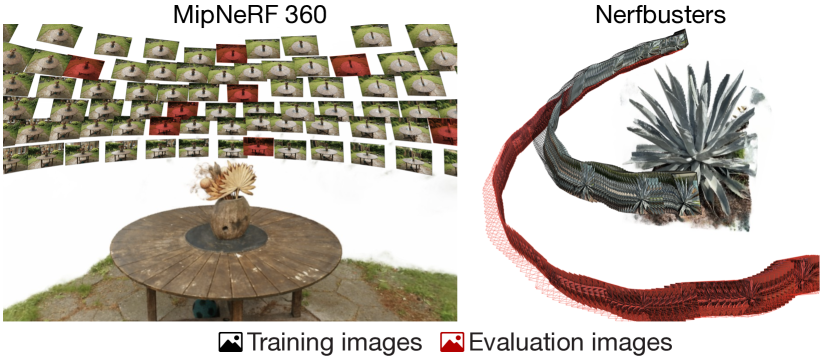
Casually captured Neural Radiance Fields (NeRFs) suffer from artifacts such as floaters or flawed geometry when rendered outside the camera trajectory. Existing evaluation protocols often do not capture these effects, since they usually only assess image quality at every 8th frame of the training capture. To push forward progress in novel-view synthesis, we propose a new dataset and evaluation procedure, where two camera trajectories are recorded of the scene: one used for training, and the other for evaluation. In this more challenging in-the-wild setting, we find that existing hand-crafted regularizers do not remove floaters nor improve scene geometry. Thus, we propose a 3D diffusion-based method that leverages local 3D priors and a novel density-based score distillation sampling loss to discourage artifacts during NeRF optimization. We show that this data-driven prior removes floaters and improves scene geometry for casual captures.
研究动机与目标
- 为解决在训练轨迹之外的视角进行渲染时,随意拍摄NeRF中持续存在的鬼影伪影和几何质量差的问题。
- 识别现有NeRF评估协议的局限性,这些协议主要测试沿同一相机路径的小视角变化,无法真实反映实际渲染质量。
- 提出一种新的评估协议,使用两条不同的相机轨迹——一条用于训练,一条用于评估——以实现对NeRF泛化能力的更真实评估。
- 开发一种数据驱动的、局部的3D几何先验,以在不依赖类别特定或全局场景先验的情况下,提升表面一致性并减少伪影。
- 证明通过扩散学习到的3D先验在真实、分布外的渲染条件下,可优于传统手工设计的正则化方法,从而提升NeRF质量。
提出的方法
- 该方法引入了一种新颖的评估协议,每组场景使用两条相机轨迹:一条用于训练,一条用于评估,从而实现对新视角合成性能的更真实评估。
- 在合成3D数据上训练3D扩散模型,以学习局部3D几何先验,以类别无关且可扩展的方式捕捉合理的表面 patch。
- 利用学习到的先验,通过一种新型的无条件密度分数蒸馏采样(DSDS)损失,指导NeRF优化,该损失在训练期间鼓励生成更真实的密度预测。
- DSDS损失将扩散模型中的分数蒸馏到NeRF的体素渲染过程中,抑制不切实际或易产生伪影的密度值。
- 该方法集成到Nerfstudio框架中,并进行端到端训练,其中扩散先验在NeRF优化过程中充当正则化器。
- 该方法采用轻量级的28 MB U-Net架构来建模局部3D几何,确保在多样化、非结构化场景中的高效性与泛化能力。
实验结果
研究问题
- RQ1在真实分布外的新视角渲染条件下,数据驱动的局部3D几何先验是否能改善随意拍摄场景中NeRF的几何质量并减少伪影?
- RQ2所提出的DSDS损失,通过从3D扩散模型蒸馏分数,是否在具有挑战性的野外环境中优于手工设计的正则化方法,实现更好的泛化性能?
- RQ3新的双轨迹评估协议如何揭示现有NeRF基准的局限性?这些基准仅在分布内视角上进行评估。
- RQ4轻量级、类别无关的3D先验在无需显式监督或场景特定调优的情况下,能在多大程度上提升NeRF质量?
- RQ5学习到的3D先验与分数蒸馏的结合是否在定量指标和定性伪影减少方面均带来可测量的性能提升?
主要发现
- 在'pipe'场景中,Nerfbusters的PSNR达到19.23,相比基线Nerfacto(19.62)提升了2.0 dB,且LPIPS降低0.03,表明感知质量更优。
- 在'plant'场景中,Nerfbusters的PSNR达到20.20,SSIM达到0.7535,优于所有基线方法,包括使用可见性、稀疏性及TV正则化的模型。
- 在'roses'场景中,Nerfbusters将平均角度误差从基线的52.08°降低至48.67°,覆盖度从0.88提升至0.69,表明几何一致性更优。
- 在'table'场景中,Nerfbusters使视角误差小于30°的占比提升0.35%,同时深度误差降低0.02,离散度降低0.03。
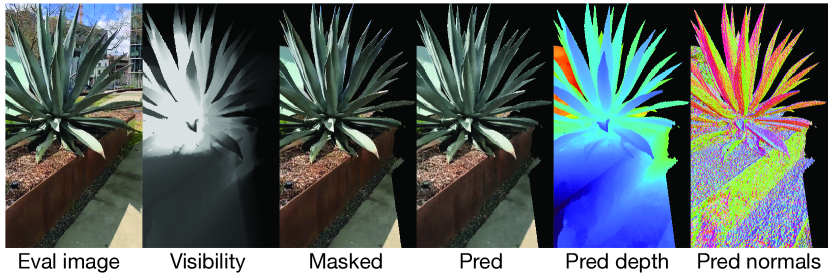
- 该方法在所有场景中均显著减少了漂浮物和云雾状伪影,定性结果表明几何更清晰,幻觉结构更少。
- 所提出的DSDS损失和局部3D先验在所有场景和指标上均持续优于手工设计的正则化方法,如可见性损失、稀疏性、总变差(TV)和RegNeRF。
阅读本论文
在 Nubint 阅读器中打开原文,边读边就任意段落提问。
在 Nubint 中阅读本论文本解读由 AI 根据论文原文生成,引用前请核对原文。