
[论文解读] NeRO: Neural Geometry and BRDF Reconstruction of Reflective Objects from Multiview Images
NeRO 提出了一种两阶段神经渲染方法,仅通过多视角 RGB 图像即可重建高度反光物体的 3D 几何形状和 BRDF,无需已知环境光照或物体掩码。通过结合分段求和近似与方向编码进行初始几何估计,再通过基于蒙特卡洛的方法优化 BRDF 和光照,NeRO 在反光表面上实现了最先进的重建质量,能够准确分解反照率、金属度和粗糙度。
We present a neural rendering-based method called NeRO for reconstructing the geometry and the BRDF of reflective objects from multiview images captured in an unknown environment. Multiview reconstruction of reflective objects is extremely challenging because specular reflections are view-dependent and thus violate the multiview consistency, which is the cornerstone for most multiview reconstruction methods. Recent neural rendering techniques can model the interaction between environment lights and the object surfaces to fit the view-dependent reflections, thus making it possible to reconstruct reflective objects from multiview images. However, accurately modeling environment lights in the neural rendering is intractable, especially when the geometry is unknown. Most existing neural rendering methods, which can model environment lights, only consider direct lights and rely on object masks to reconstruct objects with weak specular reflections. Therefore, these methods fail to reconstruct reflective objects, especially when the object mask is not available and the object is illuminated by indirect lights. We propose a two-step approach to tackle this problem. First, by applying the split-sum approximation and the integrated directional encoding to approximate the shading effects of both direct and indirect lights, we are able to accurately reconstruct the geometry of reflective objects without any object masks. Then, with the object geometry fixed, we use more accurate sampling to recover the environment lights and the BRDF of the object. Extensive experiments demonstrate that our method is capable of accurately reconstructing the geometry and the BRDF of reflective objects from only posed RGB images without knowing the environment lights and the object masks. Codes and datasets are available at https://github.com/liuyuan-pal/NeRO.
研究动机与目标
- 解决因视角依赖的镜面反射导致视图不一致性而带来的多视角反光物体重建挑战。
- 克服现有神经重建方法在强镜面反射下失效的问题,原因在于对环境光照和 BRDF 的建模不足。
- 实现在无需物体掩码或环境光照先验知识的条件下进行重建,而这些通常是当前最先进方法的必要条件。
- 仅通过带姿态的 RGB 图像,实现表面几何、BRDF 参数(反照率、金属度、粗糙度)与环境光照的联合精确估计。
- 开发一种对间接光照和复杂反射具有鲁棒性的方法,即使在输入图像中物体未被分割或孤立时也能适用。
提出的方法
- 使用分段求和近似将渲染方程分解为视角无关与视角相关分量,实现在未知光照条件下的可计算几何估计。
- 应用集成方向编码以在着色函数中表示直接与间接光照效应,提升精度,而无需在几何优化过程中显式估计光源。
- 在第二阶段固定估计的几何形状,并通过蒙特卡洛采样重建高保真度的环境光照与 BRDF 参数。
- 引入中性光照损失和平滑度损失,以提升反照率精度并防止在优化过程中出现噪声 BRDF 预测。
- 使用可微分神经网络表示表面 BRDF,可预测反照率、金属度与粗糙度,从而实现与几何和光照的端到端优化。
- 利用神经 SDF 场隐式表示 3D 形状,并通过位置编码捕捉高频表面细节,即使神经场本身存在平滑性问题。
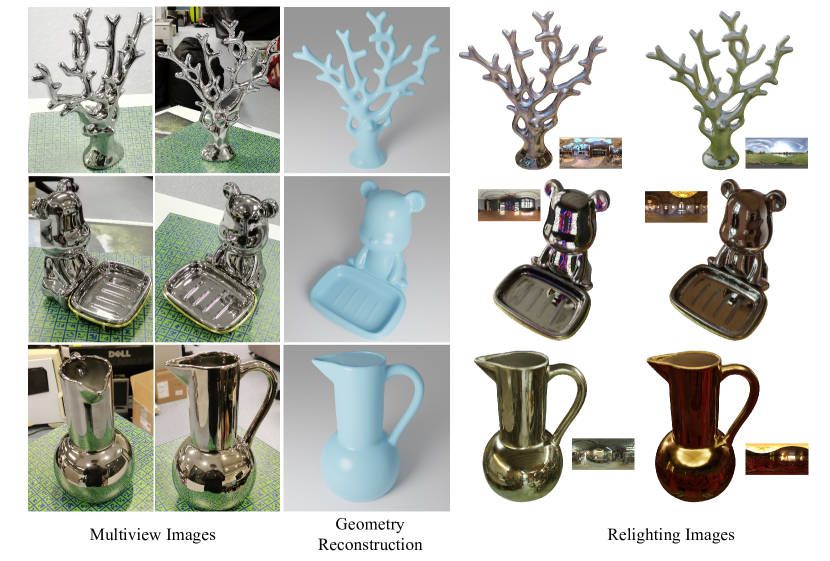
实验结果
研究问题
- RQ1当环境光照与物体掩码未知时,神经渲染框架能否准确地从多视角图像中重建反光物体的 3D 几何形状?
- RQ2在神经重建流程中,如何有效近似渲染方程,以在无显式光照监督的情况下建模直接与间接镜面反射?
- RQ3与端到端方法相比,两阶段优化策略(先几何,后 BRDF 与光照)在反光表面上能在多大程度上提升重建质量?
- RQ4该方法能否在复杂光照条件下,以高保真度将输入图像分解为物理解释性成分(反照率、光照、材质参数)?
- RQ5该方法的主要失效模式是什么?几何不准确如何在高度反光材料上影响 BRDF 估计?
主要发现
- NeRO 在反光物体上实现了最先进的 3D 重建质量,优于 COLMAP、NeuS、Ref-NeRF 和 NDRMC,尤其在捕捉锐利镜面高光与复杂形状方面表现优异。
- 即使缺少细微细节,该方法仍能成功重建反光物体的整体形状,如 'Angel' 和 'Cat' 模型所示,但因 SDF 平滑性导致胡须与衣物等精细纹理未被完全捕捉。
- BRDF 分解结果表明,反照率与光照效应被准确分离,金属度与粗糙度预测正确——例如,能区分金属烛台与非金属标定板。
- 消融实验表明,中性光照损失与平滑度损失显著提升了重光照质量,通过增强反照率精度并减少 BRDF 噪声。
- 该方法对间接光照具有鲁棒性,可在未知光照条件下重建物体,如在 Glossy-Real 数据集上成功实现重光照与分解。
- 失效案例表明,神经 SDF 场产生的不准确表面法线会导致错误的反射方向,从而降低 BRDF 估计质量,尤其在具有复杂或精细几何结构的物体上。
阅读本论文
在 Nubint 阅读器中打开原文,边读边就任意段落提问。
在 Nubint 中阅读本论文本解读由 AI 根据论文原文生成,引用前请核对原文。