
[论文解读] Neural functional theory for inhomogeneous fluids: Fundamentals and applications
本文提出了一种混合机器学习与经典密度泛函理论的框架,利用深度神经网络学习非均匀流体中单体直接关联函数对密度分布的泛函依赖关系。该方法通过自动微分和泛函线积分,能够精确预测热力学与结构性质(包括吉布斯自由能和对相关函数),其性能优于最先进的基本度量理论,同时在宏观尺度上保持了微观精度。
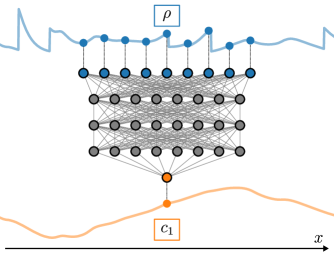
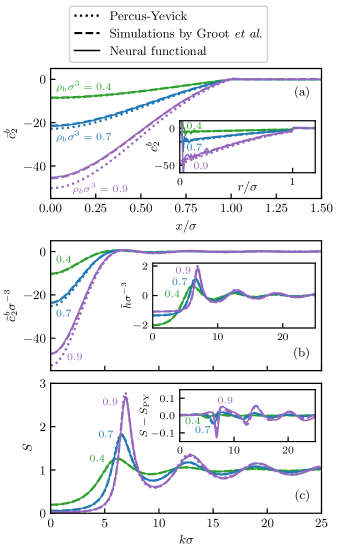
We present a hybrid scheme based on classical density functional theory and machine learning for determining the equilibrium structure and thermodynamics of inhomogeneous fluids. The exact functional map from the density profile to the one-body direct correlation function is represented locally by a deep neural network. We substantiate the general framework for the hard sphere fluid and use grand canonical Monte Carlo simulation data of systems in randomized external environments during training and as reference. Functional calculus is implemented on the basis of the neural network to access higher-order correlation functions via automatic differentiation and the free energy via functional line integration. Thermal Noether sum rules are validated explicitly. We demonstrate the use of the neural functional in the self-consistent calculation of density profiles. The results outperform those from state-of-the-art fundamental measure density functional theory. The low cost of solving an associated Euler-Lagrange equation allows to bridge the gap from the system size of the original training data to macroscopic predictions upon maintaining near-simulation microscopic precision. These results establish the machine learning of functionals as an effective tool in the multiscale description of soft matter.
研究动机与目标
- 开发一种基于机器学习的方法,用于构建在非均匀流体中精确的密度泛函,其中精确泛函未知。
- 通过利用神经网络学习从密度分布到直接关联函数的泛函映射,克服经典密度泛函理论中传统近似方法的局限性。
- 通过在训练好的神经泛函上应用泛函微积分,实现对高阶关联函数、吉布斯自由能和状态方程的预测。
- 验证该框架与已知物理定律(如热力学诺特定理求和规则)的一致性,并展示其在自洽密度分布计算中的应用。
- 建立一种可扩展的多尺度方法,在保持接近模拟精度的同时,适用于宏观系统,弥合微观训练数据与大规模预测之间的差距。
提出的方法
- 使用平面几何中系综巨正则蒙特卡洛模拟数据,训练深度神经网络以表征从局域密度分布 ρ(r) 到单体直接关联函数 c₁(r;[ρ]) 的泛函映射。
- 在模拟中引入随机外部势,以生成覆盖广泛非均匀环境的多样化训练数据。
- 通过自动微分实现泛函微积分,从神经泛函计算高阶关联函数。
- 通过沿参考路径的泛函线积分计算过剩亥姆霍兹自由能,实现热力学一致性。
- 将在DFT欧拉-拉格朗日方程中应用神经泛函,实现自洽密度分布计算,形成神经DFT框架。
- 利用对称性感知架构(如协变神经网络),将方法扩展至各向异性粒子和更高维几何结构,同时降低数据需求。
实验结果
研究问题
- RQ1深度神经网络能否在非均匀流体中准确学习单体直接关联函数对密度分布的泛函依赖关系?
- RQ2所学习的神经泛函能否以高精度重现已知物理量,如对结构、自由能及状态方程?
- RQ3神经泛函是否支持通过自动微分实现泛函微积分,以获取高阶关联函数和热力学性质?
- RQ4神经DFT框架在预测平衡流体结构方面能否优于既有的解析近似方法(如基本度量理论)?
- RQ5该方法在从平面训练数据推广至宏观三维系统时,能在多大程度上保持微观精度?
主要发现
- 神经泛函在预测密度分布方面优于最先进的基本度量理论,尤其在复杂非均匀环境中表现更优。
- 通过自动微分实现的泛函微积分成功计算出高阶关联函数,结果与既有的理论预期一致。
- 通过泛函线积分计算的自由能与已知热力学关系相符,并明确验证了热力学诺特定理求和规则。
- 使用神经泛函求解欧拉-拉格朗日方程的自洽解,在多种外部势下均能获得稳定且精确的密度分布。
- 即使在将系统外推至宏观尺度时,该方法仍保持接近模拟级别的微观精度,展现出强大的多尺度能力。
- 该框架可推广至其他体系(包括截断Lennard-Jones流体),并可利用协变神经网络扩展至各向异性粒子和三维几何结构。
阅读本论文
在 Nubint 阅读器中打开原文,边读边就任意段落提问。
在 Nubint 中阅读本论文本解读由 AI 根据论文原文生成,引用前请核对原文。