
[论文解读] Neuro-Symbolic World Models for Adapting to Open World Novelty
该论文提出 \sysname,一种神经符号世界模型,通过学习预新异环境动态的符号规则,并利用这些规则检测变化和模拟新异后状态转移,从而实现快速、样本高效的强化学习适应。与仅使用神经网络的基线方法(包括 DreamerV2)相比,该方法通过结合真实交互与基于想象的轨迹 rollout,实现了更少策略更新次数和环境交互次数的优越适应效率。
Open-world novelty--a sudden change in the mechanics or properties of an environment--is a common occurrence in the real world. Novelty adaptation is an agent's ability to improve its policy performance post-novelty. Most reinforcement learning (RL) methods assume that the world is a closed, fixed process. Consequentially, RL policies adapt inefficiently to novelties. To address this, we introduce WorldCloner, an end-to-end trainable neuro-symbolic world model for rapid novelty adaptation. WorldCloner learns an efficient symbolic representation of the pre-novelty environment transitions, and uses this transition model to detect novelty and efficiently adapt to novelty in a single-shot fashion. Additionally, WorldCloner augments the policy learning process using imagination-based adaptation, where the world model simulates transitions of the post-novelty environment to help the policy adapt. By blending ''imagined'' transitions with interactions in the post-novelty environment, performance can be recovered with fewer total environment interactions. Using environments designed for studying novelty in sequential decision-making problems, we show that the symbolic world model helps its neural policy adapt more efficiently than model-based and model-based neural-only reinforcement learning methods.
研究动机与目标
- 为解决强化学习中的开放世界新异问题,即部署后环境动态意外改变的问题。
- 提升新异后策略适应的样本效率,减少对昂贵真实环境交互的依赖。
- 开发一种能够快速检测新异并利用符号表示模拟新异后状态转移的世界模型。
- 将基于想象的适应与真实世界交互相结合,加速新异后策略收敛。
- 证明符号世界模型在适应速度与效率方面优于纯神经网络世界模型。
提出的方法
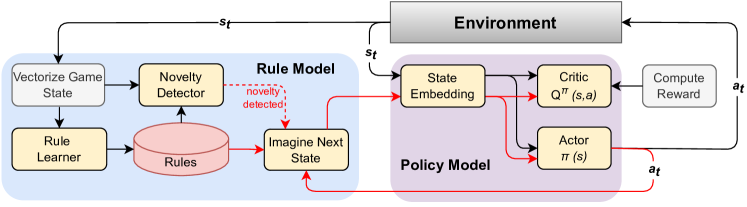
- 系统使用从单个新异后观测中更新的规则学习器,学习预新异环境状态转移的符号世界模型。
- 通过将真实环境状态转移与符号世界模型的预测结果进行比较,实现新异检测。
- 新异检测后,世界模型生成新异后环境的想象轨迹,以增强真实交互数据。
- 策略适应采用混合训练循环,结合真实环境交互与来自符号世界模型的想象轨迹。
- 通过反向传播同时优化真实与想象轨迹上的策略,实现在更少更新次数下的快速收敛。
- 系统端到端训练,符号世界模型与策略通过梯度下降联合优化。
实验结果
研究问题
- RQ1符号世界模型是否比纯神经网络模型更高效地检测开放世界新异?
- RQ2使用符号世界模型进行基于想象的适应,如何提升新异后策略学习的样本效率?
- RQ3符号世界模型能否实现比当前最先进神经世界模型(如 DreamerV2)更快的收敛速度?
- RQ4混合真实与想象数据对策略更新效率有何影响?
- RQ5该系统在多种新异类型(包括原始最优路径之外的新异)下的表现如何?
主要发现
- 在 Empty MiniGrid 环境中,符号世界模型在约 2,000 次训练步骤内达到接近完美的预测准确率,证明了其快速且样本高效的学效率。
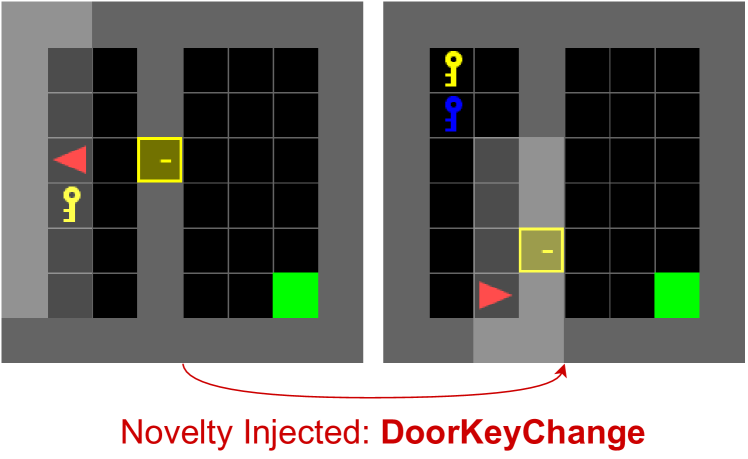
- 在所有测试的新异类型中,\sysname 所需的策略更新次数显著少于 PPO 和 DreamerV2,在 LavaHurts 和 DoorKeyChange 环境中更新次数最少。
- 仅注入 40% 的想象数据,\sysname 在所有新异类型中均表现出比无世界模型的神经策略更高的适应效率。
- 与 DreamerV2 相比,系统在使用远少的策略更新次数下实现了具有竞争力的适应效率,表明其样本效率更优。
- 在 LavaHurts 和 DoorKeyChange 等场景中,\sysname 的收敛时间方差低于 DreamerV2,表明其适应过程更具一致性。
- 结果表明,符号表示作为神经策略的补充,比纯神经网络世界模型在新异适应方面更具有效性。
阅读本论文
在 Nubint 阅读器中打开原文,边读边就任意段落提问。
在 Nubint 中阅读本论文本解读由 AI 根据论文原文生成,引用前请核对原文。