
[论文解读] Neutrino magnetic dipole portal with low energy neutrino nucleus scattering data
本文利用德累斯顿-II与COHERENT实验的低能中微子-核子散射数据,通过0.1–50 MeV质量范围内的惰性中微子磁偶极矩门户探测其存在。结果表明,在$ m_N \lesssim 0.5\,\text{MeV} $范围内,德累斯顿-II对$ e $-味门户设定了最严格的约束;而COHERENT利用完整数据集并结合时间分辨能力,首次实现了对$ m_N \approx 10\text{--}40\,\text{MeV} $范围内$ \mu $-味门户的独特探测。
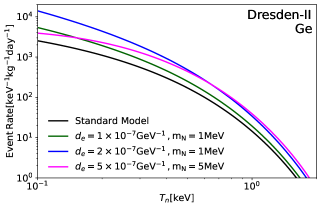
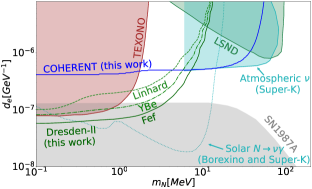
Sterile neutrinos that couple to the Standard Model via the neutrino magnetic dipole portals have been extensively studied at various experiments. In this work, we scrutinize these interactions for sterile neutrinos in the mass range of $\unit[0.1]{}-\unit[50]{MeV}$ through the nuclear and electron recoils at various neutrino scattering experiments. For the $e$-flavor specific dipole portal, we demonstrate that Dresden-II can provide leading constraints for $m_N \lesssim \unit[0.5]{MeV}$, setting aside currently unresolved theoretical uncertainties. For the $μ$-flavor case, we show that the COHERENT experiment can probe a unique parameter region for $m_N$ in the range of $\unit[10]{}-\unit[40]{MeV}$ with the full dataset collected by the CsI[Na] scintillation detector, including both the energy and timing structure of the neutrino beam. We also present limits on the parameter regions of the $τ$-flavor dipole portal using measurements of the solar neutrino flux from dark matter direct detection experiments.
研究动机与目标
- 利用低能中微子散射数据,约束亚GeV质量范围内惰性中微子的磁偶极矩门户相互作用。
- 填补超新星冷却带以上惰性中微子磁矩未被探索的参数空间。
- 利用现有实验数据集,改进对$ e $-、$ \mu $-和$ \tau $-味偶极矩门户的约束。
- 利用COHERENT的CsI[Na]数据中的时间与能量结构,分离$ \nu_\mu $、$ \bar{\nu}_\mu $和$ \bar{\nu}_e $的贡献。
- 利用PandaX-4T与Xenon1T的太阳中微子通量测量结果,独立约束$ \tau $-味门户。
提出的方法
- 采用中微子偶极矩门户的规范拉格朗日量$ \mathcal{L}_{\text{NDP}} = \frac{d_\alpha}{2}(\bar{N}\sigma^{\mu\nu}\nu^\alpha F_{\mu\nu}) + \text{h.c.} $来描述惰性中微子的相互作用。
- 计算标准模型(SM)及引入NDP贡献后,相干弹性中微子-核子散射(CE$\nu$NS)与弹性中微子-电子散射(E$\nu$ES)的微分截面。
- 对天然丰度下氙同位素的事件率取同位素平均值,以将SM预测与暗物质探测器数据进行比较。
- 利用预测事件数与SM事件数之比$ \left\langle N^{\text{SM+NDP}}(\mathcal{N}) \right\rangle / \left\langle N^{\text{SM}}(\mathcal{N}) \right\rangle \lesssim \Phi_{90\%}/\Phi_{\text{SSM}} $来约束$ d_\alpha $。
- 结合COHERENT的CsI[Na]探测器的时间飞行信息,分离$ \nu_\mu $、$ \bar{\nu}_\mu $和$ \bar{\nu}_e $通量的贡献。
- 应用PandaX-4T($ \Phi_{90\%} \simeq 9.0 \times 10^6\,\text{cm}^{-2}\text{s}^{-2} $)与Xenon1T($ \Phi_{90\%} \simeq 1.4 \times 10^7\,\text{cm}^{-2}\text{s}^{-2} $)的太阳中微子通量90%置信水平上限,以约束$ \tau $-味门户。
实验结果
研究问题
- RQ1德累斯顿-II反应堆反中微子数据能否为$ m_N \lesssim 0.5\,\text{MeV} $范围内的$ e $-味磁偶极矩门户提供最严格约束?
- RQ2COHERENT的完整数据集(含时间结构)能否探测到$ \mu $-味偶极矩门户在10–40 MeV质量范围内的独特参数区域?
- RQ3PandaX-4T与Xenon1T的太阳中微子通量测量在多大程度上约束了$ \tau $-味偶极矩门户?
- RQ4COHERENT的约束与此前来自MiniBooNE、CHARM-II和Super-K的限制相比如何?
- RQ5核 recoil 能量阈值对暗物质探测器探测$ \tau $-味门户的灵敏度有何影响?
主要发现
- 在假设Fef淬灭模型的前提下,德累斯顿-II数据对$ m_N \lesssim 0.5\,\text{MeV} $范围内的$ e $-味磁偶极矩门户设定了最严格的约束。
- COHERENT利用完整数据集并结合时间分辨能力,首次实现了对$ m_N \approx 10\text{--}40\,\text{MeV} $范围内$ \mu $-味门户的独特探测,其约束比以往结果提高了约一个数量级。
- 在$ m_N \simeq 30\,\text{MeV} $处,来自π介子衰变的单色$ \nu_\mu $峰进一步限制了$ \mu $-味门户的排除区域。
- 由于更低的能量阈值(0.5 keV vs. 4.5 keV),PandaX-4T与Xenon1T对$ \tau $-味门户的约束比以往基于核反冲的限制提高了三倍。
- PandaX-4T与Xenon1T对$ \tau $-味门户的约束覆盖了与Borexino和Super-K相同的参数区域,后者通过探测太阳中微子上散射产生的$ N $粒子衰变来寻找惰性中微子。
- 在超新星冷却带之上的$ m_N \gtrsim 40\,\text{MeV} $大范围参数空间仍处于未探索状态,提示未来需开展专门的探测研究。
阅读本论文
在 Nubint 阅读器中打开原文,边读边就任意段落提问。
在 Nubint 中阅读本论文本解读由 AI 根据论文原文生成,引用前请核对原文。