
[论文解读] Nitrogen enhancements 440 Myr after the Big Bang: super-solar N/O, a tidal disruption event or a dense stellar cluster in GN-z11?
本研究分析了大爆炸后440 Myr时红移z=10.6的GN-z11的詹姆斯·韦布空间望远镜/NIRSpec数据,发现其氮氧比(log(N/O) > -0.25)超出太阳值,与标准恒星演化模型不符。作者提出,氮的过量生成可能源于星暴星团中的失控恒星碰撞或潮汐撕裂事件等奇特过程,挑战了早期星系中常规的化学富集时间线。
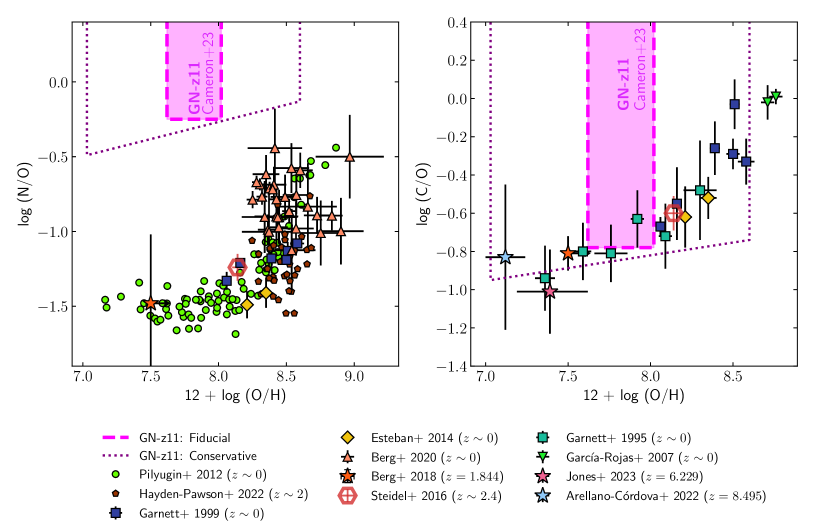
Recent observations of GN-z11 with JWST/NIRSpec revealed numerous oxygen, carbon, nitrogen, and helium emission lines at $z=10.6$. Using the measured line fluxes, we derive abundance ratios of individual elements within the interstellar medium (ISM) of this super-luminous galaxy. Driven by the unusually-bright NIII] $λ$1750 and NIV] $λ$1486 emission lines (and by comparison faint OIII] $λλ$1660, 1666 lines), our fiducial model prefers log(N/O)>-0.25, greater than four times solar and in stark contrast to lower-redshift star-forming galaxies. The derived log(C/O)>-0.78, ($\approx$30 % solar) is also elevated with respect to galaxies of similar metallicity (12+log(O/H)$\approx7.82$), although less at odds with lower-redshift measurements. Given the long timescale typically expected to enrich nitrogen with stellar winds, traditional scenarios require a very fine-tuned formation history to reproduce such an elevated N/O. We find no compelling evidence that nitrogen enhancement in GN-z11 can be explained by enrichment from metal-free Population III stars. Interestingly, yields from runaway stellar collisions in a dense stellar cluster or a tidal disruption event provide promising solutions to give rise to these unusual emission lines at $z=10.6$, and explain the resemblance between GN-z11 and a nitrogen-loud quasar. These recent observations showcase the new frontier opened by JWST to constrain galactic enrichment and stellar evolution within 440 Myr of the Big Bang.
研究动机与目标
- 利用詹姆斯·韦布空间望远镜/NIRSpec在z=10.6时测得的GN-z11发射线流量,测定其气相元素丰度。
- 评估观测到的超太阳系N/O比是否与早期星系的标准化学演化模型一致。
- 评估替代天体物理机制(如潮汐撕裂事件或致密星团)对快速氮富集的解释能力。
- 将GN-z11的发射线特性与罕见的富氮类星体进行比较,评估其电离与金属丰度模式的相似性。
- 探讨这些发现对早期星系形成及宇宙早期金属富集时间线的启示。
提出的方法
- 从GN-z11的詹姆斯·韦布空间望远镜/NIRSpec数据中测量了静止系紫外发射线流量(例如,N iii] λ1750,O iii] λλ1660,1666)。
- 利用CLOUDY光致电离模型,基于观测到的线流量比推导出电离结构、电子密度和温度。
- 使用电离校正因子和尘埃消光估计,计算元素丰度比(log(N/O),log(C/O),log(O/H))。
- 通过改变温度、密度、尘埃和电离结构等假设,检验所推导出的N/O和C/O值的稳健性。
- 评估多种竞争性情景:标准AGB风富集、第三星族恒星、潮汐撕裂事件(TDEs),以及致密星团中的失控碰撞。
- 将模型预测与观测到的线流量及富氮类星体的特性进行比较,以评估其一致性。
实验结果
研究问题
- RQ1在z=10.6时,GN-z11观测到的超太阳系N/O比能否由涉及AGB恒星的标准化学演化模型解释?
- RQ2GN-z11星际介质中N iii] λ1750发射线异常明亮,对电离与金属丰度条件有何启示?
- RQ3潮汐撕裂事件或致密星团动力学在多大程度上可解释高N/O比,而无需引入精细调制的初始条件?
- RQ4GN-z11的发射线特性与低红移处罕见的富氮类星体在定量上如何比较?
- RQ5在大爆炸后仅440 Myr的星系中,何种机制可实现比典型AGB时标更短的快速氮富集?
主要发现
- 基准模型在GN-z11中得出log(N/O) > -0.25,表明氮氧丰度超过太阳值,高出约四倍以上。
- 推导出的log(C/O) > -0.78(约30%太阳值)在具有类似金属丰度(12+log(O/H) ≈ 7.82)的典型低红移星系中偏高。
- 即使在保守假设下,模型仍得出log(N/O) > -0.49,表明N/O仍为超太阳值,排除了简单尘埃或电离校正作为解释的可能性。
- 标准AGB风富集模型无法在不引入高度人为、精细调制的初始条件及非物理解释的初始质量函数的情况下再现观测到的N/O比。
- 致密星团中的失控恒星碰撞和潮汐撕裂事件(TDEs)成为可行的替代机制,可同时解释高N/O与低O/H。
- GN-z11的发射线特征与富氮类星体具有定性相似性,尽管GN-z11处于该稀有群体的极端异常端。
阅读本论文
在 Nubint 阅读器中打开原文,边读边就任意段落提问。
在 Nubint 中阅读本论文本解读由 AI 根据论文原文生成,引用前请核对原文。