
[论文解读] nnU-Net Revisited: A Call for Rigorous Validation in 3D Medical Image Segmentation
该论文重新评估了近来的3D医学影像分割方法,并展示了在nnU-Net框架内、经过正确规模化以匹配硬件的CNN-基于的 U-Net 配置,优于基于 Transformer 和 Mamba 的方法;它还发布了更新的基线并倡导严格验证。
The release of nnU-Net marked a paradigm shift in 3D medical image segmentation, demonstrating that a properly configured U-Net architecture could still achieve state-of-the-art results. Despite this, the pursuit of novel architectures, and the respective claims of superior performance over the U-Net baseline, continued. In this study, we demonstrate that many of these recent claims fail to hold up when scrutinized for common validation shortcomings, such as the use of inadequate baselines, insufficient datasets, and neglected computational resources. By meticulously avoiding these pitfalls, we conduct a thorough and comprehensive benchmarking of current segmentation methods including CNN-based, Transformer-based, and Mamba-based approaches. In contrast to current beliefs, we find that the recipe for state-of-the-art performance is 1) employing CNN-based U-Net models, including ResNet and ConvNeXt variants, 2) using the nnU-Net framework, and 3) scaling models to modern hardware resources. These results indicate an ongoing innovation bias towards novel architectures in the field and underscore the need for more stringent validation standards in the quest for scientific progress.
研究动机与目标
- 识别3D医学影像分割研究中的验证陷阱。
- 在六种公开3D分割数据集上,进行大规模、严格受控的基准测试,涵盖CNN-、Transformer-与 Mamba-基于的方法。
- 评估数据集对基准方法进展的适用性。
- 在 nnU-Net 内提供更新的标准化基线并给出公平比较的指导。
提出的方法
- 整理验证陷阱并给出具体建议(R1-R4)。
- 在统一的硬件和交叉验证设定下,对六个公开的3D分割数据集进行大规模基准测试。
- 在 nnU-Net 框架内比较 CNN-、Transformer-和 Mamba-基于的体系结构,以及 Auto3DSeg 框架;确保相等的显存预算。
- 分析模型尺度化效应以及数据集与任务特定的表现,以识别真实进展因素。
- 发布更新的标准化基线和数据集适用性评价框架。
实验结果
研究问题
- RQ1近期关于体系结构优越性的主张在使用公平基线和标准化配置进行严格验证时是否成立?
- RQ2在控制数据、计算和基线质量后,推动3D医学影像分割当前最先进性能的关键因素是什么?
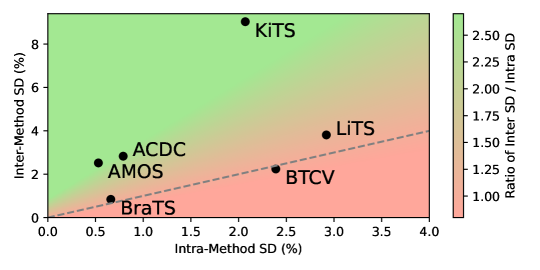
- RQ3哪些数据集最适合用于基准化方法学进展的基准评估?
- RQ4在相等资源条件下,模型尺度化和体系结构类型(CNN 与 Transformer、Mamba)对性能有何影响?
主要发现
- 在 nnU-Net 中实现的基于CNN的 U-Net 方法在六个数据集上始终表现出强劲的性能。
- MedNeXt 往往获得最佳 Dice 分数,但需要显著更长的训练时间,一些提升与目标间距有关,而非仅仅来自架构。
- 在此基准中,Transformer 的网络(SwinUNETR、nnFormer、CoTr)未能达到基于 CNN 的 nnU-Net 的性能。
- 一旦使用适当的基线(No-Mamba Base),U-Mamba 变体的表现落后,表明此前的提升可能来自混杂因素。
- 在相同资源约束下,Auto3DSeg 配置未能始终达到 nnU-Net 的性能;nnU-Net 的 ResEnc 变体以及更长时间/更高预算的配置超过开箱 Auto3DSeg。
- 放大结果显示,较大模型在更难的数据集(AMOS、KiTS)上带来实质性增益,而在较简单的任务(BTCV、BraTS)上增益较小。
- 系统性的数据集适用性分析将 KiTS、AMOS 和 ACDC 识别为最适合用于基准测试,BraTS 和 BTCV 较不适用。
阅读本论文
在 Nubint 阅读器中打开原文,边读边就任意段落提问。
在 Nubint 中阅读本论文本解读由 AI 根据论文原文生成,引用前请核对原文。