
[论文解读] Noisy Qudit vs Multiple Qubits : Conditions on Gate Efficiency for Enhancing Fidelity
本文在相同的希尔伯特空间维度和噪声环境下,比较了单-qudit 系统与多-qubit 系统的门保真度,采用林德布拉德形式下的首阶平均门保真度(AGI)。推导出一条临界曲线 $(d^2 - 1)/(3\log_2 d)$,定义了相对于退相干时间的门效率阈值,表明当门时间相对于退相干时间足够短时,某些 qudit 平台可在保真度扩展性方面与最先进的 qubit 系统相匹配或超越。
Today, multiple new platforms are implementing qudits, $d$-level quantum bases of information, for Quantum Information Processing (QIP). It is therefore crucial to study their efficiencies for QIP compared to more traditional qubit platforms. We present a comparative study of the infidelity scalings of a qudit and $n$-qubit systems, both with identical Hilbert space dimensions and noisy environments. The first-order response of the Average Gate Infidelity (AGI) to the noise in the Lindblad formalism, which was found to be gate-independent, was calculated analytically in the two systems being compared. This yielded a critical curve $O(d^2/\log_2(d))$ of the ratio of their respective gate times in units of decoherence time. This quantity indicates how time-efficient operations on these systems are. The curve delineates regions where each system has a higher rate of increase of the AGI than the other. This condition on gate efficiency was applied to different existing platforms. It was found that specific qudit platforms possess gate efficiencies competitive with state-of-the-art qubit platforms. Numerical simulations complemented this work and allowed for discussion of the applicability and limits of the linear response formalism.
研究动机与目标
- 评估单-qudit 系统在噪声条件下是否能优于等效的多-qubit 系统的计算保真度。
- 确定在存在更多错误通道的情况下,qudit 平台在平均门保真度(AGI)性能上仍能维持或超过多-qubit 系统的条件。
- 通过比较门效率与退相干时间尺度的关系,建立 qudit 平台可行性的定量基准。
- 验证 AGI 的线性响应近似在弱噪声下的有效性,并通过数值模拟评估其极限。
提出的方法
- 在林德布拉德形式下,解析计算单-qudit 和 n-量子比特系统在相同希尔伯特空间维度下对噪声的首阶响应,以获得平均门保真度(AGI)。
- 使用哈尓测度对所有幺正门进行平均,以确保保真度度量与初始状态无关。
- 利用涉及维度 $d$ 和噪声率 $γ$ 的迹表达式,推导单-qudit 在相位退相干噪声下的 AGI 扩展规律。
- 使用相同形式化方法,推导 $n$ 个量子比特在纯相位退相干下的相应 AGI 扩展规律,并与 qudit 情况进行比较。
- 将门时间与退相干时间的比值定义为性能指标,并推导出一条临界曲线 $ (d^2 - 1)/(3\log_2 d) $,用以区分两种系统在性能上的优劣区域。
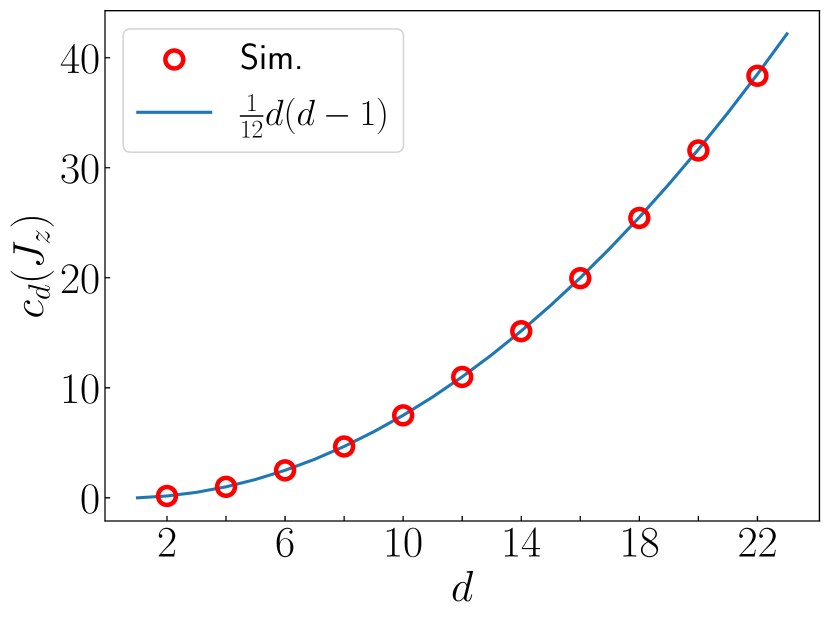
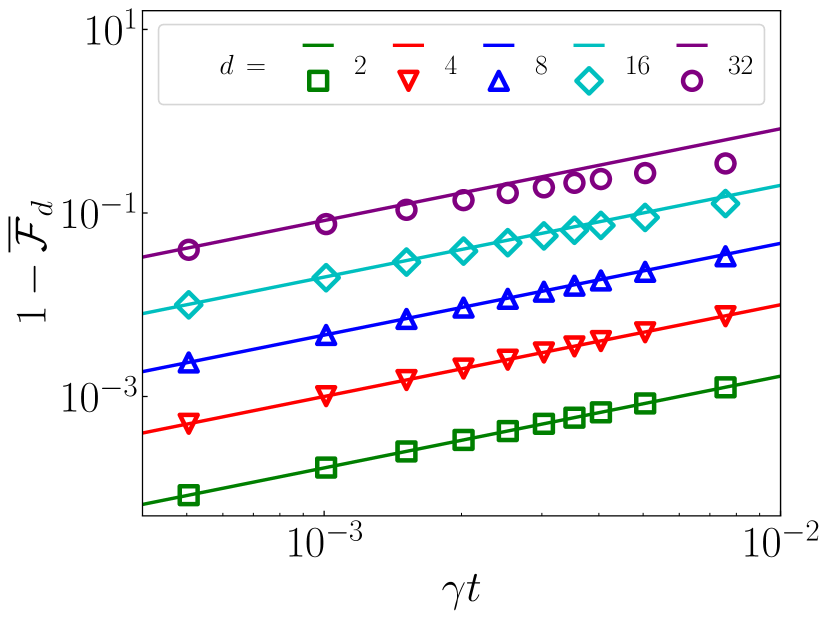
- 对 $d=4$ 和 $d=8$ 的 $N_g = 4400$ 个门进行数值模拟,以评估在高噪声水平下线性 AGI 扩展规律的偏离情况以及门依赖性。
实验结果
研究问题
- RQ1在何种门效率条件下,单-qudit 系统能保持低于等效多-qubit 系统的平均门保真度?
- RQ2与具有相同希尔伯特空间维度的多-qubit 系统相比,qudit 系统中错误通道数量的增加如何影响其保真度扩展规律?
- RQ3在弱噪声条件下,AGI 的线性响应近似对 qudit 和多-qubit 系统的有效性如何?
- RQ4门时间与退相干时间的比值达到何种阈值时,可决定 qudit 或多-qubit 系统在保真度扩展性上更具优势?
- RQ5数值模拟如何揭示线性响应形式化在预测高噪声下 AGI 增长时的局限性?
主要发现
- 临界曲线 $ (d^2 - 1)/(3\log_2 d) $ 定义了门效率比值(门时间 / 退相干时间)的阈值,当该比值处于此值时,qudit 与多-qubit 系统的 AGI 扩展规律相当。
- 对于 $d=4$,临界比值约为 $ (16 - 1)/(3 \cdot 2) = 2.5 $,表明当门时间小于退相干时间的 2.5 倍时,qudit 系统可优于多-qubit 系统。
- 数值模拟显示,当 $\gamma t$ 较高时,AGI 偏离线性行为,且 $d$ 值越大,在更小的 $\gamma t$ 下即表现出明显的非线性。
- 单-qudit 的 AGI 扩展规律为 $ \overline{\mathcal{F}}(\mathcal{E}_z) = \frac{d + d^2 - \frac{\gamma t}{12}d^2(d^2 - 1)}{d(d+1)} + o(\gamma t) $,确认了主导噪声项中对 $d$ 的二次依赖关系。
- 对于 $n$ 个量子比特,AGI 扩展规律为 $ \overline{\mathcal{F}}(\mathcal{E}_z) = \frac{2^n + 2^{2n} - \frac{\gamma t}{4}n2^{2n}}{2^n(2^n + 1)} + o(\gamma t) $,表明噪声系数中对 $n$ 的线性依赖关系。
- 本研究证实,当门时间相对于退相干时间足够短时,特定的 qudit 平台可实现与最先进的 qubit 平台相当的门效率。
阅读本论文
在 Nubint 阅读器中打开原文,边读边就任意段落提问。
在 Nubint 中阅读本论文本解读由 AI 根据论文原文生成,引用前请核对原文。