
[论文解读] Nonlinear Balanced Truncation: Part 2 -- Model Reduction on Manifolds
本论文在非线性平衡化截断方面提出一种可扩展的平衡与降维方法,通过在多项式非线性平衡流形上进行模型简化,并提出处理非线性变换病态条件的策略。
Nonlinear balanced truncation is a model order reduction technique that reduces the dimension of nonlinear systems in a manner that accounts for either open- or closed-loop observability and controllability aspects of the system. Two computational challenges have so far prevented its deployment on large-scale systems: (a) the energy functions required for characterization of controllability and observability are solutions of high-dimensional Hamilton-Jacobi-(Bellman) equations, which have been computationally intractable and (b) the transformations to construct the reduced-order models (ROMs) are potentially ill-conditioned and the resulting ROMs are difficult to simulate on the nonlinear balanced manifolds. Part~1 of this two-part article addressed challenge (a) via a scalable tensor-based method to solve for polynomial approximations of the open- and closed-loop energy functions. This article, (Part~2), addresses challenge (b) by presenting a novel and scalable method to reduce the dimensionality of the full-order model via model reduction on polynomially-nonlinear balanced manifolds. The associated nonlinear state transformation simultaneously 'diagonalizes' relevant energy functions in the new coordinates. Since this nonlinear balancing transformation can be ill-conditioned and expensive to evaluate, inspired by the linear case we develop a computationally efficient balance-and-reduce strategy, resulting in a scalable and better conditioned truncated transformation to produce balanced nonlinear ROMs. The algorithm is demonstrated on a semi-discretized partial differential equation, namely Burgers equation, which illustrates that higher-degree transformations can improve the accuracy of ROM outputs.
研究动机与目标
- 通过推导可扩展的非线性状态变换,在新坐标系中对能量函数对角化,以解决大型系统的非线性平衡截断计算挑战;并提出在非线性流形上的平衡与降维过程以缓解病态条件。
- 提供一个多项式能量函数框架,使开环和闭环能量函数以及相关非线性变换的可扩展计算成为可能。
- 在半离散化的 Burgers 型偏微分方程上演示该方法,说明高阶变换对ROM精度和奇异值行为的影响。
提出的方法
- 通过可扩展的泰勒级数张量方法计算非线性能量函数的近似,以表示开环和闭环能量。
- 推导一个实现输入归一化/输出对角化形式的非线性状态变换,并提取奇异值函数。
- 将能量函数和奇异值函数表示为具有对称系数的多项式(张量)展开,以实现高效计算。
- 开发一个在非线性流形上直接构建平衡ROM的平衡与降维策略,以缓解完整非线性变换的病态条件。
- 定义并利用度-k多项式表示来平衡能量函数,并基于逐状态的奇异值函数实现状态截断。
- 在 Burgers 型 PDE 示例上验证该框架,研究变换阶数对ROM精度的影响。
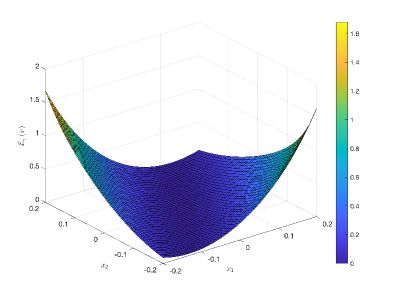
实验结果
研究问题
- RQ1如何为大型非线性系统可扩展地计算非线性能量函数,以实现平衡化?
- RQ2是否可以构建一个非线性坐标变换,在局部邻域内对开环和闭环能量函数进行对角平衡?
- RQ3如何直接在非线性平衡流形上进行模型简化,以解决非线性变换中的病态条件?
- RQ4更高阶的非线性变换对PDE类系统的降阶模型精度有何影响?
- RQ5能否用多项式(张量)表示的能量函数提供可扩展且准确的非线性平衡组成?
主要发现
- 提供一个可扩展的基于泰勒级数的策略,以在开放获取代码库中计算非线性状态变换和奇异值函数。
- 构建了一个非线性状态变换,在新坐标下对开环和闭环能量函数实现对角平衡,从而得到非线性平衡模型。
- 开发了一个在非线性流形上的平衡与降维方法,克服病态条件并实现高效的非线性ROM评估。
- 在半离散化的 Burgers 型 PDE 上演示了非线性平衡ROM,表明更高阶的变换可以提升ROM输出精度。
- 该方法不依赖特定系统形式;变换对两个多项式能量函数进行平衡,并为一般非线性系统提供可重复使用的非线性映射。
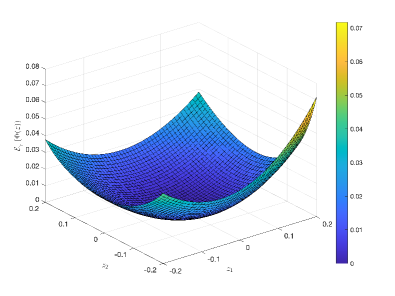
阅读本论文
在 Nubint 阅读器中打开原文,边读边就任意段落提问。
在 Nubint 中阅读本论文本解读由 AI 根据论文原文生成,引用前请核对原文。