
[论文解读] Nonlinearly Shaped Pulses in Photoinjectors and Free-Electron Lasers
本文提出了一种分散控制非线性整形(DCNS)方法,用于在光致电子枪的光阴极上生成平顶紫外激光脉冲,从而降低电子束发射度并提升自由电子激光(FEL)性能。LCLS-II的模拟结果表明,与标准高斯脉冲相比,DCNS脉冲可使X射线脉冲能量提高35%,这是由于发射度更低且束流核心的有效电荷更高。
Photoinjectors and Free Electron Lasers (FEL) are amongst the most advanced systems in accelerator physics and have consistently pushed the boundaries of emittance and x-ray peak power. In this paper, laser shaping at the cathode is proposed to further lower the emittance and reduce electron beam tails, which would result in brighter x-ray production. Using dispersion controlled nonlinear shaping (DCNS), laser pulses and beam dynamics were simulated in LCLS-II. The photoinjector emittance was optimized and the resulting e-beam profiles were then simulated and optimized in the linac. Finally, the expected FEL performance is estimated and compared to the current technology: Gaussian laser pulses on the cathode. The e-beams produced by DCNS pulses show a potential for 35% increase in x-ray power per pulse during SASE when compared to the standard Gaussian laser pulses.
研究动机与目标
- 为解决光致电子枪中高斯激光脉冲性能受限的问题,其导致发射度过高且FEL效率降低。
- 探究是否可通过非线性整形激光脉冲(特别是平顶轮廓)改善电子束质量和FEL输出。
- 评估在1 MHz重复频率下实现高重复率、高平均功率紫外脉冲生成的DCNS技术的可行性与影响。
- 在LCLS-II中对比DCNS与标准高斯脉冲在束流动力学和FEL性能方面的表现。
- 证明通过改进纵向脉冲整形可提升束流亮度和X射线脉冲能量,而无需改变核心加速器参数。
提出的方法
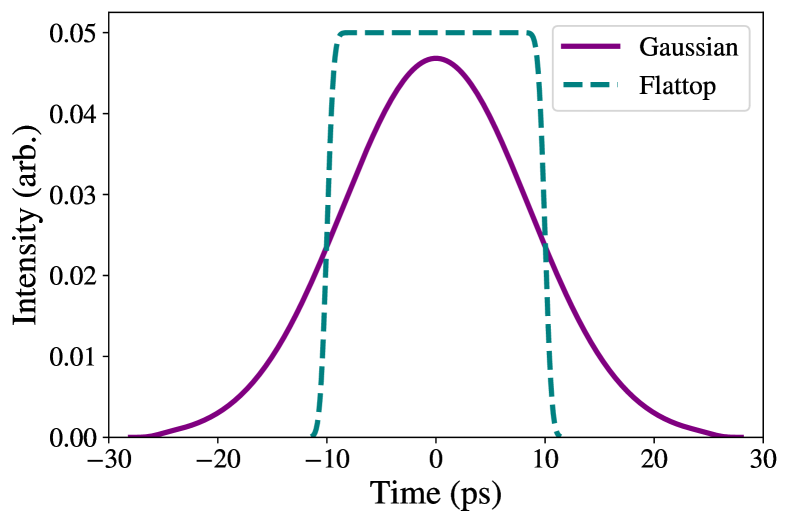
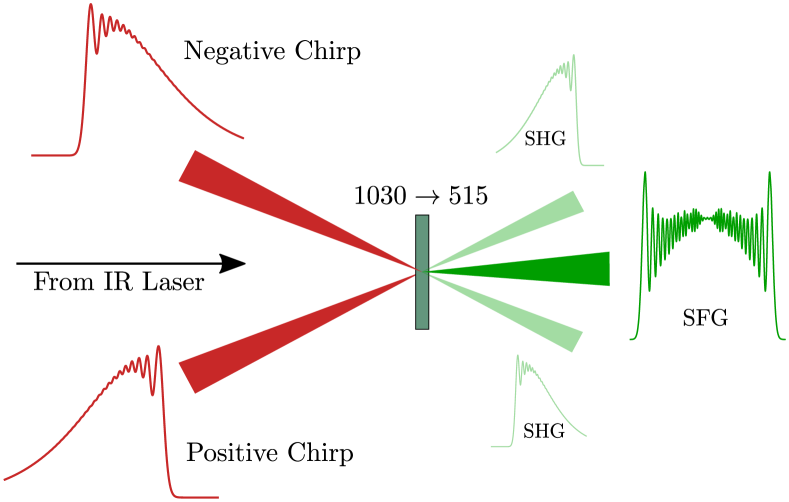
- 采用级联非线性变频链路,通过在两个臂中引入相反的一阶和三阶色散(SOD和TOD),对1030 nm基频脉冲进行整形。
- 通过频域滤波施加定制相位分布,生成两个时间上半三角形的脉冲,并在非共线和频变频(SFG)过程中进行叠加。
- 利用该SFG方案生成频率倍频的515 nm脉冲,具有平坦的光谱相位和更窄的带宽,从而实现高效且高保真的紫外脉冲生成。
- 使用LCLS-II参数对从光阴极到波荡器的完整光束线进行模拟,输入为高斯脉冲和DCNS脉冲,包括注入器和直线加速器的优化。
- 对高斯脉冲和DCNS脉冲情况应用相同的优化变量(磁铁、相位等),以确保束流动力学和FEL性能对比的公平性。
- 通过调节波荡器间隙以获取不同光子能量,估算自发辐射FEL增益和每脉冲X射线能量,束参数由核心发射度和电荷分布推导得出。
实验结果
研究问题
- RQ1与标准高斯脉冲相比,非线性整形激光脉冲(特别是平顶轮廓)是否能降低光致电子枪中电子束的发射度?
- RQ2DCNS脉冲整形如何影响直线加速器中电子束的纵向轮廓和电流分布?
- RQ3发射度和电荷分布的改善对SASE FEL增益和X射线脉冲能量有何影响?
- RQ4DCNS脉冲是否能在相同平均束参数下实现更高的每脉冲X射线功率,提升幅度为多少?
- RQ5DCNS束流核心的平坦性是否有助于降低SASE FEL输出的带宽或提升光谱亮度?
主要发现
- 与高斯脉冲相比,DCNS脉冲在每脉冲估计X射线能量上提高了35%(2.6 mJ vs. 1.9 mJ),主要归因于更低的发射度和束流核心更高的有效电荷。
- 在100 pC的束流中,DCNS束流在89 pC范围内保持了低于0.5 mm-mrad的低发射度,而高斯脉冲仅在74 pC范围内实现,表明其对电荷的利用效率更高。
- 尽管SASE功率演化过程和达到饱和的时间(在70 m内未达饱和)相似,但DCNS束流由于电流和发射度控制更优,仍显著提升了X射线脉冲能量。
- DCNS技术实现了在1 MHz重复频率下高效生成高保真、近乎变换极限的平顶紫外脉冲,克服了传统脉冲整形方法的局限。
- DCNS束流核心的平坦性表明其在降低FEL带宽和提升光谱亮度方面具有潜力,可能有利于超快和高分辨率应用。
- 本研究证明,通过在光阴极处进行纵向激光整形,可在不进行大规模加速器改造的前提下,实现更低发射度区域的访问并提升FEL性能。
阅读本论文
在 Nubint 阅读器中打开原文,边读边就任意段落提问。
在 Nubint 中阅读本论文本解读由 AI 根据论文原文生成,引用前请核对原文。