
[论文解读] Nonparametric Causal Decomposition of Group Disparities
本文提出了一种非参数因果分解框架,通过将结果差异归因于四个机制——基线结果差异、治疗普及率、平均治疗效果以及治疗的差异性选择——来剖析群体结果差异。该方法利用反事实干预和高效影响函数估计器,提供具有$√{n}$一致性、渐近正态性且双重稳健的估计结果,揭示了治疗选择是教育和收入差异中一种新颖且具有政策相关性的机制。
We introduce a new nonparametric causal decomposition approach that identifies the mechanisms by which a treatment variable contributes to a group-based outcome disparity. Our approach distinguishes three mechanisms: group differences in 1) treatment prevalence, 2) average treatment effects, and 3) selection into treatment based on individual-level treatment effects. Our approach reformulates classic Kitagawa-Blinder-Oaxaca decompositions in causal and nonparametric terms, complements causal mediation analysis by explaining group disparities instead of group effects, and isolates conceptually distinct mechanisms conflated in recent random equalization decompositions. In contrast to all prior approaches, our framework uniquely identifies differential selection into treatment as a novel disparity-generating mechanism. Our approach can be used for both the retrospective causal explanation of disparities and the prospective planning of interventions to change disparities. We present both an unconditional and a conditional decomposition, where the latter quantifies the contributions of the treatment within levels of certain covariates. We develop nonparametric estimators that are $\sqrt{n}$-consistent, asymptotically normal, semiparametrically efficient, and multiply robust. We apply our approach to analyze the mechanisms by which college graduation causally contributes to intergenerational income persistence (the disparity in adult income between the children of high- vs low-income parents). Empirically, we demonstrate a previously undiscovered role played by the new selection component in intergenerational income persistence.
研究动机与目标
- 开发一种因果框架,通过中间治疗变量分解群体结果差异,解决现有方法的局限性。
- 正式识别并估计差异性治疗选择作为贡献于差异的独立机制的作用。
- 提供反事实干预,通过隔离可改变的差异贡献因素,为政策提供信息。
- 通过解释差异而非群体效应来扩展因果中介分析,并解决随机均等化分解中的概念性问题。
提出的方法
- 提出一种反事实分解框架,从描述性角度定义群体差异,从反事实角度定义治疗干预。
- 引入三个核心组成部分:基线结果差异、治疗普及率效应和平均治疗效果,并新增一个创新的第四部分:治疗的差异性选择。
- 利用条件忽略性假设,将选择项表示为倾向得分与给定倾向得分下条件治疗效果之间的协方差。
- 基于高效影响函数开发非参数估计器,确保$√{n}$一致性、渐近正态性和半参数效率。
- 应用交叉拟合和权重稳定化技术,以改善基于机器学习估计的有限样本表现。
- 区分无条件分解与条件分解,支持边际或基于协变量的干预。
实验结果
研究问题
- RQ1高校毕业率的差异普及率在多大程度上导致了高收入来源组与低收入来源组之间的收入差异?
- RQ2有多少收入差异可归因于不同收入来源群体中高校毕业率的平均治疗效果差异?
- RQ3基于个体治疗效果的高校毕业率差异性选择对收入差异的贡献是多少?
- RQ4当对父母教育程度或早期学业成就等预处理协变量进行条件控制时,这些贡献如何变化?
- RQ5所提出的分解框架是否能提供比KBO或随机均等化分解等现有方法更具可解释性和政策相关性的洞见?
主要发现
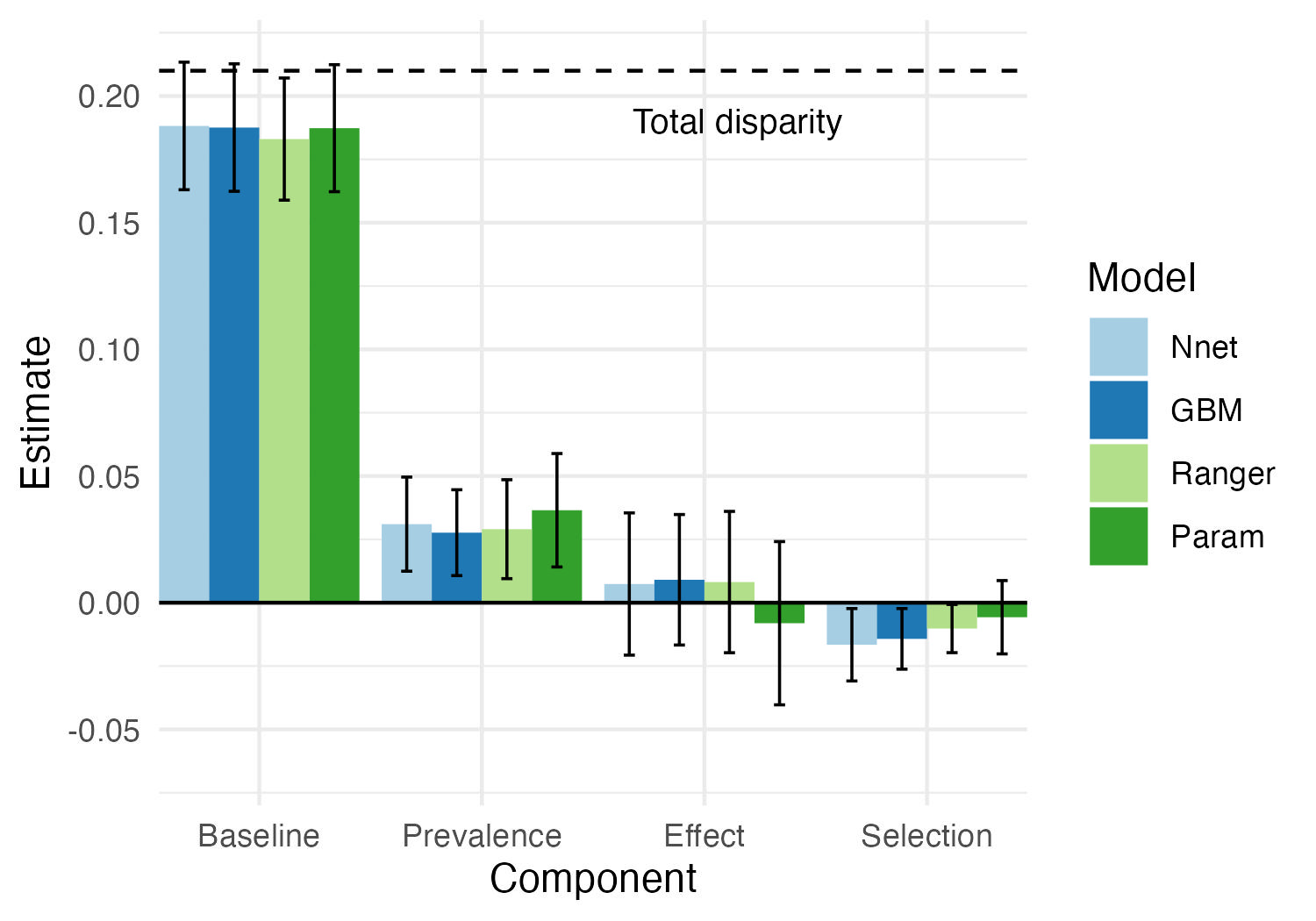
- 在无条件分解中,高校毕业率的差异普及率对总收入差异(0.210)的贡献为0.028至0.036,具体取决于模型。
- 平均治疗效果(ATE)的贡献较小且不精确,范围在-0.008至0.009之间,置信区间较宽,表明缺乏支持差异性ATE的充分证据。
- 选择项(代表治疗的差异性选择)贡献为-0.014至-0.017,表明选择模式减少了差异,且在多个模型中具有统计显著性。
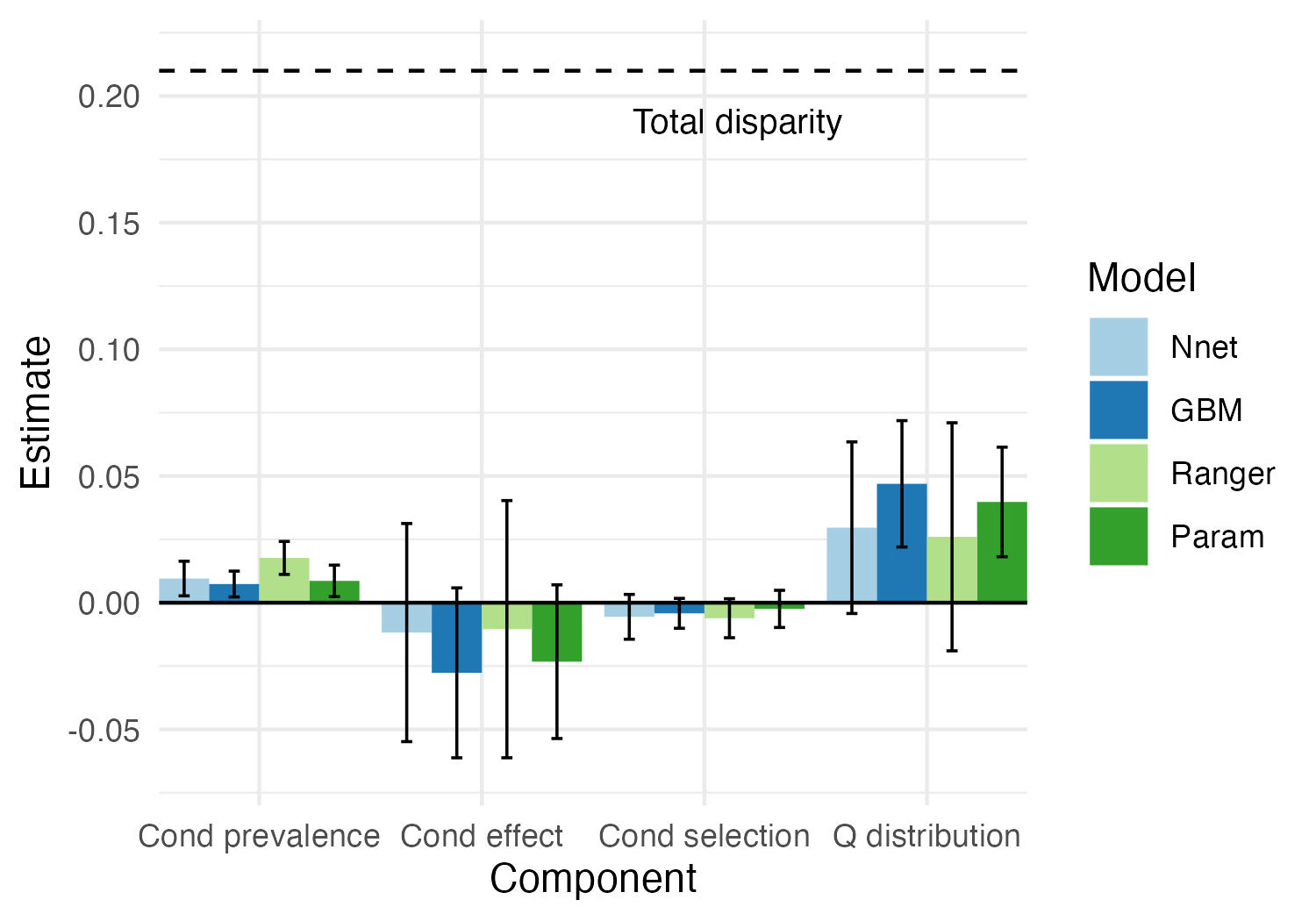
- 在条件分解中,条件普及率效应较小(0.007–0.018),而条件效应项为负值(-0.028至-0.010),表明在控制协变量后,高收入来源群体的治疗效果可能更低。
- 杰克逊缩减项(代表在均等化治疗下差异的减少)为正且显著(0.006–0.035),表明均等化治疗可减少差异。
- 该框架成功识别出治疗选择作为一项独立且可量化的机制,其估计结果在多种机器学习模型和估计技术下均具稳健性。
阅读本论文
在 Nubint 阅读器中打开原文,边读边就任意段落提问。
在 Nubint 中阅读本论文本解读由 AI 根据论文原文生成,引用前请核对原文。