
[论文解读] Normalized Validity Scores for DNNs in Regression based Eye Feature Extraction
该论文为基于回归的双眼特征提取中的深度神经网络提出了一种归一化有效性损失,通过面积归一化平衡不准确损失,并利用基于边距的梯度抑制减少微小误差带来的噪声,从而提升模型性能。该方法显著提高了视网膜、虹膜和上眼睑分割的MIoU分数,分割准确率最高提升0.15,并增强了异常值检测能力。
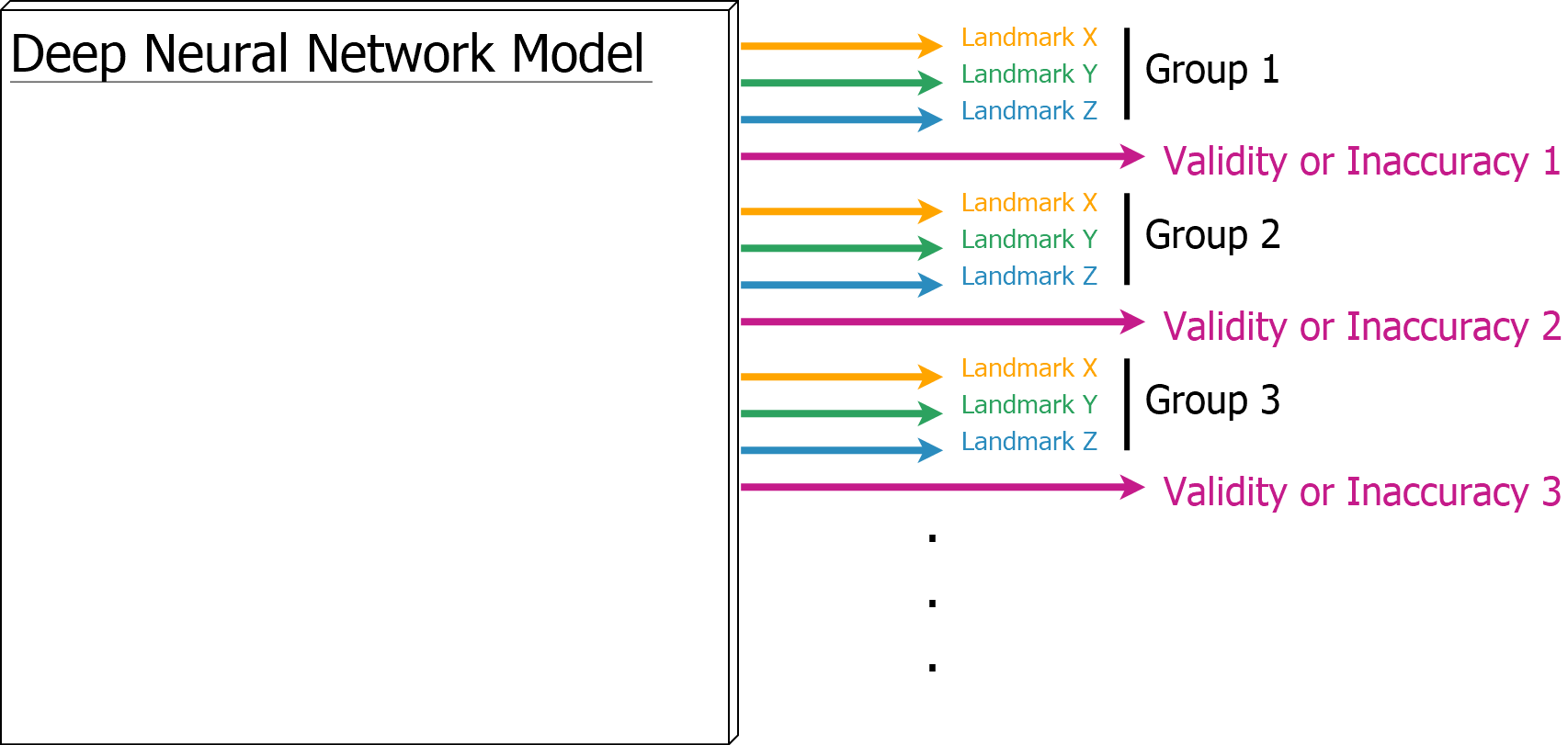
We propose an improvement to the landmark validity loss. Landmark detection is widely used in head pose estimation, eyelid shape extraction, as well as pupil and iris segmentation. There are numerous additional applications where landmark detection is used to estimate the shape of complex objects. One part of this process is the accurate and fine-grained detection of the shape. The other part is the validity or inaccuracy per landmark, which can be used to detect unreliable areas, where the shape possibly does not fit, and to improve the accuracy of the entire shape extraction by excluding inaccurate landmarks. We propose a normalization in the loss formulation, which improves the accuracy of the entire approach due to the numerical balance of the normalized inaccuracy. In addition, we propose a margin for the inaccuracy to reduce the impact of gradients, which are produced by negligible errors close to the ground truth.
研究动机与目标
- 为解决关键点检测模型中缺乏自评估的问题,即网络无法估计自身的不准确性。
- 通过将不准确性估计整合到损失函数中,提升基于回归的双眼特征提取的鲁棒性与准确性。
- 通过引入归一化不准确性损失,识别并降低不可靠关键点的权重,从而实现更可靠的形状重建。
- 评估所提出的损失公式化对分割准确率和异常值检测性能的影响。
- 探索该方法在眼动追踪之外的泛化潜力,特别是对其他基于关键点的应用。
提出的方法
- 提出一种扩展的联合关键点不准确性损失函数,通过估计形状的面积对误差贡献进行归一化。
- 采用基于边距的方法,抑制与真实值非常接近的不准确性估计所对应的梯度,从而减少反向传播中的噪声。
- 通过当前形状面积与最小面积之比(AREA/min(AREA))实现面积归一化,以平衡不同尺寸形状之间的误差。
- 采用基于欧氏空间的公式化方法(公式3),提升关键点不准确性估计的稳定性和性能。
- 使用所提出的损失函数训练多种深度学习架构(如ResNet、Hourglass),并与基线模型及先前公式化方法进行性能比较。
- 通过测量在排除不准确关键点后分割指标(MIoU)的提升,评估不准确性信号在异常值检测中的实用性。

实验结果
研究问题
- RQ1通过形状面积对不准确性损失进行归一化,如何影响双眼特征提取中关键点检测的性能?
- RQ2对微小不准确性梯度应用边距后,能在多大程度上改善模型收敛性和准确性?
- RQ3所提出的损失公式化是否能通过提升异常值检测能力,增强基于关键点的形状重建可靠性?
- RQ4与原始有效性损失公式化相比,该方法在视网膜、虹膜和上眼睑区域的分割准确率(MIoU)方面表现如何?
- RQ5不准确性损失的归一化是否能带来在不同形状尺寸下更稳定且更具泛化能力的性能?
主要发现
- 所提出的归一化不准确性损失(公式3)优于原始公式化方法及公式2,在视网膜、虹膜和上眼睑分割中分别实现0.15、0.14和0.11的MIoU提升。
- 基于面积比的归一化因子显著降低了大尺寸形状在损失中的主导作用,实现更均衡的误差分布,并提升了对小尺寸特征的性能表现。
- 基于边距的梯度抑制有效减少了微小误差带来的噪声,有助于更稳定的训练和更好的收敛性。
- 模型生成的不准确性信号能够有效支持异常值检测,其中在上眼睑和虹膜区域性能提升最为显著,归因于关键点估计可靠性的提高。
- 该方法在多种架构和任务中均表现出一致的性能提升,证实其在双眼特征提取中的鲁棒性与泛化潜力。
- 尽管在视觉变换器和非眼部应用的评估方面存在局限,但该方法在基于关键点的计算机视觉任务中展现出强大的广泛应用潜力。
阅读本论文
在 Nubint 阅读器中打开原文,边读边就任意段落提问。
在 Nubint 中阅读本论文本解读由 AI 根据论文原文生成,引用前请核对原文。