
[论文解读] Observational Parameters of Blue Large-amplitude Pulsators
本研究对蓝极大振幅脉动星(BLAPs)进行了全面的测光与光谱分析,揭示了其周期-重力关系和周期-光度关系,识别出氦丰度的双峰分布,并证实其脉动状态在数十年间保持稳定。主要贡献在于首次推导出Z型凹陷脉动星的周期-光度关系,为未来的距离测量和星族成员身份验证提供了关键工具。
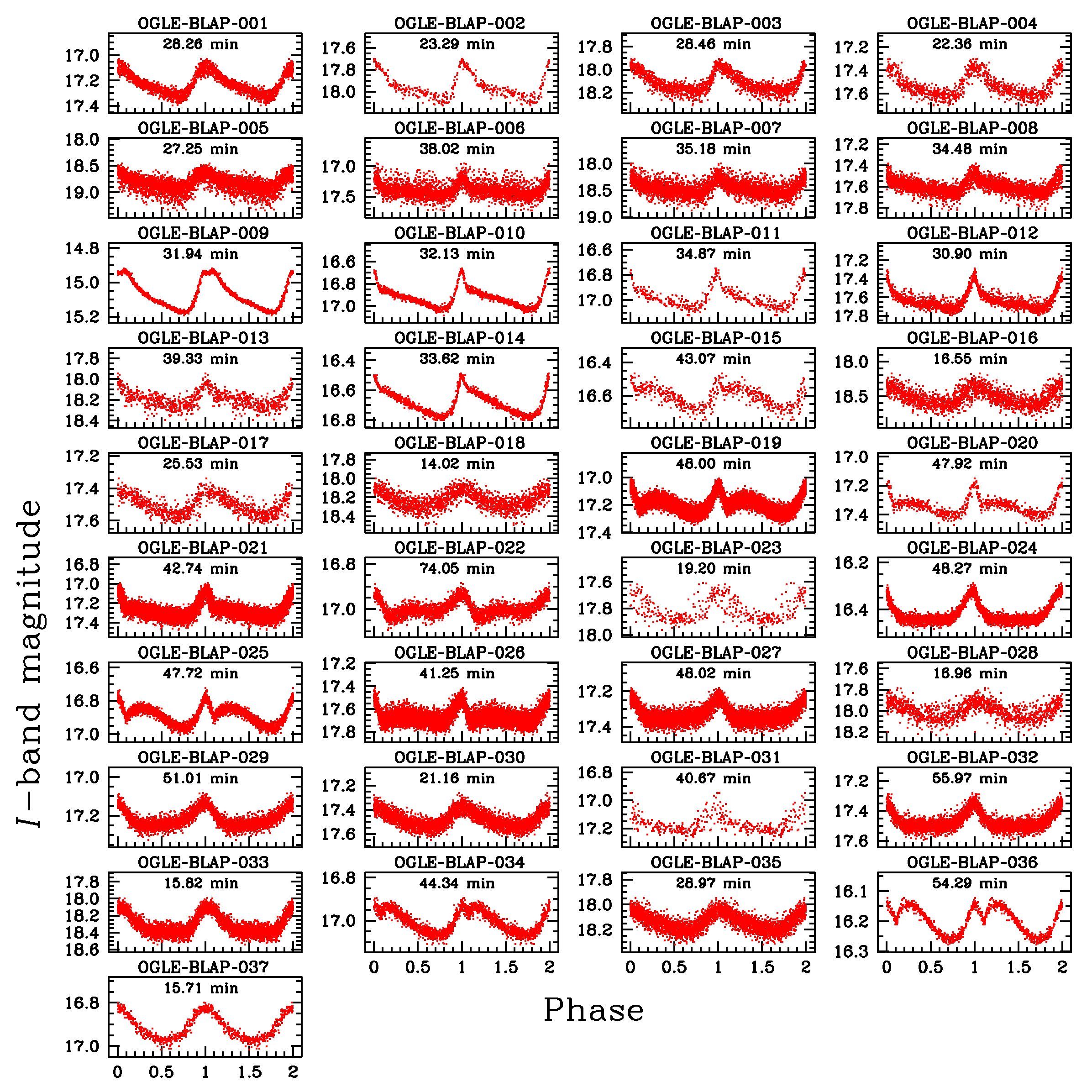
Blue large-amplitude pulsators (BLAPs) are a recently discovered class of short-period pulsating variable stars. In this work, we present new information on these stars based on photometric and spectroscopic data obtained for known and new objects detected by the Optical Gravitational Lensing Experiment (OGLE) survey. BLAPs are evolved objects with pulsation periods in the range of 3-75 minutes, stretching between subdwarf B-type stars and upper main-sequence stars in the Hertzsprung-Russell diagram. In general, BLAPs are single-mode stars pulsating in the fundamental radial mode. Their phase-folded light curves are typically sawtooth-shaped, but many longer-period objects exhibit an additional bump. The long-term OGLE observations show that the period change rates of BLAPs are usually of the order of $10^{-7}$ yr$^{-1}$ and in a quarter of the sample are negative. The spectroscopic data indicate that the BLAPs form a homogeneous group in the period, surface gravity, and effective temperature spaces. However, we observe a split into two groups in terms of helium-to-hydrogen content. The atmospheres of the He-enriched BLAPs are more abundant in metals (about 5 times) than the atmosphere of the Sun. We discover that BLAPs obey a period--gravity relationship and we use the distance to OGLE-BLAP-009 to derive a period--luminosity relation. Most of the stars observed in the OGLE Galactic bulge fields seem to reside in the bulge, while the remaining objects likely are in the foreground Galactic disk.
研究动机与目标
- 利用长期测光与光谱数据,表征蓝极大振幅脉动星(BLAPs)的观测参数。
- 确定不同周期下BLAPs的脉动模式、周期变化率及光变曲线形态。
- 研究大气成分,特别是氦与氢的比例,及其与脉动特性的关联。
- 建立BLAPs的周期-光度关系,这是进行距离估计和星族成员身份判定的关键工具。
- 澄清银河系中BLAPs的空间分布,区分银心与银盘星族。
提出的方法
- 利用1.3米华沙望远镜(OGLE巡天)的长期测光数据,测量数十年间BLAPs的脉动周期、振幅及周期变化率。
- 采用6.5米麦哲伦-巴德望远镜进行光谱分析,测定有效温度、表面重力及大气元素丰度(包括He/H比值)。
- 构建相位折叠光变曲线,以分类脉动形态,依据周期识别出锯齿形、对称形及凹陷调制形。
- 通过将脉动周期与样本中各星的表面重力值拟合,推导出周期-重力关系。
- 利用OGLE-BLAP-009的距离(2.2 ± 0.2 kpc)校准首个BLAPs周期-光度关系。
- 根据氦丰度将BLAPs分为两类:富氦(log(N_He/N_H) ≈ -0.5 dex)与贫氦(log(N_He/N_H) < -2 dex),并发现其具有周期依赖性趋势。
实验结果
研究问题
- RQ1BLAPs是否遵循周期-重力关系?该关系能否用于推断质量与半径等物理参数?
- RQ2BLAPs是否存在周期-光度关系?是否可利用已知距离进行校准?
- RQ3BLAPs大气中氦与氢的丰度分布如何?其与脉动周期及温度有何关联?
- RQ4BLAPs的长期周期变化率是多少?这对其演化状态有何启示?
- RQ5BLAPs主要位于银河系银心还是银盘?这一分布如何揭示其起源与演化?
主要发现
- BLAPs表现出线性的周期-重力关系,证实其为单模径向脉动星,具有稳定的结构参数。
- 首次基于OGLE-BLAP-009的距离(2.2 ± 0.2 kpc)推导出Z型凹陷脉动星的周期-光度关系,为未来距离估计提供了可能。
- 周期变化率通常约为10⁻⁷ yr⁻¹,其中25%的样本显示负变化率;OGLE-BLAP-030因三模脉动而具有异常高的+4.6 × 10⁻⁶ yr⁻¹变化率。
- BLAPs分为两类大气组:富氦(log(N_He/N_H) ≈ -0.5 dex),金属丰度约为太阳的5倍;贫氦(log(N_He/N_H) < -2 dex),主要分布在短周期(P ≤ 15 min)与高温(T_eff > 31,000 K)区域。
- 光变曲线在数十年间保持稳定,37颗星中未检测到掩食现象,表明双星比例不显著。
- OGLE银河系银心场中的大多数BLAPs位于银河系银心,少数位于前景银盘;OGLE-BLAP-009距离为2.2 ± 0.2 kpc,目前已知最近的BLAP(HD 133729)距离为463 ± 7 pc。
阅读本论文
在 Nubint 阅读器中打开原文,边读边就任意段落提问。
在 Nubint 中阅读本论文本解读由 AI 根据论文原文生成,引用前请核对原文。