
[论文解读] Observational Signatures of Supermassive Black Hole Binaries
本章综述利用电磁观测方法识别亚秒秒级超大质量黑洞双系统,回顾宏观尺度的证据与信号,并讨论未来展望,包括时域 surveys 与引力波探测器。
Despite solid theoretical and observational grounds for the pairing of supermassive black holes (SMBHs) after galaxy mergers, definitive evidence for the existence of close (sub-parsec) separation SMBH binaries (SMBHBs) approaching merger is yet to be found. This chapter reviews techniques aimed at discovering such SMBHBs in galactic nuclei. We motivate the search with a brief overview of SMBHB formation and evolution, and the gaps in our present-day theoretical understanding. We then present existing observational evidence for SMBHBs and discuss ongoing efforts to provide definitive evidence for a population at sub-parsec orbital separations, where many of the aforementioned theoretical gaps lie. We conclude with future prospects for discovery with electromagnetic (primarily time-domain) surveys, high-resolution imaging experiments, and low-frequency gravitational-wave detectors.
研究动机与目标
- 推动对近 SMBHB 的搜索并概述当前理论中的空缺。
- 总结在各尺度上关于 SMBHB 的现有观测证据。
- 评估并比较电磁识别技术及其优缺点。
- 将 SMBHB 人口预测与可观测信号与调查策略联系起来。
- 概述未来前景,涵盖即将到来的电磁与引力波设施。
提出的方法
- 通过一个连续性框架建模 SMBHB 人口,将电磁亮度 SMBHB 与准星星族(quasar)人口联系起来(Eq. 2–3)。
- 利用吸积速率分布将准星 luminosity 与双星质量联系起来(Eq. 3)。
- 推导基于居留时间的简易观测 SMBHB 分数估计(Eq. 6)。
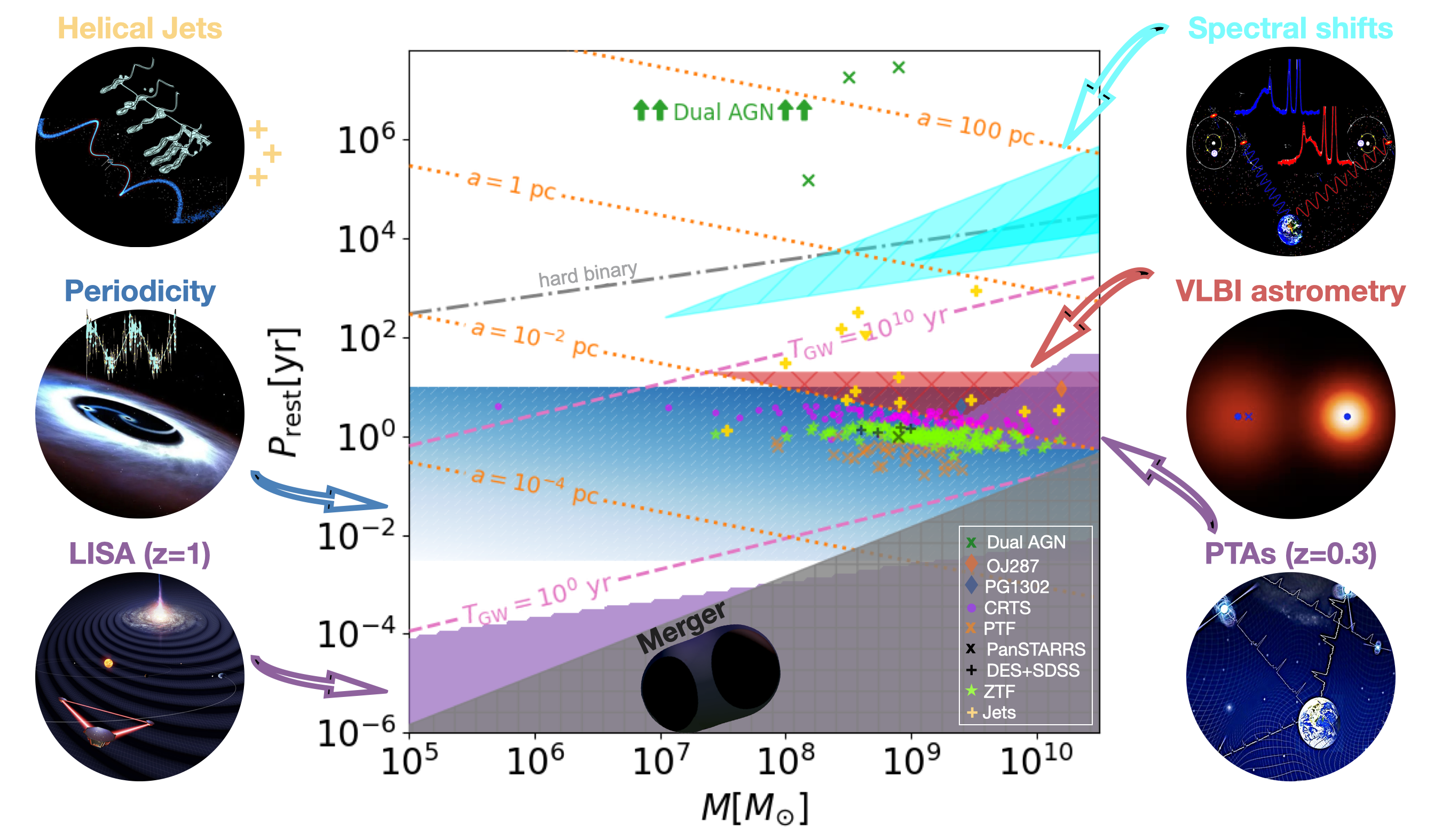
- 讨论跨尺度的观测信号:双AGN、核星系、光谱特征以及时域信号。
- 描述并比较探测方法,包括千帕秒到秒拟尺度的方法、光谱线分析以及直接成像/测光视差法。
- 强调未来观测途径(如 LSST、Roman、ngVLA、EHT、GRAVITY+)来发现 SMBHB。
实验结果
研究问题
- RQ1在不同尺度上,哪些观测信号是普遍存在且可唯一识别为 SMBHB 的?
- RQ2电磁调查如何约束 SMBHB 人口与轨道衰变过程?
- RQ3作为周期、质量与红移的函数, hosting SMBHB 的准星比例预期是多少?
- RQ4宏观尺度(双AGN、核星系)与微观尺度(光谱、光度、视差、喷流等)SMBHB 搜索方法的相对强项与局限性是什么?
- RQ5即将到来的电磁与引力波设施将如何提升对亚秒级 SMBHB 的确定性探测?
主要发现
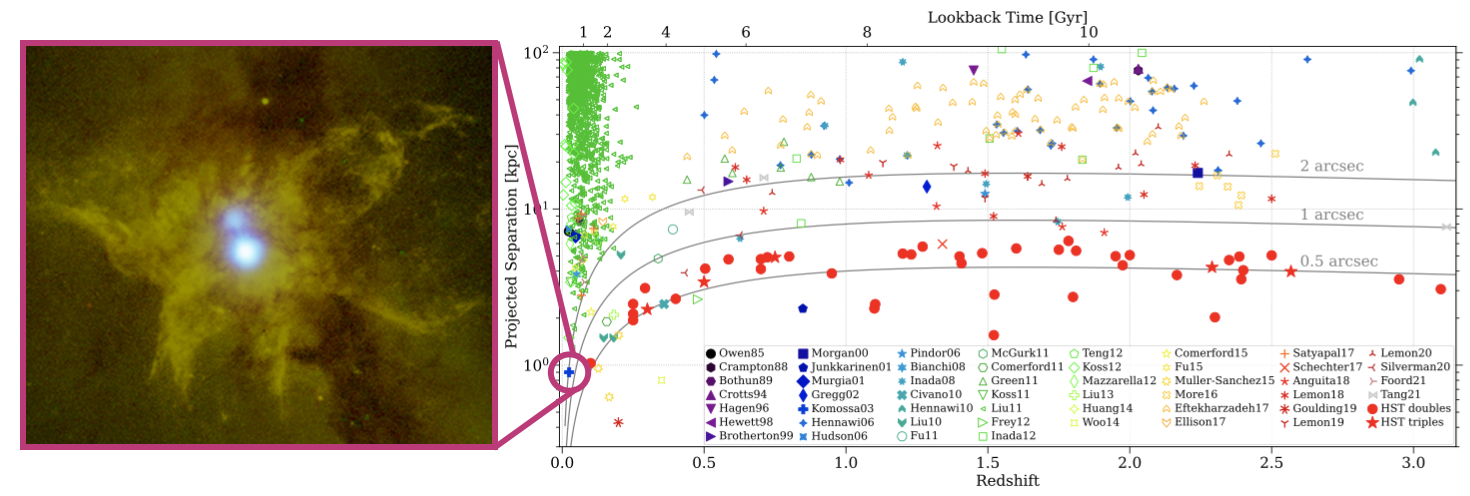
- 在多波段观测中已经发现数十个双AGN,通过高分辨成像和IFU光谱学得到确认。
- 核球椭圆星系显示出质量缺失和核心性质,与双系统清扫情景一致。
- VLBI 可在局部宇宙中将双AGN 分辨至 ~10 pc,而X 射线与光学方法提供更广但深度较浅的调查。
- 直接轨道追踪仅对少数近距离系统可行(例如创纪录的 7.3 pc 分离),凸显观测极限。
- 合成族群建模将 SMBHB 与准星人口联系起来,利用居留时间和准星寿命(Eq. 6)来估计 SMBHB 分数。
- 最终-百帕问题正在被重新定义为在亚秒级分离尺度获得明确 SMBHB 证据和详细环境相互作用的需求。
阅读本论文
在 Nubint 阅读器中打开原文,边读边就任意段落提问。
在 Nubint 中阅读本论文本解读由 AI 根据论文原文生成,引用前请核对原文。