
[论文解读] OCRBench: On the Hidden Mystery of OCR in Large Multimodal Models
本文评估大型多模态模型在OCR相关任务上的表现,并介绍 OCRBench——一个覆盖五个以文本为中心的任务、包含1000项的基准测试,用以研究LMM在手写文本和多语言文本等OCR能力。
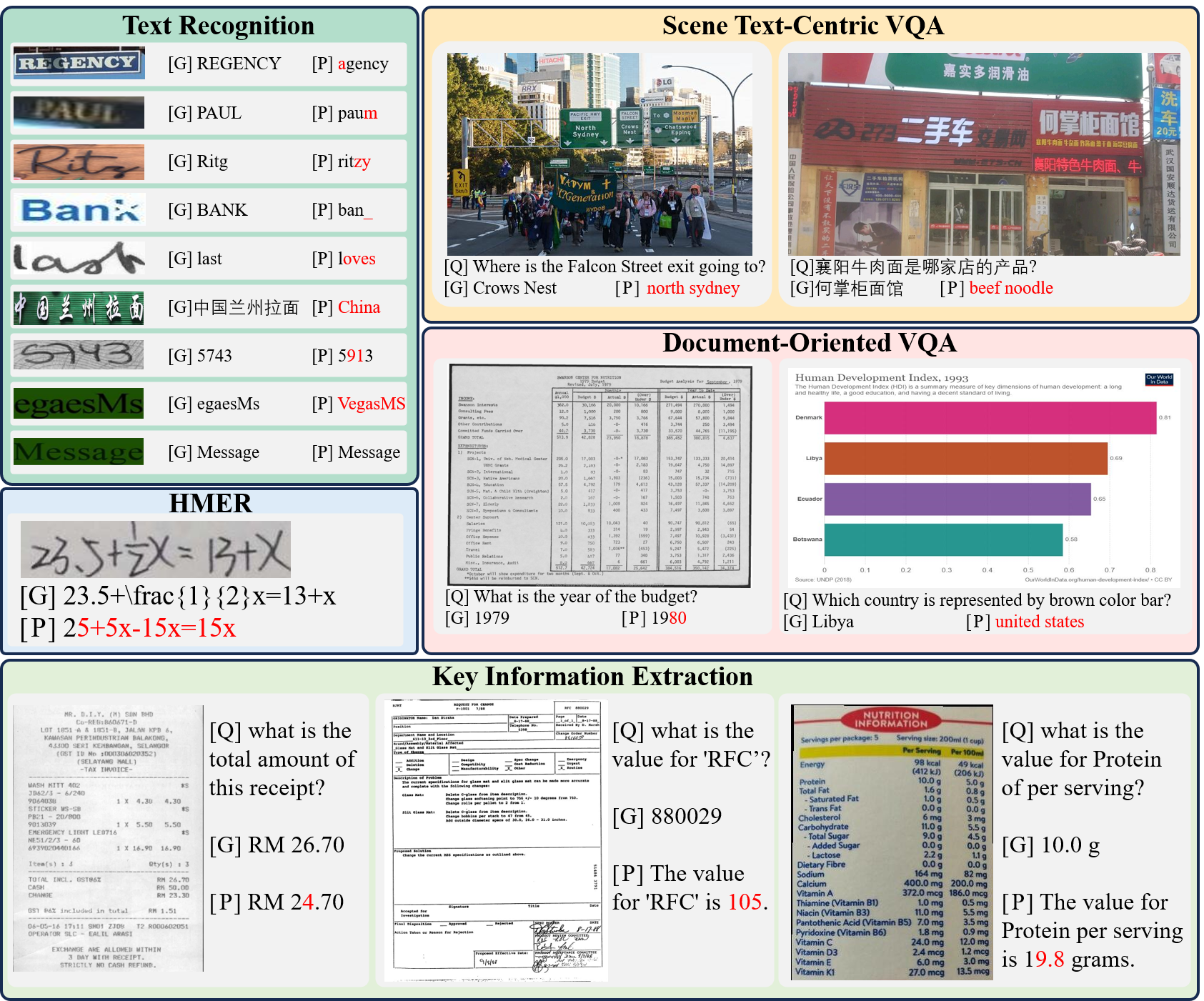
Large models have recently played a dominant role in natural language processing and multimodal vision-language learning. However, their effectiveness in text-related visual tasks remains relatively unexplored. In this paper, we conducted a comprehensive evaluation of Large Multimodal Models, such as GPT4V and Gemini, in various text-related visual tasks including Text Recognition, Scene Text-Centric Visual Question Answering (VQA), Document-Oriented VQA, Key Information Extraction (KIE), and Handwritten Mathematical Expression Recognition (HMER). To facilitate the assessment of Optical Character Recognition (OCR) capabilities in Large Multimodal Models, we propose OCRBench, a comprehensive evaluation benchmark. OCRBench contains 29 datasets, making it the most comprehensive OCR evaluation benchmark available. Furthermore, our study reveals both the strengths and weaknesses of these models, particularly in handling multilingual text, handwritten text, non-semantic text, and mathematical expression recognition. Most importantly, the baseline results presented in this study could provide a foundational framework for the conception and assessment of innovative strategies targeted at enhancing zero-shot multimodal techniques. The evaluation pipeline and benchmark are available at https://github.com/Yuliang-Liu/MultimodalOCR.
研究动机与目标
- 评估大型多模态模型(LMMs)在多样化文本相关视觉任务中的OCR能力。
- 构建并发布OCRBench,提供一个标准化、人工验证的评估套件,用于对LMM在零-shotOCR性能的评估。
- 识别在文本相关多模态理解方面的优势、局限性及改进方向(手写、多语言、HMER)。
- 比较多种LMMs(如GPT4V、Gemini、Monkey、基于BLIP的模型等)在全面的OCR任务和数据集上的表现。
提出的方法
- 对14个LMM在五个文本相关任务上的评估:文本识别、场景文本VQA、文档导向VQA、关键信息抽取(KIE)和手写数学表达式识别(HMER)。
- 采用统一评估标准:Ground-truth答案是否出现在模型输出中,并筛除非常短的答案(< 4 个符号)。
- 组建OCRBench,包含跨任务的1000个手工筛选/修正的问答对,并提供可替代的正确答案以增强鲁棒性。
- 分析29个OCR数据集的表现,包括常规/不规则/遮挡/艺术文本、手写文本、中文文本,以及语义文本与非语义文本。
- 呈现逐模型、逐任务的详细结果,识别LMMs在何处表现出色或遇到困难(如HMER、手写/中文文本等)。
- 讨论LMMs中OCR能力的潜在机制并提出未来改进方向(细粒度视觉特征、多语言数据和领域适应训练)。
实验结果
研究问题
- RQ1当前大型多模态模型在OCR相关任务上在多样数据集上的表现如何?
- RQ2在OCR中,LMMs的主要优点和弱点是什么,包括手写文本、多语言、非语义以及数学表达式识别?
- RQ3更高的输入分辨率或模型设计是否与对细粒度文本理解任务的改进相关?
- RQ4OCRBench 能否为未来在多模态模型的零-shot OCR 提供稳定基线以指导改进?
主要发现
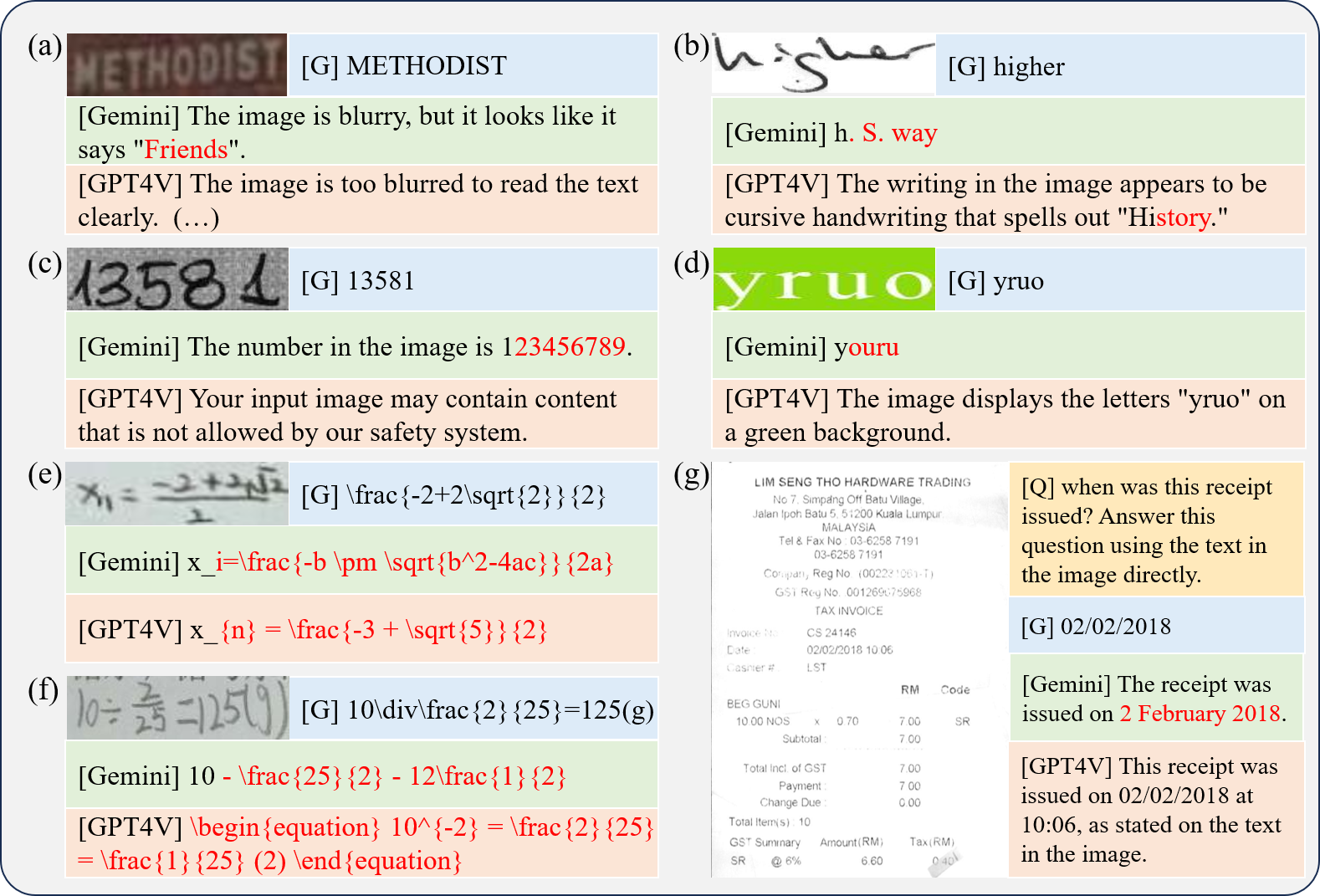
- 在文本识别方面,LMMs在常规/不规则/遮挡/艺术文本上与有监督模型相比具有竞争力,但在手写文本、中文文本、手写字符串和非语义文本方面显著欠缺。
- 较低的输入分辨率通常在场景文本VQA、文档导向VQA和KIE任务中表现较差,而较高分辨率的模型(如Monkey)可以提升这些任务的性能。
- 在HMER方面,LMMs仍存在显著差距,表明存在非OCR的领域特定挑战。
- OCRBench结果显示Gemini居首,GPT4V次之,Monkey紧随其后,而若干基线在HMER及非语义/手写案例上落后。
- LMMs倾向于依赖语义线索来识别单词,当字符顺序被打乱或缺乏语义时,性能较弱(NST vs ST)。
- 研究指出在细粒度视觉特征提取、多语言训练和领域特定OCR适应方面存在改进机会。
阅读本论文
在 Nubint 阅读器中打开原文,边读边就任意段落提问。
在 Nubint 中阅读本论文本解读由 AI 根据论文原文生成,引用前请核对原文。