
[论文解读] Octo: An Open-Source Generalist Robot Policy
Octo 是一个基于大型变换器的开源通用机器人策略,基于80万次示范进行预训练,能够高效地对新机器人、观测和动作空间进行微调,并支持语言或目标图像条件。
Large policies pretrained on diverse robot datasets have the potential to transform robotic learning: instead of training new policies from scratch, such generalist robot policies may be finetuned with only a little in-domain data, yet generalize broadly. However, to be widely applicable across a range of robotic learning scenarios, environments, and tasks, such policies need to handle diverse sensors and action spaces, accommodate a variety of commonly used robotic platforms, and finetune readily and efficiently to new domains. In this work, we aim to lay the groundwork for developing open-source, widely applicable, generalist policies for robotic manipulation. As a first step, we introduce Octo, a large transformer-based policy trained on 800k trajectories from the Open X-Embodiment dataset, the largest robot manipulation dataset to date. It can be instructed via language commands or goal images and can be effectively finetuned to robot setups with new sensory inputs and action spaces within a few hours on standard consumer GPUs. In experiments across 9 robotic platforms, we demonstrate that Octo serves as a versatile policy initialization that can be effectively finetuned to new observation and action spaces. We also perform detailed ablations of design decisions for the Octo model, from architecture to training data, to guide future research on building generalist robot models.
研究动机与目标
- 推动需要能够在不同体现形式和任务中泛化的通用机器人策略的发展。
- 开发一个开源、基于变换器的策略,能够对新的传感器、执行器和领域进行微调。
- 展示在多种机器人和语言/目标条件任务上的零-shot控制。
- 展示从一个大规模、多样化数据集中对新机器人设置进行数据高效微调。
- 提供关于通用机器人策略设计决策的指南(架构、数据、目标、规模)。
提出的方法
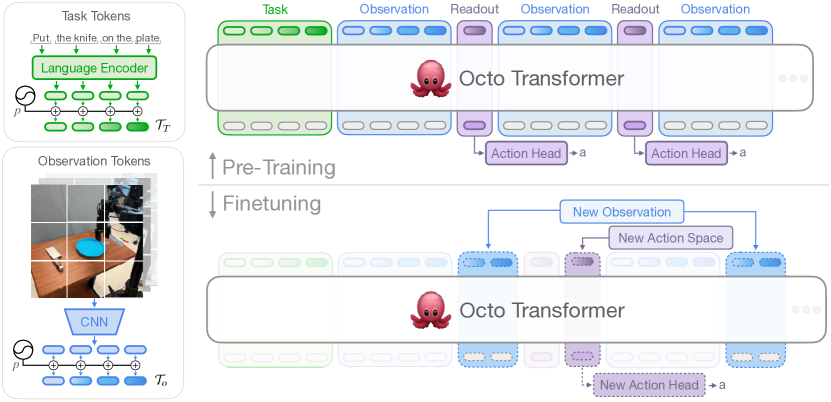
- 基于变换器的策略,将语言目标和观测转化为一个通用序列的标记。
- 输入分词器:语言使用 t5-base,图像使用轻量级 CNN 补丁,并带位置信息嵌入。
- 分块式掩蔽变换器主干,带有读出标记,便于在微调期间灵活添加/移除输入。
- 基于扩散的动作解码头,通过 DDPM 目标预测一段连续的多步动作。
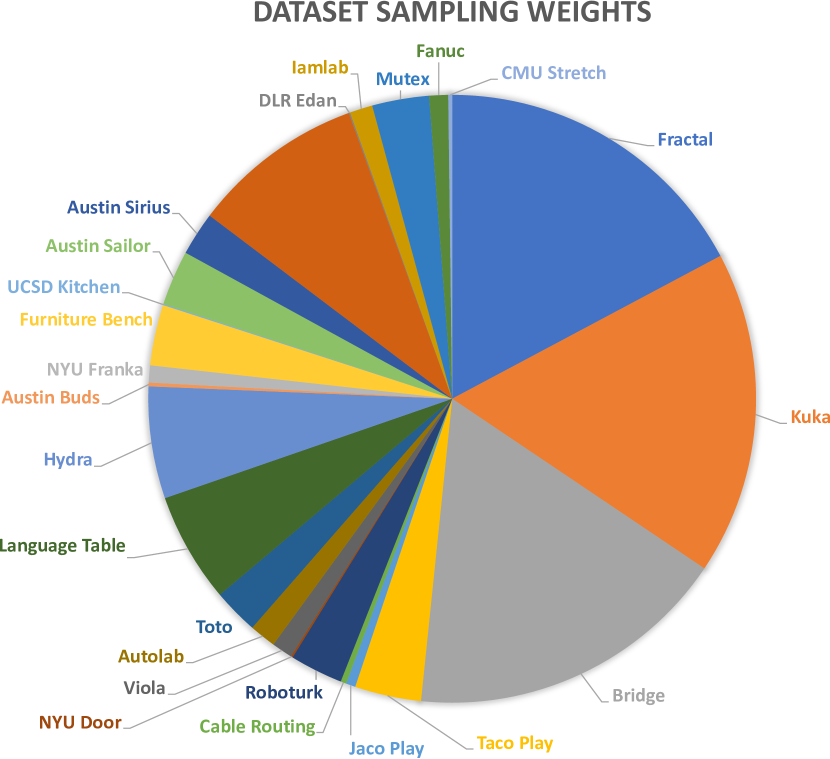
- 在多样化的 Open X-Embodiment 数据混合(25 个数据集,约 800k 示范) 上训练,对缺失模态使用零填充。
- 微调:相同的扩散目标,每个目标域约 100 条轨迹,约 50k 步在普通消费级 GPU 上;为新输入/输出添加适配器,而不重新初始化预训练权重。
实验结果
研究问题
- RQ1Octo 是否可以开箱即用地控制多种机器人(零-shot),并带有语言和目标图像条件?
- RQ2Octo 是否是对未见机器人、观测和动作空间进行数据高效微调的良好初始化?
- RQ3哪些设计选择(架构、数据混合、目标)对通用机器人策略的性能影响最大?
- RQ4Octo 在模型规模和数据多样性方面如何扩展,以提升零-shot 与微调性能?
主要发现
- Octo 能实现跨 9 个机器人和 4 所机构的零-shot 控制,在语言条件任务上超过先前公开可用的通用策略。
- 对每个领域约 100 次示范的微调,显著优于从头训练或使用预训练 VC-1 视觉模型。
- 基于扩散的连续动作头,结合广泛数据混合和以变换器为先的架构,表现优异;较大模型在零-shot鲁棒性方面更好。
- 以变换器优先的设计、扩散动作头和广泛数据混合的架构,在消融实验中表现最佳。
- 模型扩展显示 Octo-Base(93M 参数)通常提升零-shot性能和鲁棒性,相比较小的变体。
阅读本论文
在 Nubint 阅读器中打开原文,边读边就任意段落提问。
在 Nubint 中阅读本论文本解读由 AI 根据论文原文生成,引用前请核对原文。