
[论文解读] On Catastrophic Inheritance of Large Foundation Models
本文提出了“灾难性继承”(Catastrophic Inheritance)的概念——即大规模预训练数据中的偏见、噪声和污染被传播至大基础模型(LFMs)中,导致下游应用中出现有害行为。作者提出UIM框架,用于理解、解释和缓解此类继承性缺陷,旨在提升AI应用中模型的安全性、公平性和泛化能力。
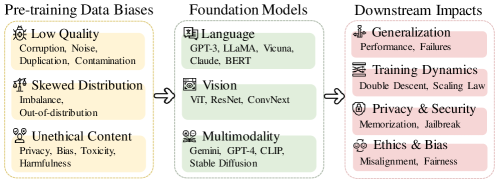
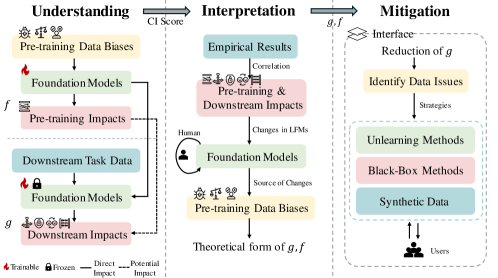
Large foundation models (LFMs) are claiming incredible performances. Yet great concerns have been raised about their mythic and uninterpreted potentials not only in machine learning, but also in various other disciplines. In this position paper, we propose to identify a neglected issue deeply rooted in LFMs: Catastrophic Inheritance, describing the weaknesses and limitations inherited from biased large-scale pre-training data to behaviors of LFMs on the downstream tasks, including samples that are corrupted, long-tailed, noisy, out-of-distributed, to name a few. Such inheritance can potentially cause catastrophes to downstream applications, such as bias, lack of generalization, deteriorated performance, security vulnerability, privacy leakage, and value misalignment. We discuss the challenges behind this issue and propose UIM, a framework to Understand the catastrophic inheritance of LFMs from both pre-training and downstream adaptation, Interpret the implications of catastrophic inheritance on downstream tasks, and how to Mitigate it. UIM aims to unite both the machine learning and social sciences communities for more responsible and promising AI development and deployment.
研究动机与目标
- 解决大基础模型(LFMs)从大规模、未经筛选的预训练数据集中继承有害偏见、噪声和污染的日益增长的担忧。
- 强调此类继承性缺陷可能导致下游应用中出现灾难性失败,包括偏见、安全漏洞和隐私泄露。
- 揭示在微调后偏见可能仍无法被检测到,从而在实际部署中隐藏风险。
- 提出一个统一的研究框架,以分析和解决大基础模型中此类继承性局限的根本原因。
- 弥合机器学习与社会科学之间的鸿沟,以实现更负责任、更稳健的AI开发与部署。
提出的方法
- 引入“灾难性继承”概念,描述预训练数据中的偏见如何导致大基础模型在下游任务中产生严重后果。
- 提出UIM——一个三阶段框架:理解来自预训练数据的继承、解释其对下游任务的影响、缓解其影响。
- 通过实证分析追踪数据级问题(如损坏、噪声、分布外样本)如何在大基础模型的训练和微调过程中传播。
- 利用现有基准和案例研究(如包含CSAM的LAION-5B)展示有害内容在现实世界中的继承现象。
- 整合机器学习与社会科学的洞见,评估继承性数据偏见在伦理、安全和泛化方面的影响。
- 倡导跨学科合作,以检测、解释并降低大基础模型部署中灾难性继承的风险。
实验结果
研究问题
- RQ1大规模预训练数据中的偏见在多大程度上导致了大基础模型下游应用中的灾难性失败?
- RQ2预训练数据中损坏、噪声或分布外的样本在多大程度上影响了大基础模型的泛化能力和行为?
- RQ3为何预训练数据中的偏见在微调后往往仍无法被检测到,从而在实际部署中构成隐藏风险?
- RQ4哪些机制能够有效检测和解释大基础模型中数据级缺陷的继承?
- RQ5像UIM这样的统一框架如何在多样化的人工智能应用和领域中缓解灾难性继承?
主要发现
- 大基础模型会从预训练数据中继承有害偏见、噪声和污染,导致下游失败,例如扩散模型生成儿童性虐待材料(CSAM)。
- 像LAION-5B这样的数据集中的偏见会被Stable Diffusion等模型直接继承,导致在无明确指令的情况下生成有害内容。
- 即使经过微调,偏见仍可能持续存在且未被察觉,从而在部署系统中造成隐藏的安全与伦理风险。
- 由于预训练数据规模巨大且为黑箱,手动清理或全面审计不可行,加剧了灾难性继承的风险。
- UIM提供了一套结构化方法,用于追踪、解释和缓解继承性缺陷,为更安全、更负责任的大基础模型部署提供了路径。
- 本研究强调了机器学习与社会科学之间迫切需要跨学科合作,以应对基础模型中的系统性风险。
阅读本论文
在 Nubint 阅读器中打开原文,边读边就任意段落提问。
在 Nubint 中阅读本论文本解读由 AI 根据论文原文生成,引用前请核对原文。