
[论文解读] On Efficient Training of Large-Scale Deep Learning Models: A Literature Review
一个任务自由、模型无关的综述,按数据、模型、优化、预算和系统视角对加速大规模深度学习模型训练的一般技术进行分类。
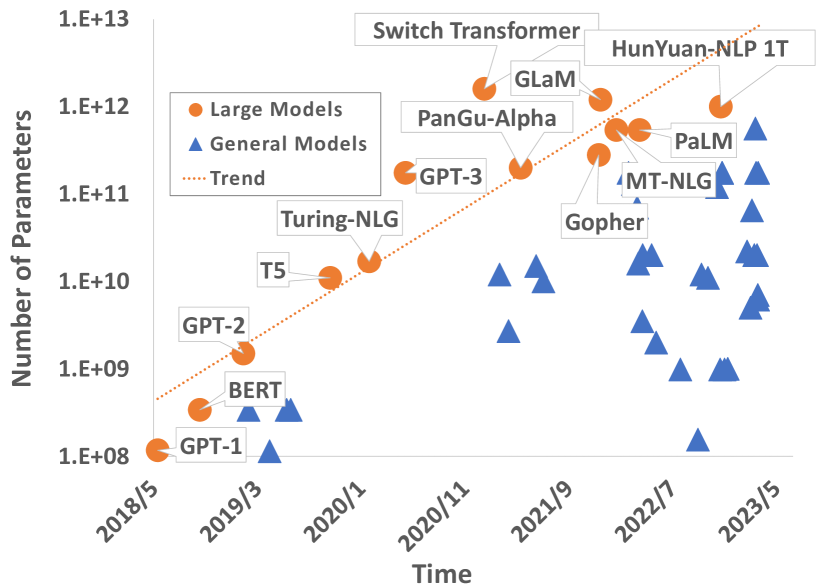
The field of deep learning has witnessed significant progress, particularly in computer vision (CV), natural language processing (NLP), and speech. The use of large-scale models trained on vast amounts of data holds immense promise for practical applications, enhancing industrial productivity and facilitating social development. With the increasing demands on computational capacity, though numerous studies have explored the efficient training, a comprehensive summarization on acceleration techniques of training deep learning models is still much anticipated. In this survey, we present a detailed review for training acceleration. We consider the fundamental update formulation and split its basic components into five main perspectives: (1) data-centric: including dataset regularization, data sampling, and data-centric curriculum learning techniques, which can significantly reduce the computational complexity of the data samples; (2) model-centric, including acceleration of basic modules, compression training, model initialization and model-centric curriculum learning techniques, which focus on accelerating the training via reducing the calculations on parameters; (3) optimization-centric, including the selection of learning rate, the employment of large batchsize, the designs of efficient objectives, and model average techniques, which pay attention to the training policy and improving the generality for the large-scale models; (4) budgeted training, including some distinctive acceleration methods on source-constrained situations; (5) system-centric, including some efficient open-source distributed libraries/systems which provide adequate hardware support for the implementation of acceleration algorithms. By presenting this comprehensive taxonomy, our survey presents a comprehensive review to understand the general mechanisms within each component and their joint interaction.
研究动机与目标
- 总结独立于任务或架构的、大规模模型训练的通用加速技术。
- 提供一个分类法,将训练过程分解为数据导向、模型导向、优化导向、预算化和系统导向五个组成部分。
- 分析组件之间的相互作用并讨论高效训练范式的未来方向。
提出的方法
- 将通用基于梯度的更新公式分解为五个组成部分(数据、模型、优化、预算、系统)。
- 提出一种五向分类法,将现有的加速技术在数据导向、模型导向、优化导向、预算化训练和系统导向视角下进行分类。
- 回顾并综合诸如数据正则化、数据采样、课程学习、结构压缩、初始化、学习率与小批量策略,以及分布式系统框架等技术。
- 讨论实际考虑、优点、弱点以及组成部分之间的相互作用。
- 概述未来研究方向以及适用于跨架构和领域的一般加速范式的潜力。
实验结果
研究问题
- RQ1存在哪些与架构和任务无关的通用技术可用于加速大规模深度学习模型的训练?
- RQ2如何将训练过程分解为数据导向、模型导向、优化导向、预算导向和系统导向的组成部分,以指导加速策略?
- RQ3在实际环境中这些组成部分之间的权衡和相互作用是什么?
- RQ4随着模型和数据集规模的继续增长,哪些未来方向可以支持高效训练?
主要发现
- 跨五个视角(数据、模型、优化、预算化、系统)对训练加速技术的全面分类。
- 数据导向的方法着重于数据增强、正则化、采样和课程学习,以在保持准确性的同时降低计算量。
- 模型导向的方法针对架构效率、压缩以及更好的初始化以降低训练成本。
- 优化导向的策略强调学习率计划、大规模批量训练以及鲁棒目标以提高效率和泛化。
- 预算化训练着眼于资源受限情景,在限制条件下最大化性能。
- 系统导向的方法讨论分布式框架和对硬件友好的实现,推动可扩展训练。
阅读本论文
在 Nubint 阅读器中打开原文,边读边就任意段落提问。
在 Nubint 中阅读本论文本解读由 AI 根据论文原文生成,引用前请核对原文。