
[论文解读] On Large Visual Language Models for Medical Imaging Analysis: An Empirical Study
本文实证评估了零-shot 和少-shot 的视觉语言模型在医学影像分类任务上的表现(脑部 MRI、ALL-IDB2 微观图像、胸部 X 光 COVID),并与 CNN 基线进行比较,突出显示零-shot/少-shot 能力与提示策略。
Recently, large language models (LLMs) have taken the spotlight in natural language processing. Further, integrating LLMs with vision enables the users to explore emergent abilities with multimodal data. Visual language models (VLMs), such as LLaVA, Flamingo, or CLIP, have demonstrated impressive performance on various visio-linguistic tasks. Consequently, there are enormous applications of large models that could be potentially used in the biomedical imaging field. Along that direction, there is a lack of related work to show the ability of large models to diagnose the diseases. In this work, we study the zero-shot and few-shot robustness of VLMs on the medical imaging analysis tasks. Our comprehensive experiments demonstrate the effectiveness of VLMs in analyzing biomedical images such as brain MRIs, microscopic images of blood cells, and chest X-rays.
研究动机与目标
- 评估大型视觉语言模型(VLM)在医学影像分类任务上的零-shot 与少-shot 鲁棒性。
- 在三个数据集(BTD、ALL-IDB2、CX-Ray)中将 VLM 与 CNN 基线进行对比。
- 分析提示策略及其对生物医学影像中 VLM 性能的影响。
提出的方法
- 在不进行微调的情况下评估五种 VLM(BiomedCLIP、OpenCLIP、OpenFlamingo、LLaVA、ChatGPT-4)以及两种 CNN 基线(CNN、ResNet-18)。
- 对大多数 VLM 采用零-shot 提示,对 OpenFlamingo 使用少-shot 提示并附带演示图像。
- 报告每个数据集的测试准确率并计算跨数据集的平均值。
- 描述特定数据集的提示以改善基于 CLIP 的模型(如为每个数据集设计丰富的描述性提示)。
- 讨论提示策略(单步 vs 多步、演示选择)及其对性能的影响。
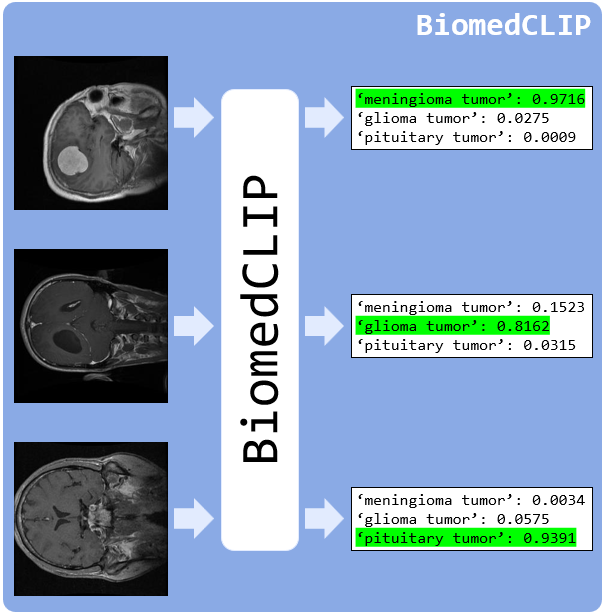
实验结果
研究问题
- RQ1零-shot 视觉语言模型在不进行任务特定微调的情况下在医学影像分类任务中的表现如何?
- RQ2少-shot 提示是否在医学影像上的 VLM 分类准确率上有提升,在哪些条件下有效?
- RQ3VLM 与基于 CNN 的模型在脑部 MRI、ALL-IDB2、CX-Ray 数据集上的比较如何?
- RQ4哪些提示策略能为此领域的基于 CLIP 的模型带来最佳准确率?
- RQ5在将 VLM 应用于医学影像时有哪些局限性和安全性考量?
主要发现
- 基于 CNN 的模型在所有数据集上仍达到最佳性能,反映出受监督训练的益处。
- BiomedCLIP 在三个数据集(BTD、ALL-IDB2、CX-Ray)上通常提供最强的平均性能。
- OpenFlamingo、LLaVA 与 ChatGPT-4 展现出显著的零-shot 能力,少-shot 提示在某些数据集上带来增益。
- 零-shot 的 CLIP 基模型(BiomedCLIP、OpenCLIP)在不同数据集上的表现差异较大,凸显数据集特异的提示设计重要性。
- 提示工程与演示选择(少-shot 提示)可以提升 VLM 在医学影像任务中的准确性。
- 总体而言,VLM 作为预训练且未微调的工具以及作为诊断前预判的对话助手,具有一定价值,但在基准任务上尚未超越专门的 CNN 模型。

阅读本论文
在 Nubint 阅读器中打开原文,边读边就任意段落提问。
在 Nubint 中阅读本论文本解读由 AI 根据论文原文生成,引用前请核对原文。