
[论文解读] On the fractional instanton liquid picture of the Yang-Mills vacuum and Confinement
本文提出了分数瞬子液态模型(FILM),作为4D SU(N)杨-米尔斯理论在零温下的 confinement 微观机制。该模型将真空描述为具有 $1/N$ 外尔特征的自对偶分数瞬子的液态,这些瞬子携带 $\mathbb{Z}_N$ 通量并具有有限自由能,通过通量诱导的弦形成实现 confinement,同时与大-$N$ 极限及诸如拓扑敏感度等非微扰性质保持一致。
I review the main features of our model of the 4-dimensional Yang-Mills theory vacuum as a liquid of fractional instantons. The model provides a possible microscopic mechanism for Confinement in four dimensional Yang-Mills theory at $T=0$. It also connects this property to other non-perturbative properties of the theory which can be explained by the same model. This paper is a, somewhat enlarged, written up version of my recent talks on the subject given at ICTS-Bangalore, KITP-Santa Barbara and IMSC-Chennai.
研究动机与目标
- 为4D杨-米尔斯理论在零温下的 confinement 提供统一的、微观的解释。
- 将 confinement 与其它非微扰特征(如有限拓扑敏感度和 theta 依赖性)联系起来。
- 证明分数瞬子——具有 $1/N$ 拓扑特征的光滑自对偶构型——可形成稳定的液态真空结构。
- 表明该模型在大-$N$ 极限下依然有效,保持 confinement 和非微扰动力学。
- 通过量子涨落和通量线,建立半经典构型与长距离 confinement 之间的联系。
提出的方法
- 在四维环面上利用扭曲边界条件构造分数瞬子的周期性阵列,以实现具有 $\mathbb{Z}_N$ 通量的自对称构型。
- 利用指标定理论证:分数瞬子的晶格结构可无能量代价连续地形变为液相。
- 将真空建模为分数瞬子与反瞬子的液态,其尺寸与间距由量子涨落和反 $\Lambda$ 参数决定。
- 通过忽略短距离量子涨落,分析长距离性质(如 confinement),关注分数瞬子的通量与自由能。
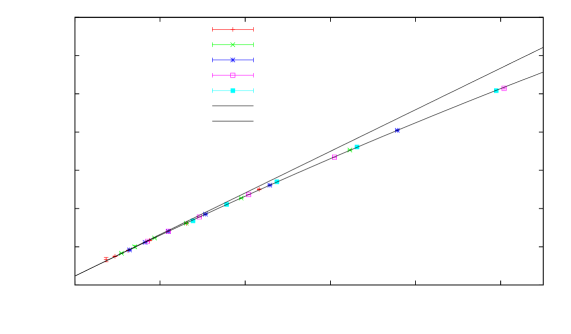
- 利用 SU(2) 杨-米尔斯理论中的有限体积格点模拟,探测从半经典到非微扰区域的演化。
- 通过证明单位分数瞬子(电荷为 $1/N$)在大-$N$ 极限下具有有限作用量,将模型与大-$N$ 行为联系起来。
实验结果
研究问题
- RQ1如何通过涉及拓扑缺陷的微观非微扰机制,解释4D杨-米尔斯理论中的 confinement?
- RQ2为何具有 $1/N$ 拓扑特征的分数瞬子在大-$N$ 极限下保持稳定且相关,而全瞬子则不然?
- RQ3$\mathbb{Z}_N$ 通量与有限自由能在通过弦状通量管生成 confinement 中起什么作用?
- RQ4分数瞬子的液态排列如何从拓扑、量子涨落与规范动力学的相互作用中涌现?
- RQ5分数瞬子液态模型能否在统一框架下一致地解释 confinement 与拓扑敏感度?
主要发现
- 分数瞬子液态模型为4D杨-米尔斯理论在 $T=0$ 下的 confinement、拓扑敏感度与 theta 依赖性提供了统一解释。
- 具有 $1/N$ 拓扑特征的分数瞬子是稳定的、自对偶的,并携带 $\mathbb{Z}_N$ 通量,可通过通量线形成实现 confinement。
- 在 SU(2) 理论中,分数瞬子的典型尺寸与间距估计为 0.7 飞米,由量子涨落和反 $\Lambda$ 参数决定。
- 该模型在大-$N$ 极限下保持一致,因为单位分数瞬子具有有限作用量,从而保留了 confinement 等非微扰特征。
- 来自 SU(2) 格点模拟的数值证据支持分数瞬子类构型的存在及其在真空结构中的作用。
- 该模型表明,真空并非瞬子的气体,而是一种分数瞬子的液态,其位置与通量决定了如 confinement 等长距离物理行为。
阅读本论文
在 Nubint 阅读器中打开原文,边读边就任意段落提问。
在 Nubint 中阅读本论文本解读由 AI 根据论文原文生成,引用前请核对原文。