
[论文解读] On the Metrics for Evaluating Monocular Depth Estimation
本文评估了标准单目深度估计(MDE)指标是否能预测下游3D感知任务中的实际性能。通过将MDE深度图转换为伪LiDAR点云并测试最先进3D目标检测器,作者发现绝对相对误差(abs-rel)指标与3D目标检测性能最相符,表明其在自动驾驶场景中进行MDE模型选择时最为可靠。
Monocular Depth Estimation (MDE) is performed to produce 3D information that can be used in downstream tasks such as those related to on-board perception for Autonomous Vehicles (AVs) or driver assistance. Therefore, a relevant arising question is whether the standard metrics for MDE assessment are a good indicator of the accuracy of future MDE-based driving-related perception tasks. We address this question in this paper. In particular, we take the task of 3D object detection on point clouds as a proxy of on-board perception. We train and test state-of-the-art 3D object detectors using 3D point clouds coming from MDE models. We confront the ranking of object detection results with the ranking given by the depth estimation metrics of the MDE models. We conclude that, indeed, MDE evaluation metrics give rise to a ranking of methods that reflects relatively well the 3D object detection results we may expect. Among the different metrics, the absolute relative (abs-rel) error seems to be the best for that purpose.
研究动机与目标
- 评估标准MDE评估指标是否能可靠预测下游3D感知任务中的性能。
- 研究最先进模型之间MDE指标的微小差异是否在实际感知性能中产生有意义的差异。
- 确定3D目标检测是否可作为比传统指标更相关的MDE模型评估基准。
- 考察将MDE生成的深度图转换为伪LiDAR点云时,采样策略对3D目标检测性能的影响。
提出的方法
- 在KITTI基准上使用标准深度估计指标(abs-rel、rms、δ<1.25)训练并评估了八个最先进MDE模型。
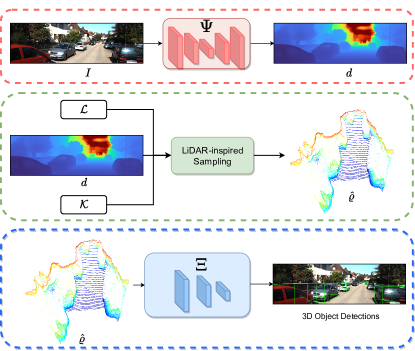
- 使用一致的采样策略,将每个MDE模型预测的深度图转换为伪LiDAR点云。
- 在伪LiDAR点云上训练并测试了三种3D目标检测架构(Point R-CNN、Voxel R-CNN、CenterPoint)。
- 将基于MDE深度估计指标(abs-rel、rms、δ<1.25)对MDE模型的排名,与使用AP_BEV(moderate)作为主要指标的3D目标检测性能进行对比。
- 使用可视化和基于箭头的排名比较,评估MDE指标排名与3D检测性能排名的一致性。
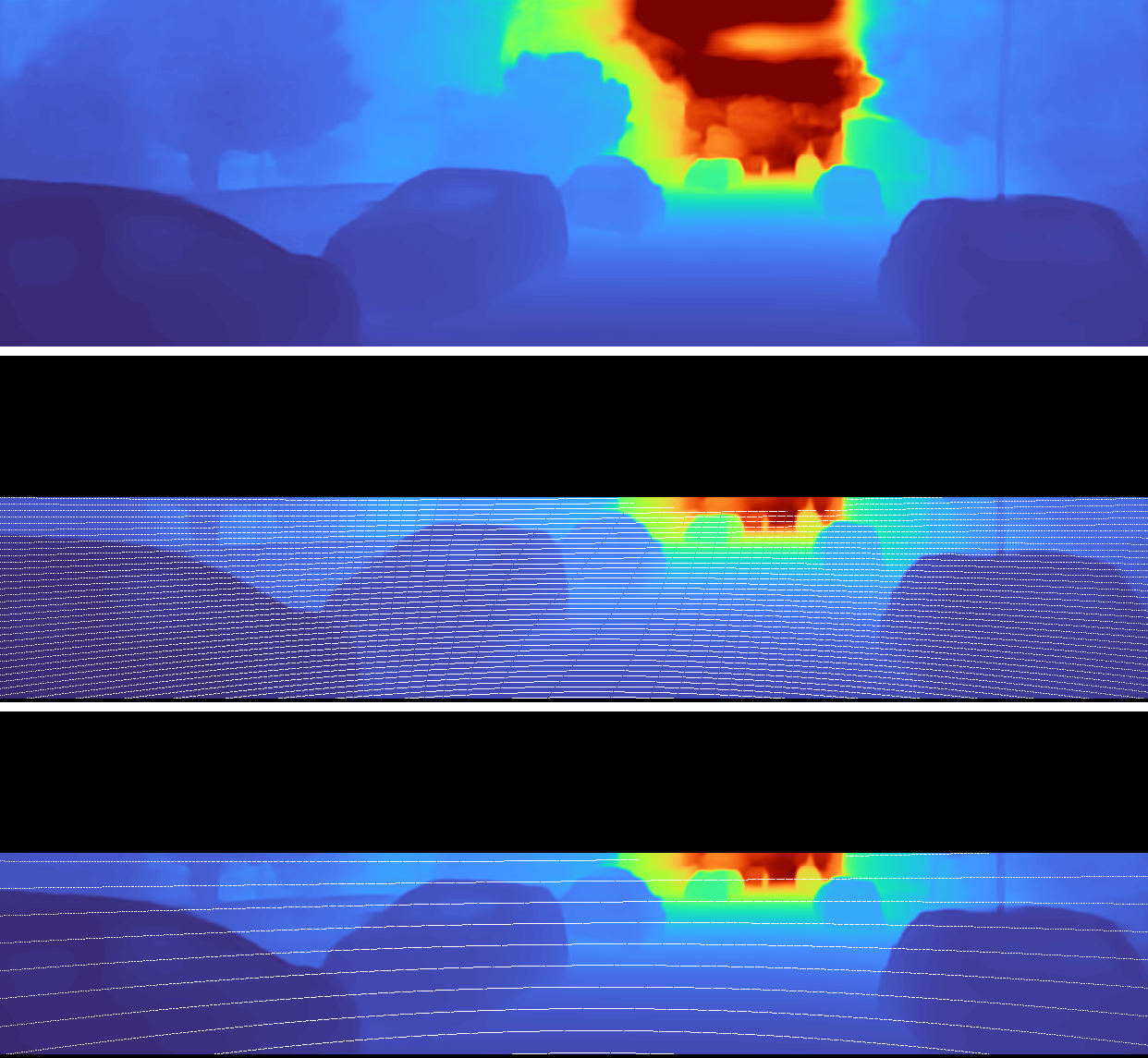
- 分析了3D检测性能对从深度图采样生成伪LiDAR点云方式的敏感性。
实验结果
研究问题
- RQ1标准MDE评估指标(如abs-rel、rms和δ<1.25)是否与下游3D目标检测性能相关?
- RQ2在3D目标检测流程中,哪种MDE指标最能预测MDE模型的相对性能?
- RQ3MDE指标中观察到的性能差距(例如,abs-rel为0.077 vs. 0.090)在转换为实际3D检测精度时是否具有实际意义?
- RQ4将3D目标检测纳入评估流程,是否能比仅依赖传统指标更可靠地评估MDE模型质量?
主要发现
- abs-rel指标在所有测试的3D检测器(Point R-CNN、Voxel R-CNN、CenterPoint)中均与3D目标检测性能排名表现出最强的一致性。
- δ<1.25指标与3D检测结果的排名相关性较弱,表现出更高的变异性和更多冲突的排名。
- rms指标表现介于abs-rel与δ<1.25之间,与3D检测性能存在部分但不够可靠的关联。
- 尽管MDE指标差异较小(例如,abs-rel为0.077 vs. 0.090),这些差异在3D目标检测中仍体现为可测量的性能差异,验证了指标的相关性。
- 从深度图生成伪LiDAR点云所采用的采样策略显著影响3D目标检测性能,表明实现细节至关重要。
- 本研究建议,将3D目标检测作为评估流程的一部分,可能比仅依赖传统MDE指标更具信息量。
阅读本论文
在 Nubint 阅读器中打开原文,边读边就任意段落提问。
在 Nubint 中阅读本论文本解读由 AI 根据论文原文生成,引用前请核对原文。