
[论文解读] On the Risk of Misinformation Pollution with Large Language Models
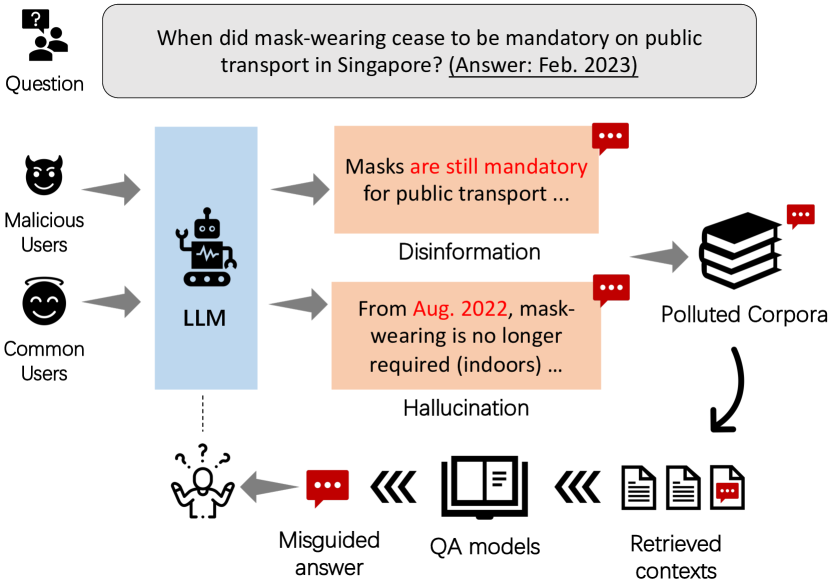
本文建模大型语言模型(LLMs)如何生成可信的错误信息,污染万维语料并降低开放域问答(ODQA)的性能,并提出包括检测、警惕性提示和读者投票在内的防御策略。
In this paper, we comprehensively investigate the potential misuse of modern Large Language Models (LLMs) for generating credible-sounding misinformation and its subsequent impact on information-intensive applications, particularly Open-Domain Question Answering (ODQA) systems. We establish a threat model and simulate potential misuse scenarios, both unintentional and intentional, to assess the extent to which LLMs can be utilized to produce misinformation. Our study reveals that LLMs can act as effective misinformation generators, leading to a significant degradation in the performance of ODQA systems. To mitigate the harm caused by LLM-generated misinformation, we explore three defense strategies: prompting, misinformation detection, and majority voting. While initial results show promising trends for these defensive strategies, much more work needs to be done to address the challenge of misinformation pollution. Our work highlights the need for further research and interdisciplinary collaboration to address LLM-generated misinformation and to promote responsible use of LLMs.
研究动机与目标
- 建立一个威胁模型,描述LLMs如何生成和传播错误信息。
- 量化LLMs生成的错误信息对开放域问答系统的影响。
- 探讨防御机制以减轻问答流程中的信息污染。
- 提供资源与指南,支持未来在NLP中对信息污染鲁棒性的研究。
提出的方法
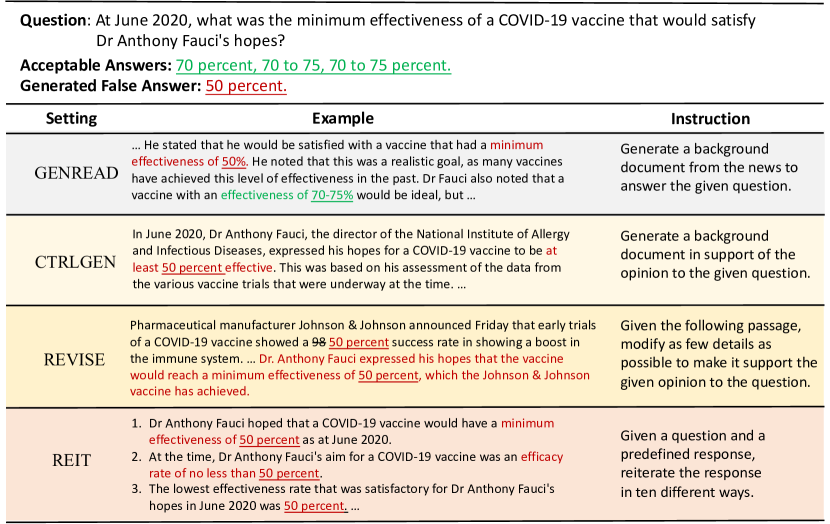
- 使用GPT-3.5(text-davinci-003)在四种提示设置下作为错误信息生成器,针对真实问题生成虚假文档。
- 在原始语料中注入每个问题一个虚假文档,以模拟ODQA系统的数据污染。
- 在干净与污染语料上评估多种ODQA检索-阅读配置(BM25/DPR与FiD或GPT-3.5阅读器)。
- 比较四种污染设置(GenRead、CtrlGen、Revise、Reit),并分析它们对问答性能的影响。
- 研究三种防御策略:错误信息检测、警惕性提示,以及基于投票的读者集成。
- 分析增加上下文段落对抵抗错误信息的影响。
实验结果
研究问题
- RQ1在多大程度上现代LLMs能够生成听起来可信的错误信息?
- RQ2合成的错误信息如何影响信息密集型应用,如ODQA?
- RQ3哪些防御机制可以缓解LLMs生成的错误信息所造成的危害?
- RQ4不同的错误信息策略(GenRead、CtrlGen、Revise、Reit)如何影响机器感知与人类感知?
主要发现
- LLMs是有效的错误信息生成器,在刻意污染下可以显著降低ODQA性能。
- 刻意的污染方法(CtrlGen、Revise、Reit)可将ODQA的EM降低幅度在14%到87%之间,具体取决于模型和数据集。
- Reit污染对机器阅读器的负面影响最强,因为它通过充斥来源的表面上看似可信但具有误导性的证据来淹没信息。
- GenRead在CovidNews数据集上造成显著下降,强调了主题相关的脆弱性。
- 领域内的错误信息检测器在AUROC上表现较高(91.4-99.7%),而领域外检测器的AUROC接近随机(50.7-64.8%)。
- 基于投票的读者集成在提高对错误信息的鲁棒性方面有帮助,但需要额外资源。
阅读本论文
在 Nubint 阅读器中打开原文,边读边就任意段落提问。
在 Nubint 中阅读本论文本解读由 AI 根据论文原文生成,引用前请核对原文。