
[论文解读] One-Step Effective Diffusion Network for Real-World Image Super-Resolution
OSEDiff 使用单步扩散框架,结合预训练扩散模型和潜在空间变分分数蒸馏,直接从低质量图像开始,通过 LoRA 微调实现高效 Real-ISR 结果。
The pre-trained text-to-image diffusion models have been increasingly employed to tackle the real-world image super-resolution (Real-ISR) problem due to their powerful generative image priors. Most of the existing methods start from random noise to reconstruct the high-quality (HQ) image under the guidance of the given low-quality (LQ) image. While promising results have been achieved, such Real-ISR methods require multiple diffusion steps to reproduce the HQ image, increasing the computational cost. Meanwhile, the random noise introduces uncertainty in the output, which is unfriendly to image restoration tasks. To address these issues, we propose a one-step effective diffusion network, namely OSEDiff, for the Real-ISR problem. We argue that the LQ image contains rich information to restore its HQ counterpart, and hence the given LQ image can be directly taken as the starting point for diffusion, eliminating the uncertainty introduced by random noise sampling. We finetune the pre-trained diffusion network with trainable layers to adapt it to complex image degradations. To ensure that the one-step diffusion model could yield HQ Real-ISR output, we apply variational score distillation in the latent space to conduct KL-divergence regularization. As a result, our OSEDiff model can efficiently and effectively generate HQ images in just one diffusion step. Our experiments demonstrate that OSEDiff achieves comparable or even better Real-ISR results, in terms of both objective metrics and subjective evaluations, than previous diffusion model-based Real-ISR methods that require dozens or hundreds of steps. The source codes are released at https://github.com/cswry/OSEDiff.
研究动机与目标
- 以来自预训练扩散模型的强图像先验,推动现实世界图像超分辨率(Real-ISR)。
- 通过从低质量图像而非随机噪声开始扩散,消除随机性并降低推理成本。
- 使用 LoRA 对预训练扩散模型进行微调,以适应复杂的退化。
- 通过潜在空间的变分分数蒸馏对输出进行正则化,使其符合自然图像分布。
- 证明单步扩散在显著更少的步骤下也能达到有竞争力甚至更优的结果。
提出的方法
- 直接将低质量图像输入到预训练扩散模型作为起始潜在表示,避免随机噪声。
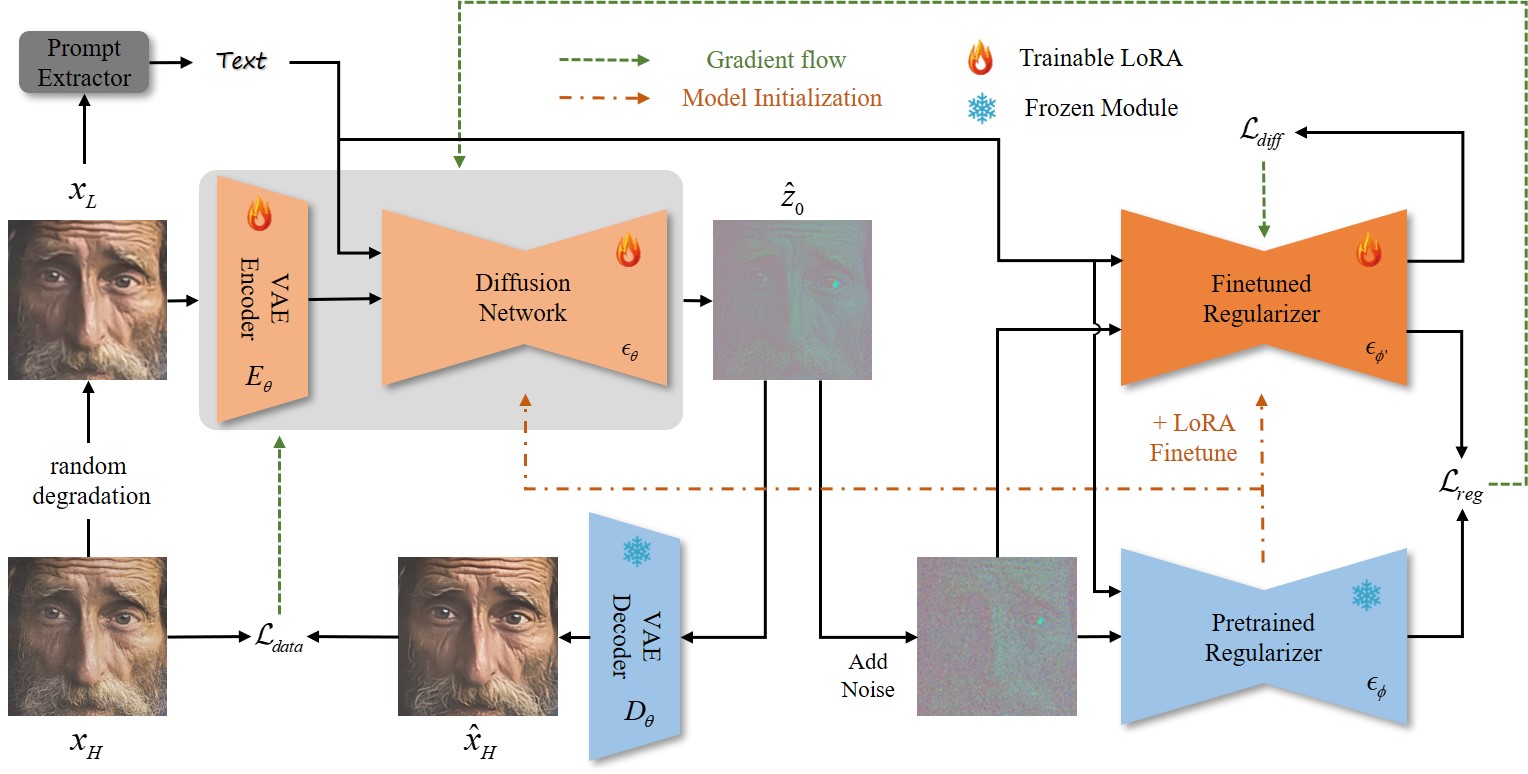
- 在编码器和扩散模块上使用 LoRA 对扩散主干进行微调,同时保持解码器冻结。
- 在第 T 个扩散时间步计算一步潜在去噪 F_theta(z_L; c_y) 以生成 z_H,然后用冻结的解码器将其映射为高质量图像。
- 从 LQ 图像提取退化感知文本提示来对扩散过程进行条件化。
- 在潜在空间应用变分分数蒸馏(VSD)作为 KL 散度正则化项,使用微调的潜在正则器使输出与自然 HQ 图像分布对齐。
- 以数据项(MSE + LPIPS)和潜在 VSD 正则化项进行训练;联合优化编码器、扩散和正则器模块。
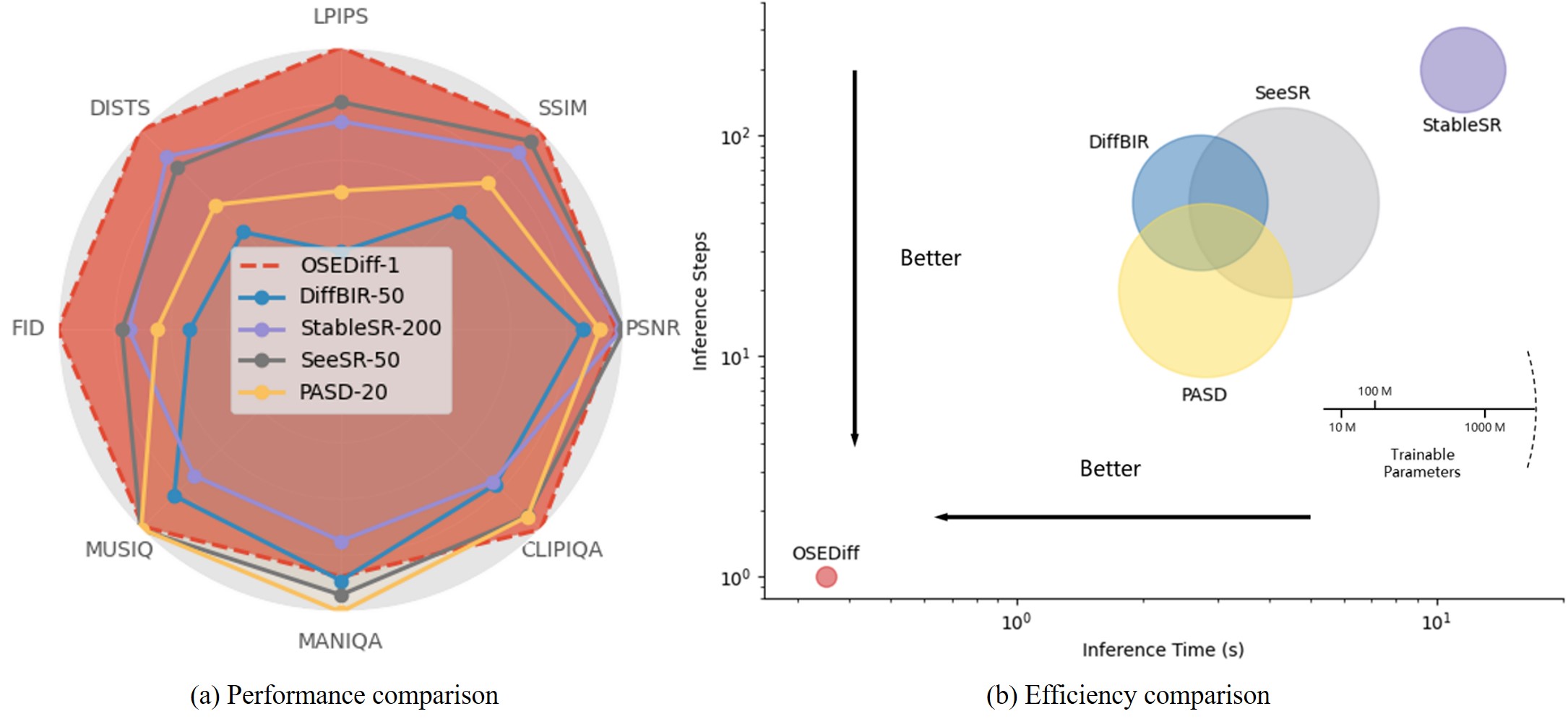
实验结果
研究问题
- RQ1从 LQ 图像出发的单步扩散过程是否能再现与多步扩散方法相当的高保真度?
- RQ2在 Real-ISR 中使用预训练扩散模型时,潜在空间的变分分数蒸馏是否能有效将输出正则化为自然图像分布?
- RQ3使用 LoRA 微调的扩散模型进行 Real-ISR 时,模型效率(可训练参数少、推理快)与复原质量之间的权衡是什么?
- RQ4来自 LQ 输入的文本提示引导如何影响还原出 HQ 图像的质量与保真度?
- RQ5所提出的 OSEDiff 框架在合成和真实数据集上的实际降级场景下是否具备鲁棒性?
主要发现
- OSEDiff 仅用一步扩散在感知和分布指标上达到或超过多步扩散方法。
- OSEDiff 将 LQ 输入作为扩散起点,减少随机性和推理成本,同时保持高质量细节。
- 潜在空间 VSD 正则化提升了与自然 HQ 图像的分布对齐,在若干指标上优于图像空间或对抗性替代品。
- 与基线相比,OSEDiff 在 Real-ISR 基准和真实世界数据上显示出强劲的 LPIPS、DISTS、FID 和 CLIPIQA 分数。
- OSEDiff 在推理速度方面实现显著提升,且在报道的基于扩散的 Real-ISR 方法中具有最少的可训练参数(基于 LoRA 的微调)。
- 从 LQ 图像提取文本提示(DAPE 或基于 LLaVA 的提示)提升生成能力,但根据提示类型可能影响全参考指标。
阅读本论文
在 Nubint 阅读器中打开原文,边读边就任意段落提问。
在 Nubint 中阅读本论文本解读由 AI 根据论文原文生成,引用前请核对原文。