
[论文解读] One-Step Image Translation with Text-to-Image Models
本文提出 CycleGAN-Turbo 和 pix2pix-Turbo,一种一步图像到图像转换框架,通过对抗学习将预训练的文本到图像扩散模型适应到新任务和新领域,在未配对和配对设置下均实现快速推理并强力保持结构。
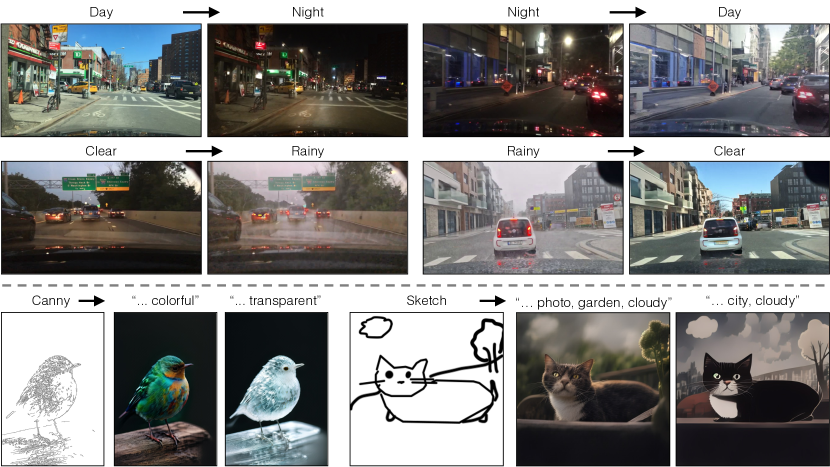
In this work, we address two limitations of existing conditional diffusion models: their slow inference speed due to the iterative denoising process and their reliance on paired data for model fine-tuning. To tackle these issues, we introduce a general method for adapting a single-step diffusion model to new tasks and domains through adversarial learning objectives. Specifically, we consolidate various modules of the vanilla latent diffusion model into a single end-to-end generator network with small trainable weights, enhancing its ability to preserve the input image structure while reducing overfitting. We demonstrate that, for unpaired settings, our model CycleGAN-Turbo outperforms existing GAN-based and diffusion-based methods for various scene translation tasks, such as day-to-night conversion and adding/removing weather effects like fog, snow, and rain. We extend our method to paired settings, where our model pix2pix-Turbo is on par with recent works like Control-Net for Sketch2Photo and Edge2Image, but with a single-step inference. This work suggests that single-step diffusion models can serve as strong backbones for a range of GAN learning objectives. Our code and models are available at https://github.com/GaParmar/img2img-turbo.
研究动机与目标
- 推动在条件扩散模型的图像翻译中降低推理时间和数据需求。
- 开发一种一步翻译框架,在适应新领域的同时保持输入结构。
- 使用单一端到端生成器、极少的可训练参数,实现未配对和配对翻译。
- 利用 LoRA 适配器和跳跃连接在翻译过程中防止过拟合并保留细节。
提出的方法
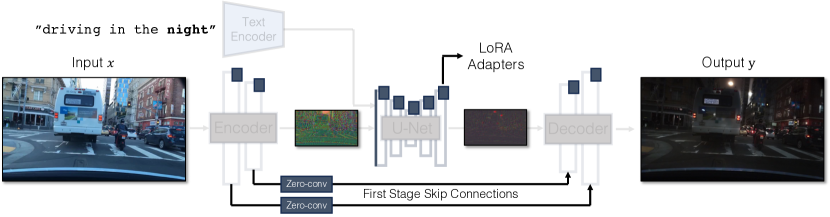
- 通过将编码器、UNet 和解码器整合为单一网络,将预训练的文本到图像扩散模型转化为端到端的一步生成器。
- 将输入条件直接送入噪声编码分支,并使用 LoRA 适配器将主干适配到新的控制和领域。
- 通过零卷积层在编码器和解码器之间引入跳跃连接,以保持输入的高频细节。
- 在未配对设置中(CycleGAN-Turbo)采用对抗损失和循环一致性损失进行训练,在配对设置中(pix2pix-Turbo)采用重建损失和基于 CLIP 的损失进行训练。
- 通过在预训练模型特征与学习的编码器特征之间插值、调整适配器权重和重建损失,结合可调伽马参数,启用随机性与多样化输出。
实验结果
研究问题
- RQ1一个一步扩散模型能否在未配对和配对设置中充当图像到图像翻译任务的强大骨干?
- RQ2如何将条件输入整合进来,避免与潜在噪声冲突并在翻译过程中保持输入结构?
- RQ3具备轻量可训练组件的统一端到端生成器是否在质量和速度方面与传统扩散或基于GAN的方法相竞争?
- RQ4哪些机制(例如跳跃连接、LoRA 适配器)在一步翻译过程中最能保持输入细节(文本、标志、纹理)?
- RQ5在受控的一步推断模式下,框架能否产生多样化的输出?
主要发现
- CycleGAN-Turbo 在分布匹配和输入结构保持方面具有更优表现,同时比基线扩散方法更快。
- Pix2pix-Turbo 在配对翻译的最先进方法中取得具竞争力的结果,同时仅使用单次前向传播和一步推理。
- 直接将输入图像条件送入主干并使用 LoRA 适配器,使得在极少的可训练参数下也能有效地适应新领域。
- 通过零卷积层实现的跳跃连接有助于在翻译过程中保持输入的高频细节。
- 该方法在未配对任务(如日夜转换、天气变化)上表现出色,在配对任务(如 Edge2Image、Sketch2Photo)上也具有竞争力。
- 该框架通过在噪声与编码器特征之间插值并可对文本条件进行插值,支持多样化输出。
阅读本论文
在 Nubint 阅读器中打开原文,边读边就任意段落提问。
在 Nubint 中阅读本论文本解读由 AI 根据论文原文生成,引用前请核对原文。