
[论文解读] Open-World Pose Transfer via Sequential Test-Time Adaption
本文提出SEquential Test-time Adaption(SETA),一种新颖的开放世界姿态迁移框架,可在推理过程中顺序适应分布外(OOD)的外观和骨骼信号。通过使用自监督增强进行外观纹理提取,并利用行人重识别(Re-ID)模型计算非欧几里得姿态相似性,SETA在TikTok和SHHQ等未见数据集上提升了泛化能力,与基线方法相比,LPIPS降低高达76.8%。
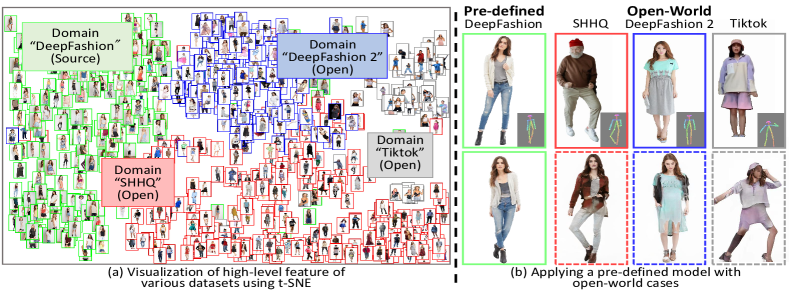
Pose transfer aims to transfer a given person into a specified posture, has recently attracted considerable attention. A typical pose transfer framework usually employs representative datasets to train a discriminative model, which is often violated by out-of-distribution (OOD) instances. Recently, test-time adaption (TTA) offers a feasible solution for OOD data by using a pre-trained model that learns essential features with self-supervision. However, those methods implicitly make an assumption that all test distributions have a unified signal that can be learned directly. In open-world conditions, the pose transfer task raises various independent signals: OOD appearance and skeleton, which need to be extracted and distributed in speciality. To address this point, we develop a SEquential Test-time Adaption (SETA). In the test-time phrase, SETA extracts and distributes external appearance texture by augmenting OOD data for self-supervised training. To make non-Euclidean similarity among different postures explicit, SETA uses the image representations derived from a person re-identification (Re-ID) model for similarity computation. By addressing implicit posture representation in the test-time sequentially, SETA greatly improves the generalization performance of current pose transfer models. In our experiment, we first show that pose transfer can be applied to open-world applications, including Tiktok reenactment and celebrity motion synthesis.
研究动机与目标
- 为解决在测试数据分布与训练数据显著不同的开放世界设置中姿态迁移泛化能力不足的问题。
- 克服现有测试时自适应(TTA)方法的局限性,这些方法假设OOD数据中存在统一信号,但在复杂多信号分布下表现不佳。
- 开发一种顺序自适应策略,分别学习并整合OOD外观与骨骼信号,以提升姿态迁移的鲁棒性与真实感。
- 实现在TikTok重演和名人动作合成等实际应用场景中的姿态迁移部署,这些场景中普遍存在多样且未见的数据。
提出的方法
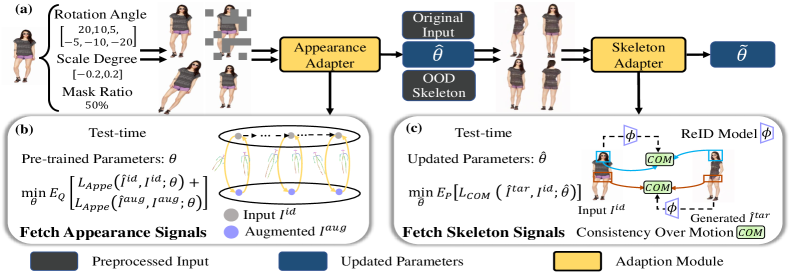
- SETA采用顺序测试时自适应流程,首先利用外部测试数据的自监督数据增强对OOD外观信号进行适应。
- 引入外观适配器,从增强后的OOD样本中提取并分发外部外观纹理,稳定特征扭曲过程。
- 随后应用骨骼适配器,通过预训练行人重识别(Re-ID)模型的图像特征学习隐式姿态表征。
- 利用Re-ID嵌入建模姿态间的非欧几里得相似性,实现在多样化OOD骨骼上的稳定运动表征。
- 框架在外观与骨骼自适应阶段之间交替进行,避免灾难性遗忘,确保特征学习的稳定性。
- 该方法采用固定样本更新次数的迭代测试时训练,平衡性能与推理效率。
实验结果
研究问题
- RQ1测试时自适应能否有效扩展至开放世界姿态迁移场景,其中外观与骨骼等多个独立OOD信号共存?
- RQ2顺序自适应(先外观后骨骼)是否相比同时或单信号自适应能提升泛化性能?
- RQ3在增强的OOD数据上使用自监督学习能否有效提取解耦的外观纹理,而无需真实标签监督?
- RQ4使用Re-ID特征如何提升在高度形变或未见骨骼中的非欧几里得姿态一致性?
- RQ5在测试时设置下,自适应迭代次数与性能增益之间的最优权衡是什么?
主要发现
- 使用骨骼适配器时,SETA在NTED上将LPIPS降低41.66%,在CASD上降低46.84%,表明感知质量显著提升。
- 人工评估显示,使用骨骼适配器时NTED的平均意见得分(MOS)为76.13,CASD为72.17,证实视觉保真度更高且伪影更少。
- 外观适配器提升了全局外观一致性,使骨骼适配器能够稳定训练,并减少了生成图像中的失真。
- 采用30次测试时迭代可获得最佳性能,使SHHQ上NTED的LPIPS降低至0.049,但推理时间增加至28.48秒。
- 顺序自适应(先外观后骨骼)比同时或反向顺序更有效,避免了不稳定性与灾难性遗忘。
- 该框架成功实现了在TikTok和SHHQ等真实开放世界数据集上的姿态迁移,而基线模型则表现出严重的扭曲模式与伪影。
阅读本论文
在 Nubint 阅读器中打开原文,边读边就任意段落提问。
在 Nubint 中阅读本论文本解读由 AI 根据论文原文生成,引用前请核对原文。