
[论文解读] OpenChemIE: An Information Extraction Toolkit For Chemistry Literature
OpenChemIE 是一个开源的多模态信息提取工具包,将文本、表格和图形拼接在一起,从文献中提取详细的化学反应,达到模块级别的强性能,在 curated substrate-scope 数据集上实现 69.5% 的 F1、并在 Reaxys 上达到 64.3% 的准确率。
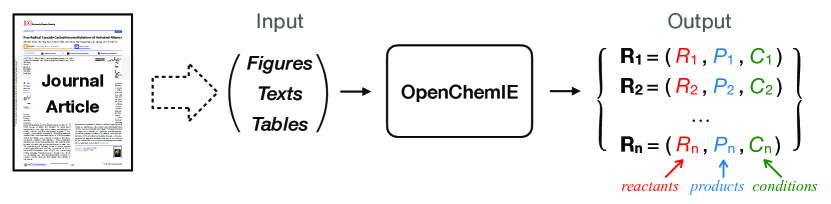
Information extraction from chemistry literature is vital for constructing up-to-date reaction databases for data-driven chemistry. Complete extraction requires combining information across text, tables, and figures, whereas prior work has mainly investigated extracting reactions from single modalities. In this paper, we present OpenChemIE to address this complex challenge and enable the extraction of reaction data at the document level. OpenChemIE approaches the problem in two steps: extracting relevant information from individual modalities and then integrating the results to obtain a final list of reactions. For the first step, we employ specialized neural models that each address a specific task for chemistry information extraction, such as parsing molecules or reactions from text or figures. We then integrate the information from these modules using chemistry-informed algorithms, allowing for the extraction of fine-grained reaction data from reaction condition and substrate scope investigations. Our machine learning models attain state-of-the-art performance when evaluated individually, and we meticulously annotate a challenging dataset of reaction schemes with R-groups to evaluate our pipeline as a whole, achieving an F1 score of 69.5%. Additionally, the reaction extraction results of \ours attain an accuracy score of 64.3% when directly compared against the Reaxys chemical database. We provide OpenChemIE freely to the public as an open-source package, as well as through a web interface.
研究动机与目标
- 推动面向数据驱动化学的最新反应数据整理,并降低对人工提取的依赖。
- 开发一个文档级提取系统,将多模态信息结合起来以还原完整的反应。
- 构建面向化学的子模块,用于图形、文本和表格解析,并通过指代消解、对齐和 R-基团分辨将它们整合。
- 提供一个开源工具包和公开网页界面,以促进更广泛的采用与评估。
提出的方法
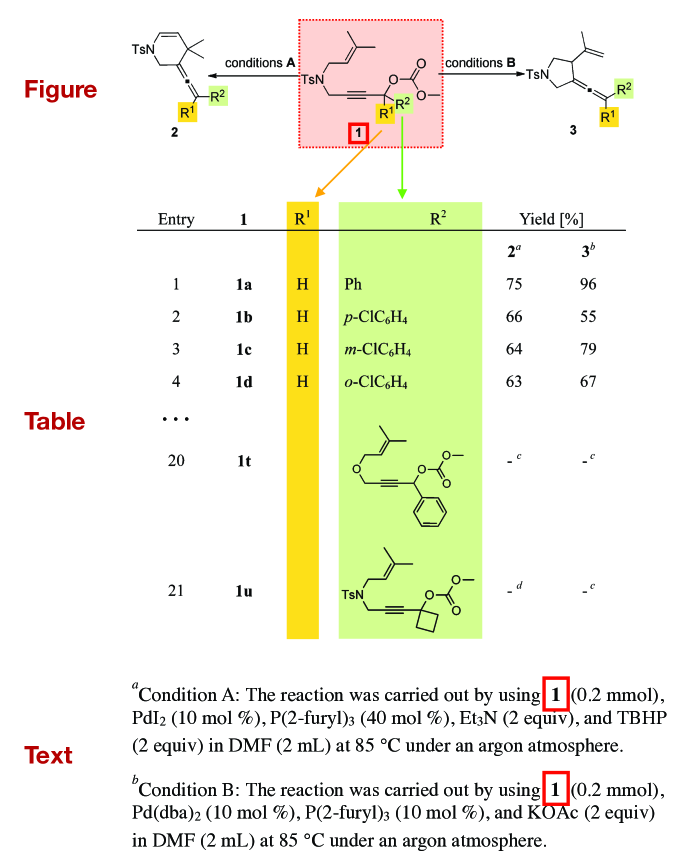
- 将提取分解为模态特定组件:图形分析(分子检测、指代消解、示意图解析、分子识别)、文本分析(命名实体识别、反应提取)以及多模态整合(R-基团分辨、反应条件对齐)。
- 在统一的流水线中表示输出,以获得包含反应物、产物和条件的最终反应列表;从表格对齐条件与图形,并利用 substrate scope 信息替换 R-基团。
- 使用 MolDetect、MolCoref、RxnScribe、MolScribe、ChemNER 和 ChemRxnExtractor 作为专门的神经模块;通过化学知情的算法进行条件对齐和 R-基团分辨的输出融合。
- 标注一个来自五本期刊的 78 张 substrate scope 图 figure 的 1007 条反应数据的数据集,以评估端到端流水线;并与 Reaxys 进行比较以获得外部验证。
实验结果
研究问题
- RQ1Can multimodal integration across figures, tables, and text yield more complete reaction data than per-modality extraction alone?
- RQ2How effective are chemistry-informed alignment and R-group resolution techniques in recovering full reaction structures from substrate scope diagrams?
- RQ3What is the end-to-end performance of OpenChemIE on a manually annotated dataset and on external databases (e.g., Reaxys)?
主要发现
- OpenChemIE 在标注的 substrate scope 数据集上实现了端到端 F1 为 69.5%。
- OpenChemIE 在与 Reaxys 对比提取的反应时达到 64.3% 的准确率。
- 该标注数据集包含来自五本期刊、78 张 substrate scope 图的 1007 条反应,展示了该流水线的覆盖范围。
- 单独模块表现出强大的基准:MolCoref F1 约 90.1%、RxnScribe F1 约 91.0%、MolDetect AP 86.0、MolScribe 准确性 71.9%、ChemNER F1 约 87.6–88.1%、ChemRxnExtractor F1 约 78.7%。
- 端到端错误主要来自分子识别和 OCR;R-基团分辨对错误的贡献适中。
阅读本论文
在 Nubint 阅读器中打开原文,边读边就任意段落提问。
在 Nubint 中阅读本论文本解读由 AI 根据论文原文生成,引用前请核对原文。