
[论文解读] OpenGSL: A Comprehensive Benchmark for Graph Structure Learning
OpenGSL 为图结构学习(GSL)提供了一个公平、统一的基准,评估13种方法在10个数据集上的表现,并分析同质性、泛化性和效率,以揭示何时GSL有助于或削弱GNNs。
Graph Neural Networks (GNNs) have emerged as the de facto standard for representation learning on graphs, owing to their ability to effectively integrate graph topology and node attributes. However, the inherent suboptimal nature of node connections, resulting from the complex and contingent formation process of graphs, presents significant challenges in modeling them effectively. To tackle this issue, Graph Structure Learning (GSL), a family of data-centric learning approaches, has garnered substantial attention in recent years. The core concept behind GSL is to jointly optimize the graph structure and the corresponding GNN models. Despite the proposal of numerous GSL methods, the progress in this field remains unclear due to inconsistent experimental protocols, including variations in datasets, data processing techniques, and splitting strategies. In this paper, we introduce OpenGSL, the first comprehensive benchmark for GSL, aimed at addressing this gap. OpenGSL enables a fair comparison among state-of-the-art GSL methods by evaluating them across various popular datasets using uniform data processing and splitting strategies. Through extensive experiments, we observe that existing GSL methods do not consistently outperform vanilla GNN counterparts. We also find that there is no significant correlation between the homophily of the learned structure and task performance, challenging the common belief. Moreover, we observe that the learned graph structure demonstrates a strong generalization ability across different GNN models, despite the high computational and space consumption. We hope that our open-sourced library will facilitate rapid and equitable evaluation and inspire further innovative research in this field. The code of the benchmark can be found in https://github.com/OpenGSL/OpenGSL.
研究动机与目标
- 评估在标准化的数据预处理和划分下,现有GSL方法取得了多大进展。
- 研究学习更同质化的图结构是否会提升GSL性能。
- 评估所学结构在不同GNN骨干网络以及简单的非GNN基线上的泛化性。
- 考察当前GSL方法的时间和内存效率,以识识别实际限制。
提出的方法
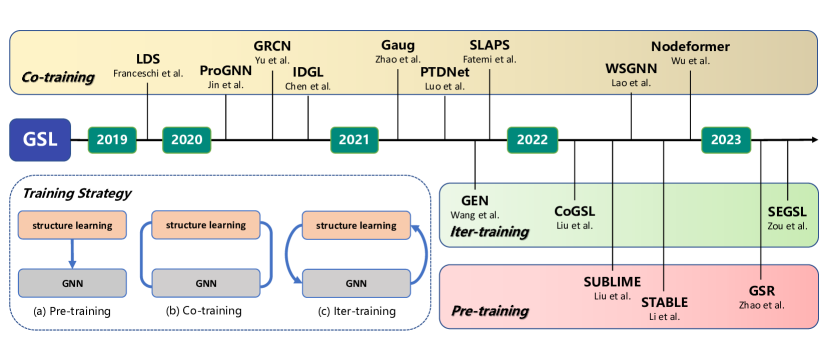
- 在统一的API下,对十三种最先进的GSL方法进行重新实现与复现。
- 在十个数据集上进行评估,采用一致的数据处理与划分以实现公平比较。
- 使用GCN骨干进行训练和测试,并在10次运行中报告均值±标准差。
实验结果
研究问题
- RQ1RQ1:在公平、标准化评估下,现有的GSL方法取得了多大进展?
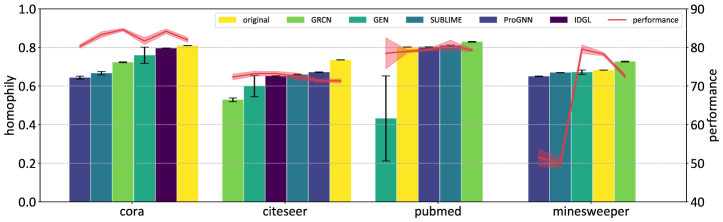
- RQ2RQ2:学习具有更高同质性的图结构是否能持续提升性能?
- RQ3RQ3:所学结构是否能够泛化到除训练骨干网以外的其他GNN模型?
- RQ4RQ4:现有的GSL方法在时间和空间方面是否高效?
主要发现
- GSL方法在所有数据集上并不总是优于原生的GCN。
- 所学习结构的同质性并不普遍与更好性能相关,提升也因数据集而异。
- 所学结构在不同GNN模型之间表现出强泛化性,甚至可以帮助非GNN方法如LPA和LINK。
- 大多数GSL方法在时间和内存方面效率低下,某些方法的运行时间比GCN长最多190倍,内存占用高出最多66倍。
阅读本论文
在 Nubint 阅读器中打开原文,边读边就任意段落提问。
在 Nubint 中阅读本论文本解读由 AI 根据论文原文生成,引用前请核对原文。