
[论文解读] OpenShape: Scaling Up 3D Shape Representation Towards Open-World Understanding
OpenShape 学习可扩展的多模态嵌入用于与语言和 2D 图像对齐的 3D 形状,从而实现强大的零样本开放世界 3D 识别和跨模态任务。
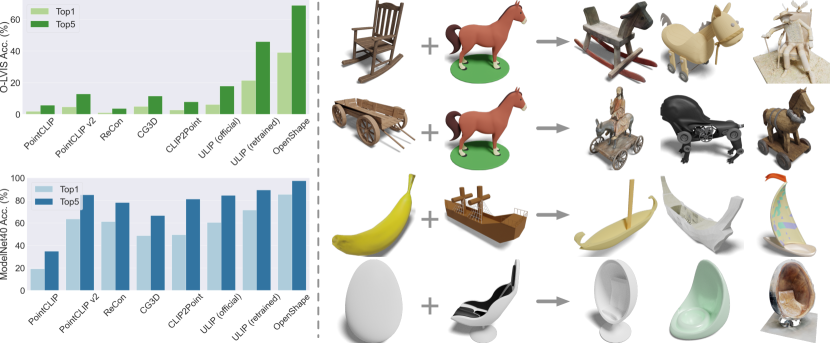
We introduce OpenShape, a method for learning multi-modal joint representations of text, image, and point clouds. We adopt the commonly used multi-modal contrastive learning framework for representation alignment, but with a specific focus on scaling up 3D representations to enable open-world 3D shape understanding. To achieve this, we scale up training data by ensembling multiple 3D datasets and propose several strategies to automatically filter and enrich noisy text descriptions. We also explore and compare strategies for scaling 3D backbone networks and introduce a novel hard negative mining module for more efficient training. We evaluate OpenShape on zero-shot 3D classification benchmarks and demonstrate its superior capabilities for open-world recognition. Specifically, OpenShape achieves a zero-shot accuracy of 46.8% on the 1,156-category Objaverse-LVIS benchmark, compared to less than 10% for existing methods. OpenShape also achieves an accuracy of 85.3% on ModelNet40, outperforming previous zero-shot baseline methods by 20% and performing on par with some fully-supervised methods. Furthermore, we show that our learned embeddings encode a wide range of visual and semantic concepts (e.g., subcategories, color, shape, style) and facilitate fine-grained text-3D and image-3D interactions. Due to their alignment with CLIP embeddings, our learned shape representations can also be integrated with off-the-shelf CLIP-based models for various applications, such as point cloud captioning and point cloud-conditioned image generation.
研究动机与目标
- 推动超越小型精选数据集的开放世界三维形状理解。
- 扩大三维数据规模并丰富嘈杂的文本描述,以改进与 CLIP 空间的语义对齐。
- 研究三维骨干网络的扩展并引入离线困难负样本挖掘以应对数据不平衡。
- 展示与 CLIP 对齐嵌入的强零样本三维分类和跨模态能力。
提出的方法
- 将四个大型公开三维数据集进行集合化,用于训练,共 876k 个形状。
- 使用多模态对比学习在不更新 CLIP 编码器的前提下,将三维形状嵌入与 CLIP 的语言和图像空间对齐。
- 通过 GPT-4 过滤、BLIP/Azure 标注,以及图像检索得到的文本描述来筛选和丰富文本描述,以改善 3D–文本对齐。
- 扩大三维骨干网络规模(例如 PointBERT、SparseConv),并比较它们相对于训练数据规模的性能。
- 引入离线困难负样本挖掘,以创建具有挑战性的批次组成并提升判别学习。
- 利用一个公共嵌入空间以实现跨模态任务并与基于 CLIP 的模型集成。
实验结果
研究问题
- RQ1大规模多模态预训练的三维形状是否能实现开放世界理解和强大的零样本性能?
- RQ2数据规模、文本质量、骨干网络扩展以及困难负样本挖掘如何影响零样本三维识别?
- RQ3将三维嵌入与 CLIP 的语言和图像空间对齐对跨模态任务有何影响?
- RQ4OpenShape 嵌入如何在跨模态的检索和生成任务中发挥作用?
- RQ5零样本三维识别在标准基准上能多接近甚至匹配完全监督基线?
主要发现
- OpenShape 在 Objaverse-LVIS(1,156 个类别)上实现 46.8% 零样本准确率,远高于之前的方法。
- 在 ModelNet40 上,OpenShape 达到 85.3% 零样本准确率,至少比先前的零样本基线高出 20%。
- OpenShape 展示了强大的少样本和跨模态检索能力,包括从图像或文本中检索形状,并实现形状条件生成。
- 将三维嵌入对齐到 CLIP 空间使得能够与基于 CLIP 的模型集成,用于点云字幕生成以及点云条件的图像生成等任务。
- 骨干网络扩展和文本丰富策略显著提升性能,困难负样本挖掘有助于解决数据不平衡。

阅读本论文
在 Nubint 阅读器中打开原文,边读边就任意段落提问。
在 Nubint 中阅读本论文本解读由 AI 根据论文原文生成,引用前请核对原文。