
[论文解读] Optimal, hardware native decomposition of parameterized multi-qubit Pauli gates
本文提出了一种参数化多量子比特泡利(PMQP)门到参数化两量子比特泡利(P2QP)门的最优、硬件原生分解方法,最小化电路深度和门数。该方法基于路径和星型拓扑进行递归分解,可推广至任意硬件图,并在组合优化电路中实现门抵消,无论系统规模如何,LHZ映射问题的电路深度恒为6。
We show how to efficiently decompose a parameterized multi-qubit Pauli (PMQP) gate into native parameterized two-qubit Pauli (P2QP) gates minimizing both the circuit depth and the number of P2QP gates. Given a realistic quantum computational model, we argue that the technique is optimal in terms of the number of hardware native gates and the overall depth of the decomposition. Starting from PMQP gate decompositions for the path and star hardware graph, we generalize the procedure to any generic hardware graph and provide exact expressions for the depth and number of P2QP gates of the decomposition. Furthermore, we show how to efficiently combine the decomposition of multiple PMQP gates to further reduce the depth as well as the number of P2QP gates for a combinatorial optimization problem using the Lechner-Hauke-Zoller (LHZ) mapping.
研究动机与目标
- 开发参数化多量子比特泡利(PMQP)门到硬件原生两量子比特门的系统化、最优分解方法。
- 在实际量子硬件模型中,最小化电路深度和P2QP门的数量。
- 将分解方法推广至基于路径和星型拓扑的任意硬件图。
- 在组合优化电路中,实现连续PMQP门分解之间的门抵消。
- 在使用莱彻-豪克-佐勒(LHZ)映射的奇偶编码量子近似优化算法(QAOA)上展示该方法的有效性。
提出的方法
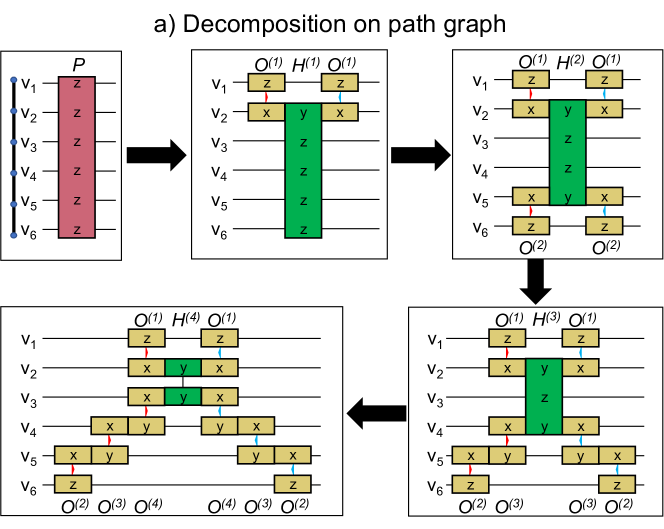
- 该方法基于硬件图结构,通过系统化程序递归地使用参数化两量子比特泡利(P2QP)门分解PMQP门。
- 针对路径图和星型图,推导出深度和门数的精确表达式,证明在两项指标上均达到最优。
- 开发了一种通用策略,利用相同的递归框架,将PMQP门分解到任意硬件图上。
- 该方法支持可交换P2QP门的并行执行,并利用优化电路中相邻晶胞间符号相反耦合项的抵消效应。
- 将该分解方法应用于LHZ映射QAOA中的四量子比特晶胞项,其中中心门并行执行,以降低深度。
- 通过将门序列与多量子比特门的相关性结构对齐,确保最小深度,实现电路深度的下限。
实验结果
研究问题
- RQ1PMQP门能否在门数和电路深度两方面,均实现到硬件原生P2QP门的最优分解?
- RQ2在给定硬件图上,PMQP门分解的最小可实现深度是多少?是否可达?
- RQ3如何组合多个PMQP门分解以实现门抵消并进一步降低深度?
- RQ4该分解方法能否推广至路径和星型拓扑之外的任意硬件图?
- RQ5使用该分解技术时,LHZ映射优化问题的电路深度如何随系统规模变化?
主要发现
- 在路径图和星型图上,该分解方法在门数和电路深度上均达到最优,路径图的深度呈线性增长,星型图的深度保持恒定。
- 在LHZ映射QAOA的四量子比特晶胞项中,通过分解交替行,电路深度降低至3,而使用先前的X形CNOT结构时深度为5。
- 通过并行执行中心两量子比特门并抵消符号相反的耦合门,整个正方形晶格的总电路深度降低至5,且运行时间与系统规模无关。
- 由于最优并行化和抵消策略,完整LHZ映射优化问题的最小深度恒为6,与系统规模无关。
- 该分解方法具有普适性,可应用于长程多量子比特相互作用,在近期量子应用中显著降低易出错的电路深度。
- 该技术通过最小化电路深度并促进费米子和优化电路中高效门抵消,有助于改善噪声抑制。
阅读本论文
在 Nubint 阅读器中打开原文,边读边就任意段落提问。
在 Nubint 中阅读本论文本解读由 AI 根据论文原文生成,引用前请核对原文。