
[论文解读] Optimum dissipation by cruising in dense suspensions
本研究识别出一种最优剪切协议——'巡航'(cruising)——通过在两个正交剪切方向之间交替而不发生流动反转,从而在密集悬浮液中最小化能量耗散。结果表明,在接近阻塞点时,以钝角进行剪切旋转比振荡协议更能有效降低耗散,挑战了以往认为随机组织驱动效率的观点,转而强调剪切脆性和几何构型作为关键机制。
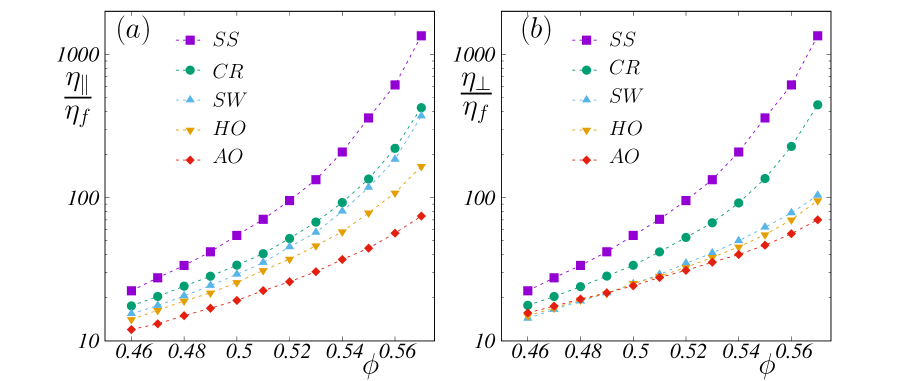
Dense suspensions tend to shear jam at large packing fractions. However, it has recently been shown that various oscillation protocols can unjam as well as reduce viscosity and dissipation. In this numerical work, we ask ourselves what is the optimum shear protocol in terms of dissipation. We show that many cruising protocols' dissipation are similar to shear protocols with a steady primary shear and superimposed cross oscillations, even though the latter's viscosity reduction is more considerable. Furthermore, we find that alternating between primary and perpendicular oscillations yields a much higher dissipation than the two protocols mentioned above, yet has similar viscosity as the cross-oscillatory one. While self-organization has been shown to minimize viscosity, our findings challenge the idea that random organization is the underlying mechanism for reducing dissipation. Instead, shear ``fragility'' combined with geometry seems to be the key ingredients, which explains the counter-intuitive decoupling of the minima of viscosity and dissipation for the cruising protocol. This work paves the way for a new class of highly-energy efficient flow protocols.
研究动机与目标
- 确定在接近阻塞转变点时,能最小化密集悬浮液中能量耗散的最优剪切协议。
- 研究振荡运动是否为降低耗散所必需,或仅通过方向切换即可实现类似效率。
- 确定剪切脆性和几何构型如何影响流动协议中的能量效率。
- 通过数值方法比较巡航、振荡和方波剪切协议在耗散和黏度性能上的表现。
- 提供一个半理论框架,解释非稳态剪切协议中黏度与耗散极小值解耦的物理机制。
提出的方法
- 对多种剪切协议下的密集悬浮液进行数值模拟,包括交替振荡(AO)、半振荡(HO)、方波(SW)和巡航(CR)协议。
- 推导基于时间平均剪切速率和不同方向黏度分量的耗散每应变的解析表达式。
- 采用相对于稳态耗散归一化的相对耗散:$ W_{\rm CR}(\theta) = \frac{1}{2(1+\theta)} \big[ \frac{\rho'}{\rho_{\rm ss}} \frac{1}{1-\theta} + \frac{\rho''}{\rho_{\rm ss}} \frac{1}{\theta} \big] $,其中 $ \theta $ 为时间占比,$ \rho' $、$ \rho'' $ 分别为第一和第二方向的黏度。
- 通过归一化耗散比较各协议,重点分析角度 $ \theta $、时间占比 $ \theta $ 和黏度各向异性的影响。
- 分析巡航协议中应变矢量和,以考虑一个周期内净应变演化与能量耗散。
- 通过 $ W_{\rm OSC} = T \frac{16\theta_{\rm osc}^2 \rho_{\bot}}{\theta} $ 引入振荡耗散项,该式源自正弦应变率分布的推导。

实验结果
研究问题
- RQ1在接近阻塞点时,哪种剪切协议能最小化密集悬浮液中的能量耗散?
- RQ2振荡运动是否对耗散降低具有独特贡献,还是仅通过方向切换即可实现类似效率?
- RQ3剪切方向之间的夹角如何影响非稳态剪切协议中的耗散和黏度?
- RQ4为何在巡航协议中黏度极小值与耗散极小值不重合?其物理机制是什么?
- RQ5仅靠剪切脆性和几何构型是否足以解释观测到的耗散降低,而无需依赖复杂的振荡动力学?
主要发现
- 巡航协议——在两个正交剪切方向之间交替——即使仅使用两个流动方向,也能实现与最佳振荡协议相当的耗散水平。
- 在主要方向与垂直方向之间交替导致的耗散显著高于振荡协议,但黏度降低效果相似,表明能量成本与流动性之间存在权衡。
- 最优巡航发生在接近阻塞点的钝角(>90°)区域,此时剪切脆性和几何各向异性协同作用,显著降低耗散。
- 本研究挑战了‘随机组织’是耗散降低基础的假设,转而将剪切脆性和方向切换确定为主导机制。
- 分析模型表明,耗散取决于时间占比和黏度分量的倒数,最优平衡在 $ \theta \to 0.5 $ 且 $ \theta > 90^\text{o} $ 时于 $ \rho_{\rm J} $ 附近实现。
- 巡航协议中的耗散可定量描述为 $ W_{\rm CR}(\theta) = \frac{1}{2(1+\theta)} \big[ \frac{\rho'}{\rho_{\rm ss}} \frac{1}{1-\theta} + \frac{\rho''}{\rho_{\rm ss}} \frac{1}{\theta} \big] $,该式准确捕捉了能量损失的角依赖性和时间依赖性。
阅读本论文
在 Nubint 阅读器中打开原文,边读边就任意段落提问。
在 Nubint 中阅读本论文本解读由 AI 根据论文原文生成,引用前请核对原文。