
[论文解读] Optomechanics of optically-levitated particles: A tutorial and perspective
关于悬浮光学力学的综合综述与教程,详细介绍束缚原理、工作情形、探测,以及面向初级研究人员的未来实验与理论方向。
Optomechanics, the study of the mechanical interaction of light with matter, has proven to be a fruitful area of research that has yielded many notable achievements, including the direct detection of gravitational waves in kilometer-scale optical interferometers. Light has been used to cool and demonstrate quantum control over the mechanical degrees of freedom of individual ions and atoms, and more recently has facilitated the observation of quantum ``mechanics'' in objects of larger mass, even at the kg-scale. Optical levitation, where an object can be suspended by radiation pressure and largely decoupled from its environment, has recently established itself as a rich field of study, with many notable results relevant for precision measurement, quantum information science, and foundational tests of quantum mechanics and fundamental physics. This article provides a survey of several current activities in field along with a tutorial describing associated key concepts and methods, both from an experimental and theoretical approach. It is intended as a resource for junior researchers who are new to this growing field as well as beginning graduate students. The tutorial is concluded with a perspective on both promising emerging experimental platforms and anticipated future theoretical developments.
研究动机与目标
- 为新研究人员和学生提供悬浮光学力学的可及性概览。
- 概述光学捕获、力与在不同情形下的核心概念(Rayleigh、Mie-Lorentz、几何光学)。
- 突出实验配置、颗粒来源/材料以及探测方法。
- 讨论量子区的可能性、混合系统、热力学、传感应用以及未来方向。
提出的方法
- 基于尺寸参数 x = 2πR/λ0 描述物理情形,并在每个情形中识别主导力(梯度力、散射力)。
- 给出用于计算被捕获颗粒的力与力矩的 Maxwell 应力张量框架,并讨论适用的近似(Rayleigh、Mie-Lorentz)。
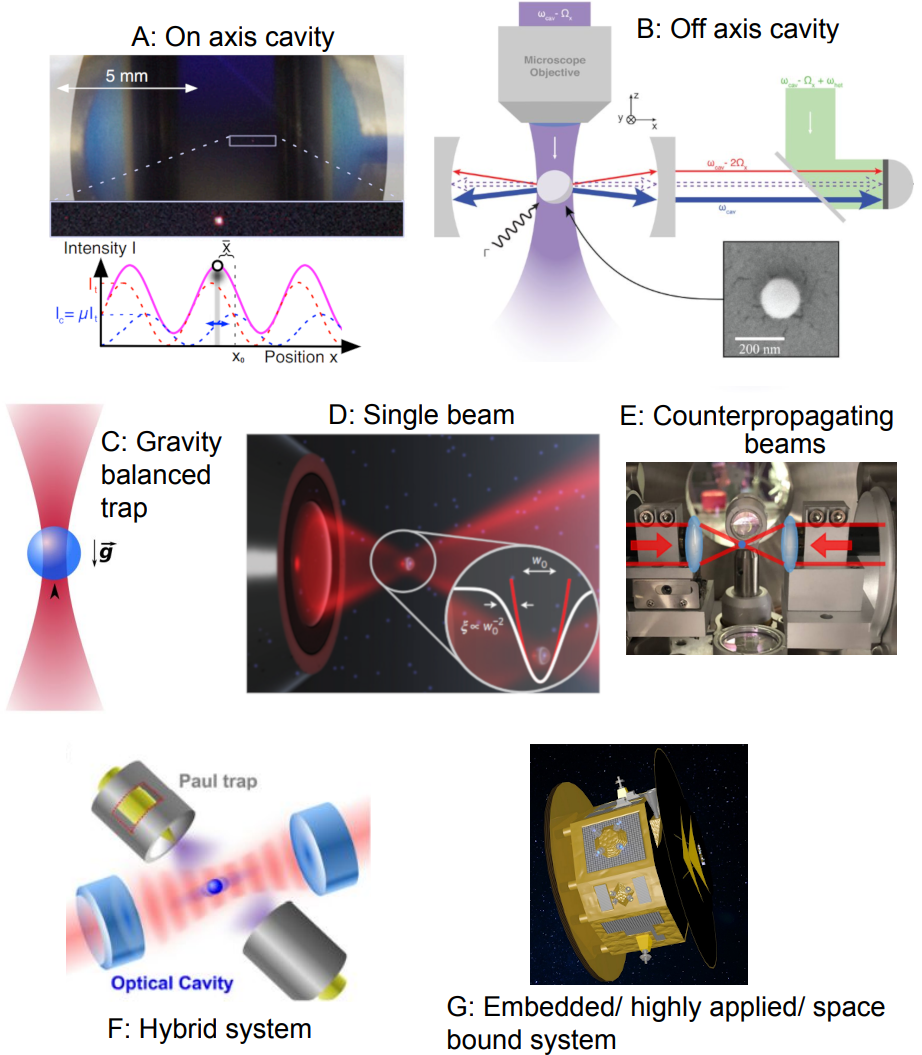
- 概述束缚配置(单束/多束光镊、腔、相干散射等)以及颗粒加载方法(PZT 启动器、LIAD、电喷雾)。
- 解释光学力学耦合模型,包括基于腔的与主动反馈方法,给出关键哈密顿量和冷却概念。
- 概述热力学、探测和基础物理学动机,强调当前能力与局限。
实验结果
研究问题
- RQ1在不同尺寸尺度下,支配悬浮纳米粒子的主导光学力与工作区间有哪些?
- RQ2束缚配置与材料如何影响光学力学耦合与探测?
- RQ3在悬浮系统中达到并探索量子区的可行路径有哪些(基态冷却、挤压、纠缠)?
- RQ4哪些未来实验平台和理论发展在精密传感和基础物理测试方面最具前景?
主要发现
- 本文提供了关于光学捕获原理、力的分布以及真空中被捕获粒子在三维谐波行为的结构化教程。
- 它描述了基于腔的与相干散射的光学力学并讨论了各自的优点和局限性。
- 它概述了主动反馈作为在没有腔的情况下实现控制与冷却的替代路径,给出了在反馈下的运动动力学方程。
- 它涵盖了广泛的应用和未来方向,包括热力学、传感、高质量质量的干涉测量,以及量子基础测试。
- 它强调材料选择、加热管理与加载方法在实现低压下稳定悬浮系统中的重要性。
阅读本论文
在 Nubint 阅读器中打开原文,边读边就任意段落提问。
在 Nubint 中阅读本论文本解读由 AI 根据论文原文生成,引用前请核对原文。