
[论文解读] OR-NeRF: Object Removing from 3D Scenes Guided by Multiview Segmentation with Neural Radiance Fields
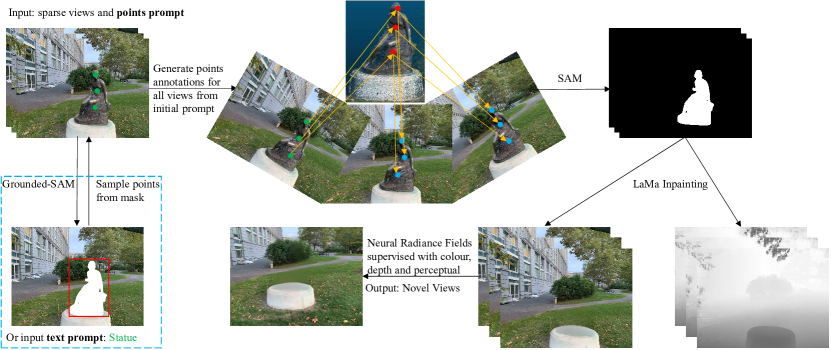
OR-NeRF 通过单视图提示(点或文本)从 3D 场景中移除对象,利用 3D 几何和 SAM 生成多视图掩模;然后使用 NeRF/TensoRF 结合颜色、深度和感知损失来实现一致性的场景重建。
The emergence of Neural Radiance Fields (NeRF) for novel view synthesis has increased interest in 3D scene editing. An essential task in editing is removing objects from a scene while ensuring visual reasonability and multiview consistency. However, current methods face challenges such as time-consuming object labeling, limited capability to remove specific targets, and compromised rendering quality after removal. This paper proposes a novel object-removing pipeline, named OR-NeRF, that can remove objects from 3D scenes with user-given points or text prompts on a single view, achieving better performance in less time than previous works. Our method spreads user annotations to all views through 3D geometry and sparse correspondence, ensuring 3D consistency with less processing burden. Then recent 2D segmentation model Segment-Anything (SAM) is applied to predict masks, and a 2D inpainting model is used to generate color supervision. Finally, our algorithm applies depth supervision and perceptual loss to maintain consistency in geometry and appearance after object removal. Experimental results demonstrate that our method achieves better editing quality with less time than previous works, considering both quality and quantity.
研究动机与目标
- 用最少的用户输入(单视图上的点或文本)来激发并实现对 3D 场景中对象的移除。
- 通过在 3D 几何中传播标注,提供快速、精确的多视图分割。
- 在用 NeRF/TensoRF 重建已编辑场景的同时,确保颜色、深度和感知一致性。
提出的方法
- 使用基于 3D COLMAP 的对应关系以及 2D 与 3D 空间之间的投影,将一个视图的用户标注扩展到所有视图。
- 使用 Segment-Anything (SAM) 从投影的点提示预测掩模(或通过 Grounded-SAM 采样将文本提示转换为点提示)。
- 使用 LaMa(2D 修补)为删除区域获取颜色与深度先验。
- 用颜色、深度和感知损失的监督来训练神经辐射场,以在移除后确保跨视图的一致性。
- 采用深度监督和聚焦于掩膜区域的感知损失,以提高几何和外观的合理性。
实验结果
研究问题
- RQ1如何将单视图的用户提示(点或文本)传播到所有视图,以实现一致的多视图对象移除?
- RQ2哪种深度监督和感知监督的组合能在基于 NeRF 的重建中提高 3D 一致性移除?
- RQ3利用带几何传播的 SAM 是否比以往的多步 SEG/NeRF 方法产生更快且更准确的掩模?
- RQ4在分割质量和编辑速度方面,OR-NeRF 与 SPIn-NeRF 相比如何?
主要发现
- 通过 3D 几何传播和 SAM,可以快速生成所有视图的掩模(在 RTX 3090 上约两帧/秒),优于以往的多步方法。
- 使用点提示或转换后的文本提示进行多视图分割,实现高精度和 IoU,在与 SPIn-NeRF 在报道场景的比较中,平均准确率约 99%、IoU 约 95%。
- 采用全部深度先验的深度监督和感知损失可提升跨视图的一致性和渲染质量,尽管对 FID/LPIPS 的影响因配置而异。
- 在所给出的评估中,OR-NeRF 实现了更快的掩模生成,并通常具有比 SPIn-NeRF 更好的分割指标。
- 在 20 个场景的实验中,所提出的方法相较基线在对象移除任务上获得更清晰的渲染和更快的处理速度。
- 研究指出局限性与 2D 修补质量相关,并建议以扩散式修补作为潜在改进,以获得更可信的补全。

阅读本论文
在 Nubint 阅读器中打开原文,边读边就任意段落提问。
在 Nubint 中阅读本论文本解读由 AI 根据论文原文生成,引用前请核对原文。