
[论文解读] PaLI-3 Vision Language Models: Smaller, Faster, Stronger
PaLI-3 是一个具有 5B 参数的视觉-语言模型,使用 SigLIP 对比预训练的图像编码器,在多模态基准测试中达到 SOTA,在定位和可视化情境文本任务方面优于更大模型。
This paper presents PaLI-3, a smaller, faster, and stronger vision language model (VLM) that compares favorably to similar models that are 10x larger. As part of arriving at this strong performance, we compare Vision Transformer (ViT) models pretrained using classification objectives to contrastively (SigLIP) pretrained ones. We find that, while slightly underperforming on standard image classification benchmarks, SigLIP-based PaLI shows superior performance across various multimodal benchmarks, especially on localization and visually-situated text understanding. We scale the SigLIP image encoder up to 2 billion parameters, and achieves a new state-of-the-art on multilingual cross-modal retrieval. We hope that PaLI-3, at only 5B parameters, rekindles research on fundamental pieces of complex VLMs, and could fuel a new generation of scaled-up models.
研究动机与目标
- 激励对高效、体积更小的 VLM 的需求,同时在多模态任务上仍能实现出色表现。
- 探究图像编码器的对比预训练是否相较于分类预训练在 VLM 中带来优势。
- 使用基于 SigLIP 的图像编码器、改进的多模态数据混合以及更高分辨率的训练来实现 SOTA 结果。
- 在可视化情境文本理解、通用 VLM 基准测试和与视频相关的任务中评估 PaLI-3,以展示泛化能力。
提出的方法
- 在 PaLI 框架内,将分类预训练的 ViT 主干与 SigLIP 对比预训练的 ViT 进行比较。
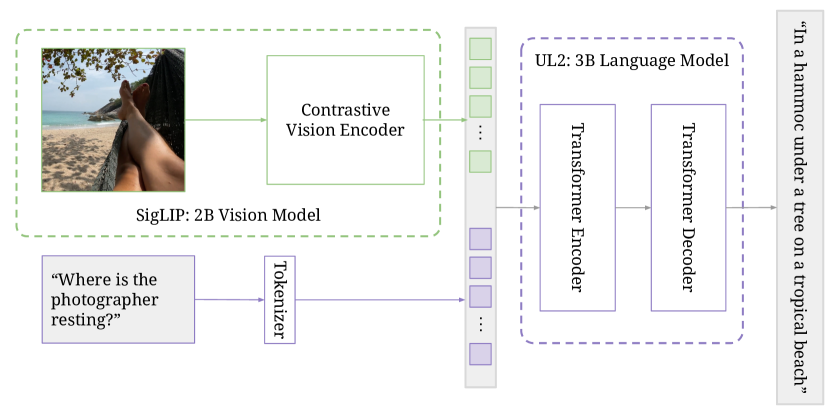
- 在网络规模的嘈杂图像文本数据上使用 SigLIP 对图像编码器进行预训练,并在多模态数据上训练一个 3B UL2 文本编码器-解码器。
- 在训练期间提高图像分辨率(812x812 和 1064x1064),并在合适时对组件进行冻结或非冻结以执行特定任务的微调。
- 将 ViT 的视觉标记融合到 3B UL2 编码器-解码器中,以生成任务特定的文本输出。
- 用文档和面向 OCR 的数据丰富 WebLI 数据混合,以提升可视化情境文本理解。
实验结果
研究问题
- RQ1在 PaLI-3 的多模态任务中,基于 SigLIP 的对比预训练图像编码器是否相较于分类预训练编码器带来提升?
- RQ2一个更小的 PaLI-3(5B 参数)是否能够在自然场景理解和可视化情境文本任务上同时达到 SOTA?
- RQ3更高分辨率的训练和数据混合对 OCR 密集任务和定位任务的性能有何影响?
- RQ4在不进行视频预训练的情况下,PaLI-3 在视频问答上的表现如何,它如何泛化到视频基准测试?
主要发现
- 基于 SigLIP 的 PaLI 在可视化情境文本理解和定位任务上相比分类预训练的主干显示出更优的性能。
- PaLI-3 在 10+ 个视觉-语言基准测试中达到 SOTA,同时体积比当前 SOTA 模型小 10 倍,在可视化情境文本任务上获得显著提升。
- 该模型在多语言跨模态检索方面达到新的 SOTA,使用在多语言 SigLIP 设置中的 2B SigLIP 图像编码器。
- 尽管没有视频预训练,PaLI-3 在若干视频 QA 基准测试上达到新的 SOTA,表明强大的泛化能力。
- 在 OCR 输入被禁用的任务中,PaLI-3 经常超越先前的方法,强调了其强大的内在 OCR 和多模态推理能力。
阅读本论文
在 Nubint 阅读器中打开原文,边读边就任意段落提问。
在 Nubint 中阅读本论文本解读由 AI 根据论文原文生成,引用前请核对原文。