
[论文解读] PaLM2-VAdapter: Progressively Aligned Language Model Makes a Strong Vision-language Adapter
该论文提出 PaLM2-VAdapter,一种视觉-语言适配器,利用逐步训练的小型 PaLM-2 语言模型,将冻结的视觉编码器与大型语言模型对齐。通过两阶段训练——首先作为解码器训练,然后作为带有感知器重采样器的适配器——该方法在收敛速度、性能和可扩展性方面优于先前方法,在 VQA 和图像字幕生成任务上达到最先进水平,参数量减少 30–80%。
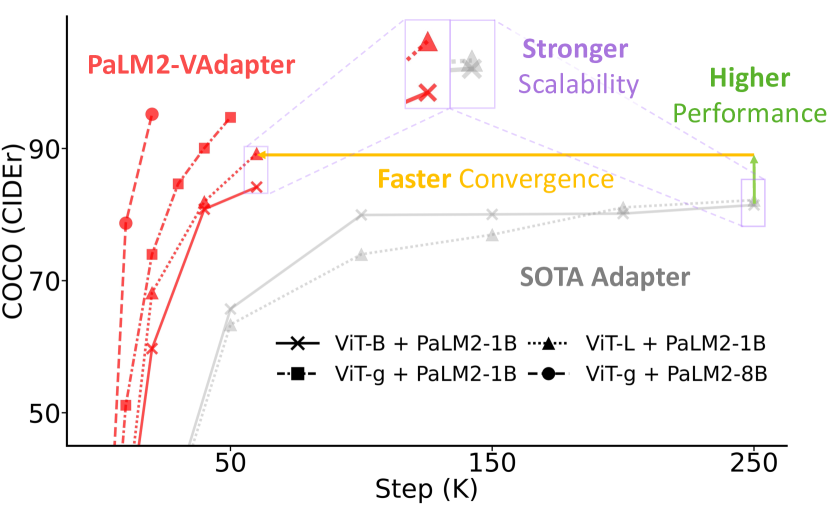
This paper demonstrates that a progressively aligned language model can effectively bridge frozen vision encoders and large language models (LLMs). While the fundamental architecture and pre-training methods of vision encoders and LLMs have been extensively studied, the architecture and training strategy of vision-language adapters vary significantly across recent works. Our research undertakes a thorough exploration of the state-of-the-art perceiver resampler architecture and builds a strong baseline. However, we observe that the vision-language alignment with perceiver resampler exhibits slow convergence and limited scalability with a lack of direct supervision. To address this issue, we propose PaLM2-VAdapter, employing a progressively aligned language model as the vision-language adapter. Compared to the strong baseline with perceiver resampler, our method empirically shows faster convergence, higher performance, and stronger scalability. Extensive experiments across various Visual Question Answering (VQA) and captioning tasks on both images and videos demonstrate that our model exhibits state-of-the-art visual understanding and multi-modal reasoning capabilities. Notably, our method achieves these advancements with 30~70% fewer parameters than the state-of-the-art large vision-language models, marking a significant efficiency improvement.
研究动机与目标
- 为解决现有视觉-语言适配器在收敛速度和可扩展性方面的不足,特别是基于感知器重采样器架构的模型。
- 探究逐步训练的语言模型是否能更有效地作为适配器,用于对齐冻结的视觉编码器与大型语言模型。
- 在保持或提升视觉-语言基准性能的同时,减少模型参数量和训练成本。
- 建立一种可扩展且高效的视觉-语言对齐框架,支持零样本迁移至更大规模的 LLM。
提出的方法
- 采用两阶段训练策略:首先将小型 PaLM-2 模型(108M 参数)预训练为语言模型解码器,然后将其微调为带有感知器重采样器的视觉-语言适配器。
- 适配器使用交叉注意力机制,将来自冻结视觉编码器的视觉特征与语言模型的隐藏状态对齐。
- 逐步对齐机制通过先学习语言建模,再学习跨模态对齐,实现更优的优化。
- 适配器通过图像-文本对端到端训练,利用预训练 PaLM-2 模型的强大归纳偏置。
- 开展基于 Gumbel-Softmax 的量化研究,评估是否可将视觉嵌入直接映射到 LLM 词汇表标记。
- 在基于图像和视频的 VQA 与字幕生成基准上评估该方法,包括 COCO、MSVD-QA、MSRVTT-QA 和 iVQA。
实验结果
研究问题
- RQ1与标准感知器重采样器架构相比,逐步训练的语言模型是否能作为更有效的视觉-语言适配器?
- RQ2逐步训练是否能提升视觉-语言对齐中的收敛速度和可扩展性?
- RQ3小型语言模型是否能在显著减少参数量的前提下实现最先进性能,优于现有大型视觉-语言模型?
- RQ4是否可行将视觉嵌入量化为 LLM 词汇表中的离散标记,以实现向更大模型的零样本迁移?
主要发现
- PaLM2-VAdapter 在图像和视频 VQA 与字幕生成基准上达到最先进性能,包括在 COCO 字幕任务上取得 44.1 的 CIDEr 分数,在 MSVD-QA 上达到 75.6% 的准确率。
- 在 MSVD-QA 基准上,该模型达到 75.6% 的准确率,尽管仅使用其参数量的 14%(10.8B 对比 80B),仍优于 Flamingo 基线模型。
- 在 iVQA 数据集上,PaLM2-VAdapter 达到 72.1% 的准确率,展现出强大的多模态推理能力。
- 与最先进模型相比,该方法在保持或提升性能的同时,实现了 30–80% 的参数量减少。
- Gumbel-Softmax 量化实验在 COCO 上仅取得 15.3 的 CIDEr 分数,表明通过简单匹配无法有效将视觉嵌入映射到 LLM 词汇表标记。
- 逐步训练策略显著提升了收敛速度和可扩展性,尤其在扩大视觉编码器规模时表现更优。

阅读本论文
在 Nubint 阅读器中打开原文,边读边就任意段落提问。
在 Nubint 中阅读本论文本解读由 AI 根据论文原文生成,引用前请核对原文。