
[论文解读] PanoGen: Text-Conditioned Panoramic Environment Generation for Vision-and-Language Navigation
PanoGen 通过 BLIP-2 标注和基于扩散的外绘制生成无限的文本条件全景室内环境,然后使用它们来对 VLN 代理进行预训练和微调,在 R2R、R4R 和 CVDN 上达到 SOTA。
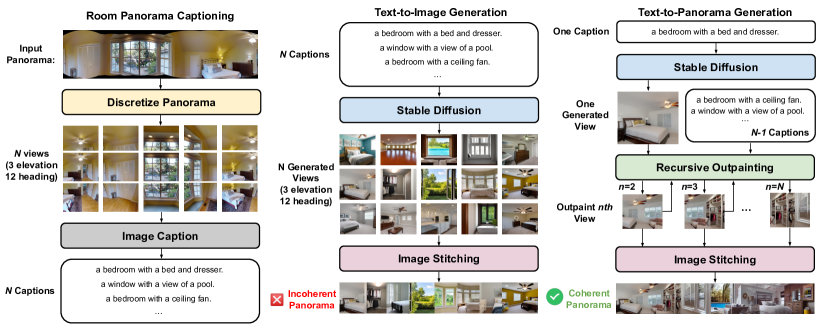
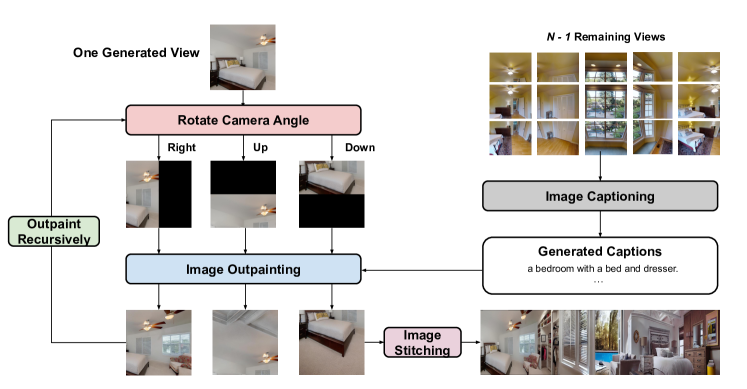
Vision-and-Language Navigation (VLN) requires the agent to follow language instructions to navigate through 3D environments. One main challenge in VLN is the limited availability of photorealistic training environments, which makes it hard to generalize to new and unseen environments. To address this problem, we propose PanoGen, a generation method that can potentially create an infinite number of diverse panoramic environments conditioned on text. Specifically, we collect room descriptions by captioning the room images in existing Matterport3D environments, and leverage a state-of-the-art text-to-image diffusion model to generate the new panoramic environments. We use recursive outpainting over the generated images to create consistent 360-degree panorama views. Our new panoramic environments share similar semantic information with the original environments by conditioning on text descriptions, which ensures the co-occurrence of objects in the panorama follows human intuition, and creates enough diversity in room appearance and layout with image outpainting. Lastly, we explore two ways of utilizing PanoGen in VLN pre-training and fine-tuning. We generate instructions for paths in our PanoGen environments with a speaker built on a pre-trained vision-and-language model for VLN pre-training, and augment the visual observation with our panoramic environments during agents' fine-tuning to avoid overfitting to seen environments. Empirically, learning with our PanoGen environments achieves the new state-of-the-art on the Room-to-Room, Room-for-Room, and CVDN datasets. Pre-training with our PanoGen speaker data is especially effective for CVDN, which has under-specified instructions and needs commonsense knowledge. Lastly, we show that the agent can benefit from training with more generated panoramic environments, suggesting promising results for scaling up the PanoGen environments.
研究动机与目标
- 解决 Vision-and-Language Navigation (VLN) 的受限且不可扩展的 3D 训练环境。
- 在没有人工标注的情况下,生成多样且连贯的以文本描述为条件的全景环境。
- 利用生成的全景图用于 VLN 的预训练和微调,以提升对未见环境的泛化能力。
- 通过文本条件的递归外绘制来保持全景的语义一致性。
提出的方法
- 通过使用 BLIP-2 为 Matterport3D 全景图生成描述来收集房间描述。
- 使用扩散模型根据描述生成 36 视角离散化的房间图像。
- 通过从初始视图和旋转相机角度的递归外绘制来创建连贯的 360 度全景。
- 基于 mPLUG 训练一个说话者,用于为我们的 PanoGen 全景提供 VLN 预训练的路径指令。
- 使用来自 PanoGen 和原始数据的指令-轨迹对对 VLN 代理进行预训练。
- 通过用生成的全景替换部分观测来微调 VLN 代理,以减少过拟合。
实验结果
研究问题
- RQ1在大规模生成文本条件的全景环境时,是否能够在保持语义一致性的同时符合人类常识?
- RQ2生成的全景图是否提升了 VLN 的预训练和微调,从而对未见环境有更好的泛化?
- RQ3在微调阶段(观测替换)引入生成的全景图如何影响在 R2R、R4R 和 CVDN 上的 VLN 性能?
- RQ4生成全景图数量对 VLN 泛化的影响是什么?
主要发现
- PanoGen 在 Room-to-Room (R2R) 和 CVDN 测试集上达到新的 SOTA。
- 使用 PanoGen speaker 数据进行预训练取得显著提升,特别是在对指令未充分指定的 CVDN 上。
- 使用全景观测替换进行微调在 R2R、R4R 和 CVDN 数据集上提升了性能。
- 在微调阶段增加生成的全景数量会带来持续的收益,表明具有可扩展的收益。
- PanoGen 有效替换或增补训练数据,同时不牺牲指令与观测之间的一致性。
阅读本论文
在 Nubint 阅读器中打开原文,边读边就任意段落提问。
在 Nubint 中阅读本论文本解读由 AI 根据论文原文生成,引用前请核对原文。