
[论文解读] Parameter-Efficient Fine-Tuning Design Spaces
本文提出了参数高效微调(PEFT)的设计空间,发现了通用的设计模式,并展示了在多种骨干网络和NLP任务上优于现有策略的新型PEFT方法。
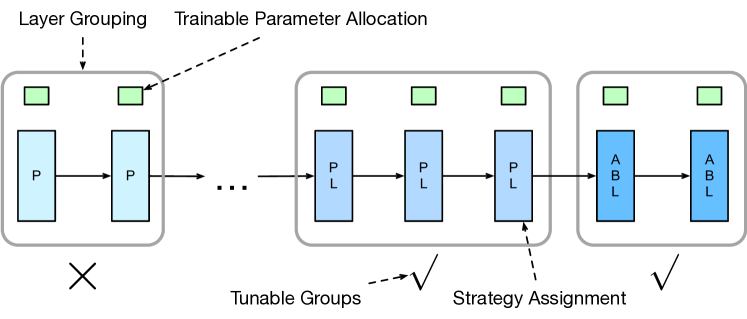
Parameter-efficient fine-tuning aims to achieve performance comparable to fine-tuning, using fewer trainable parameters. Several strategies (e.g., Adapters, prefix tuning, BitFit, and LoRA) have been proposed. However, their designs are hand-crafted separately, and it remains unclear whether certain design patterns exist for parameter-efficient fine-tuning. Thus, we present a parameter-efficient fine-tuning design paradigm and discover design patterns that are applicable to different experimental settings. Instead of focusing on designing another individual tuning strategy, we introduce parameter-efficient fine-tuning design spaces that parameterize tuning structures and tuning strategies. Specifically, any design space is characterized by four components: layer grouping, trainable parameter allocation, tunable groups, and strategy assignment. Starting from an initial design space, we progressively refine the space based on the model quality of each design choice and make greedy selection at each stage over these four components. We discover the following design patterns: (i) group layers in a spindle pattern; (ii) allocate the number of trainable parameters to layers uniformly; (iii) tune all the groups; (iv) assign proper tuning strategies to different groups. These design patterns result in new parameter-efficient fine-tuning methods. We show experimentally that these methods consistently and significantly outperform investigated parameter-efficient fine-tuning strategies across different backbone models and different tasks in natural language processing.
研究动机与目标
- 理解是否存在超越单个手工设计策略的PEFT总体设计模式。
- 提出一个设计空间框架,对层分组、参数分配、可调组和策略分配进行参数化。
- 通过经验方法识别在骨干模型(T5、RoBERTa、BART)和任务(GLUE、生成任务)上具有广泛泛化性的设计模式。
- 展示基于发现的模式制定的新型PEFT方法,在低参数预算下超越现有PEFT方法。
提出的方法
- 定义一个由四个组成部分组成的PEFT设计空间:层分组、可训练参数分配、可调组和策略分配。
- 通过施加约束并在GLUE上通过随机采样和低轮次微调来评估模型质量,逐步细化无约束的设计空间。
- 识别在不同模式下始终提升性能的设计模式(例如 spindle 层分组、统一参数分配、对所有组进行调优、给不同组分配不同策略)。
- 实例化包含发现模式的新型PEFT方法并在多个骨干上与 Adapter、Prefix、BitFit、LoRA 进行比较。
- 在多个骨干(T5-base、T5-3b、RoBERTa-base/large、BART-base/large)以及包括GLUE和生成任务的任务上验证这些模式。
实验结果
研究问题
- RQ1在不同骨干上,哪些设计空间模式能为PEFT带来最佳性能?
- RQ2层分组、参数分配、可调组和策略分配是否相互作用以产生可迁移的设计原则?
- RQ3所发现的设计模式是否能催生在多样化NLP任务上优于现有策略的新型PEFT方法?
- RQ4所识别的模式是否在理解任务(GLUE)和生成任务(摘要、翻译)中都具备鲁棒性?
主要发现
- 在GLUE上使用T5-base时,层分组的 spindle 模式持续优于其他分组。
- 在所探索的空间中,跨层的可训练参数的统一分配获得了最高的GLUE平均分。
- 对所有层组进行调优对性能有利。
- 将不同的调优策略分配给不同的组比统一策略分配取得更好的结果。
- 基于这些模式构建的PEFT方法(S4-model, S4-3b-model)超越强基线,在若干设置中甚至在低参数预算下超过全微调。
- Pattern-derived methods generalize across backbones (T5, RoBERTa, BART) and NLP tasks (classification, generation).

阅读本论文
在 Nubint 阅读器中打开原文,边读边就任意段落提问。
在 Nubint 中阅读本论文本解读由 AI 根据论文原文生成,引用前请核对原文。