
[论文解读] Paxion: Patching Action Knowledge in Video-Language Foundation Models
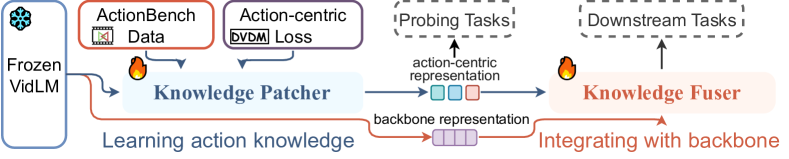
Paxion 将行动知识嵌入冻结的视频-语言模型,通过 Knowledge Patcher 与 Knowledge Fuser,使用一种新颖的 Discriminative Video Dynamics Modeling 目标来提升动作理解,同时保持对象级能力。
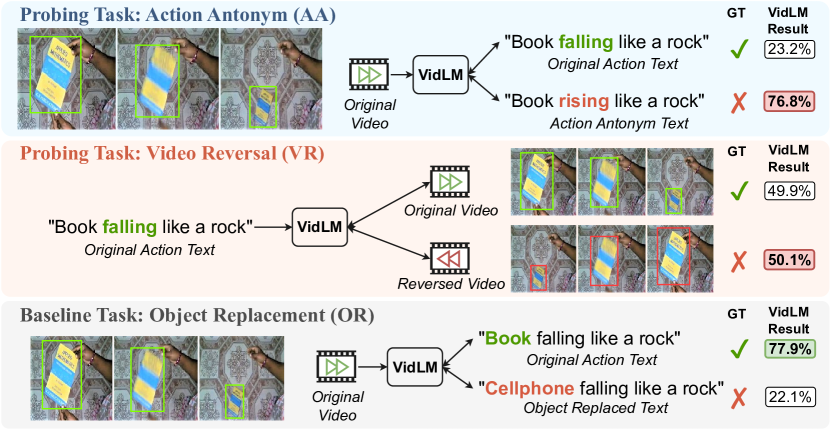
Action knowledge involves the understanding of textual, visual, and temporal aspects of actions. We introduce the Action Dynamics Benchmark (ActionBench) containing two carefully designed probing tasks: Action Antonym and Video Reversal, which targets multimodal alignment capabilities and temporal understanding skills of the model, respectively. Despite recent video-language models' (VidLM) impressive performance on various benchmark tasks, our diagnostic tasks reveal their surprising deficiency (near-random performance) in action knowledge, suggesting that current models rely on object recognition abilities as a shortcut for action understanding. To remedy this, we propose a novel framework, Paxion, along with a new Discriminative Video Dynamics Modeling (DVDM) objective. The Paxion framework utilizes a Knowledge Patcher network to encode new action knowledge and a Knowledge Fuser component to integrate the Patcher into frozen VidLMs without compromising their existing capabilities. Due to limitations of the widely-used Video-Text Contrastive (VTC) loss for learning action knowledge, we introduce the DVDM objective to train the Knowledge Patcher. DVDM forces the model to encode the correlation between the action text and the correct ordering of video frames. Our extensive analyses show that Paxion and DVDM together effectively fill the gap in action knowledge understanding (~50% to 80%), while maintaining or improving performance on a wide spectrum of both object- and action-centric downstream tasks. The code and data will be made publicly available for research purposes at https://github.com/MikeWangWZHL/Paxion.git.
研究动机与目标
- 定义 Action Dynamics Benchmark (ActionBench) 以在多模态和时间维度上探测行动知识。
- 诊断最先进 VidLMs 的行动理解相对于对象偏见的不足。
- 提出 Paxion 框架,将行动知识补丁到冻结的 VidLM 主干中,同时不损害 VL 性能。
- 引入 Discriminative Video Dynamics Modeling (DVDM) 损失,以更好地学习行动-文本和帧动态。
- 在保持对象中心能力的同时,展示在以行动为中心的下游任务上的性能提升。
提出的方法
- 引入基于 Perceiver 的 Knowledge Patcher (KP),用于对冻结的 VidLM 主干进行轻量级的行动中心特征增强。
- 开发 Discriminative Video Dynamics Modeling (DVDM),配合 Video-Action Contrastive (VAC) 与 Action-Temporal Matching (ATM) 损失来学习行动动态。
- 证明单独的 VTC 对行动知识而言不足;DVDM 提供必要的判别信号。
- 将 KP 与 Knowledge Fuser (KF) 集成,利用跨注意力将行动中心表示与对象中心表示融合以用于下游任务。
- 在 ActionBench 及下游任务(包括视频-文本检索、视频到行动检索,以及 NExT-QA,考虑零-shot 域转移)上评估 Paxion。
实验结果
研究问题
- RQ1前沿 VidLMs 是否能够在超越对象识别的方面展现出稳健的行动知识?
- RQ2基于补丁的、冻结主干的方式结合判别式动力学目标,是否能在不牺牲 VL 性能的前提下提升行动理解?
- RQ3将行动中心的补丁与主干表示融合如何影响一系列下游任务(对象中心、行动中心和时序中心)?
主要发现
- ActionBench 表明领先 VidLMs 在 Action Antonym 和 Video Reversal 上几乎接近随机的表现,表明行动知识薄弱并偏向对象。
- Paxion 搭配 DVDM 显著提升行动理解(AA 与 VR),同时维持或提升基于对象的任务性能。
- KP 与 VTC+DVDM 的组合显著提高 AA/VR 分数(例如 InternVideo 变体从 58.8/46.2 提升到 90.1/75.5),并带来强的总体 Avg 增益。
- Knowledge Fuser (KF) 通过平衡行动中心与对象中心表示来提升下游任务性能,特别提升像 Temporal-SSv2 和 NExT-QA 等对时序要求较高的任务。
- 在使用 KF 时,Paxion 展示对领域偏移的鲁棒性和在零-shot 设置中的正迁移,说明泛化能力提升。
阅读本论文
在 Nubint 阅读器中打开原文,边读边就任意段落提问。
在 Nubint 中阅读本论文本解读由 AI 根据论文原文生成,引用前请核对原文。