
[论文解读] Pay Attention to What You Read: Non-recurrent Handwritten Text-Line Recognition
该论文提出了一种首个非循环的、基于Transformer的行 handwritten text recognition(HTR)方法,通过在视觉和文本阶段均采用多头自注意力机制,实现无需循环结构的字符识别与语言建模联合优化。该方法在IAM数据集上实现了最先进性能,包括出色的 few-shot 学习结果和对未登录词(OOV)的完整支持,通过在字符级别端到端训练,无需预定义词典。
The advent of recurrent neural networks for handwriting recognition marked an important milestone reaching impressive recognition accuracies despite the great variability that we observe across different writing styles. Sequential architectures are a perfect fit to model text lines, not only because of the inherent temporal aspect of text, but also to learn probability distributions over sequences of characters and words. However, using such recurrent paradigms comes at a cost at training stage, since their sequential pipelines prevent parallelization. In this work, we introduce a non-recurrent approach to recognize handwritten text by the use of transformer models. We propose a novel method that bypasses any recurrence. By using multi-head self-attention layers both at the visual and textual stages, we are able to tackle character recognition as well as to learn language-related dependencies of the character sequences to be decoded. Our model is unconstrained to any predefined vocabulary, being able to recognize out-of-vocabulary words, i.e. words that do not appear in the training vocabulary. We significantly advance over prior art and demonstrate that satisfactory recognition accuracies are yielded even in few-shot learning scenarios.
研究动机与目标
- 解决循环模型在手写文本识别中训练效率低下和序列瓶颈的问题。
- 实现在无需依赖预定义封闭词典情况下的端到端识别,支持未登录词(OOV)。
- 证明自注意力机制可在非循环架构中有效建模视觉特征与语言依赖关系。
- 通过合成数据预训练,在低数据场景下验证方法性能。
- 表明模型本身具备语言建模能力,从而减少对外部语言模型的依赖。
提出的方法
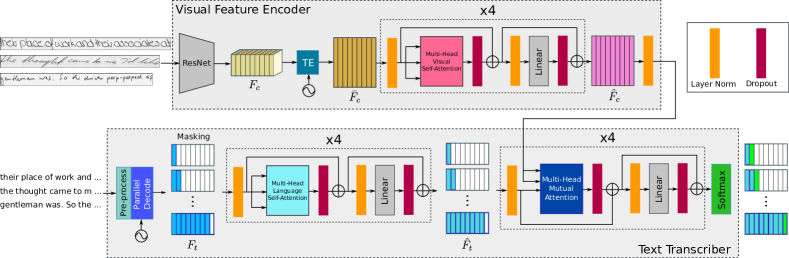
- 模型使用视觉Transformer编码器从手写文本行图像中提取视觉特征,替代传统的卷积或循环编码器。
- 多头自注意力机制处理视觉标记,以学习图像中空间与序列依赖关系。
- 解码器使用另一个多头自注意力模块,自回归地生成字符,同时关注视觉特征和先前生成的标记。
- 整个架构通过字符级预测的交叉熵损失进行端到端训练,实现视觉与语言建模的联合优化。
- 采用合成数据上的预训练步骤,以提升在少量真实标注数据下的少样本泛化能力。
- 模型以字符为单位运行,无需固定词典,从而支持对未见过的OOV词的识别。
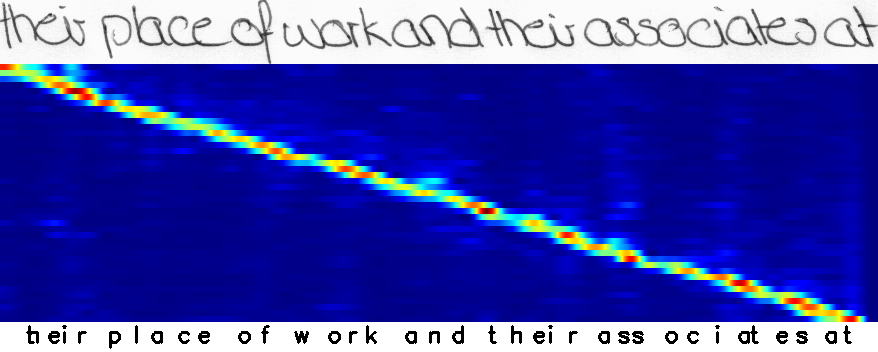
实验结果
研究问题
- RQ1与循环模型相比,非循环的基于Transformer的架构能否在手写文本行识别中实现具有竞争力的性能?
- RQ2所提出的方法是否能在不依赖外部语言模型的情况下有效建模语言依赖关系?
- RQ3在少样本学习场景下,尤其是真实标注数据有限时,模型能否实现良好泛化?
- RQ4在合成数据上进行预训练在多大程度上能提升真实世界手写文本识别任务的性能?
- RQ5模型能否在无需预定义词典的情况下识别未登录词?
主要发现
- 所提出的基于Transformer的方法在IAM数据集上实现了4.67%的字符错误率(CER)和15.45%的词错误率(WER),在开放词汇HTR任务中创下新的SOTA记录。
- 即使仅使用20%的真实训练数据,该模型在合成数据预训练后仍优于序列到序列基线模型,展现出强大的少样本泛化能力。
- 在后处理中添加外部语言模型并未带来性能提升(CER:4.66% vs. 4.67%),表明模型已能充分捕捉内部语言上下文。
- 与以往依赖封闭词典的SOTA方法相比,该模型在开放词汇设置下表现显著更优,全面超越所有先前方法。
- 消融研究证实,视觉和文本自注意力机制对最优性能均至关重要,其中视觉编码器在特征表示中起关键作用。
- 使用合成数据进行预训练使模型在真实数据有限的情况下仍能实现高性能,凸显其在低资源场景下的可扩展性。
阅读本论文
在 Nubint 阅读器中打开原文,边读边就任意段落提问。
在 Nubint 中阅读本论文本解读由 AI 根据论文原文生成,引用前请核对原文。