
[论文解读] Pediatric Wrist Fracture Detection in X-rays via YOLOv10 Algorithm and Dual Label Assignment System
本论文在GRAZPEDWRI-DX数据集上评估YOLOv10变体用于儿科手腕骨折检测,结果显示YOLOv10-M在mAP@50-95(51.9%)上达到最新水平并超越YOLOv9的基准。
Wrist fractures are highly prevalent among children and can significantly impact their daily activities, such as attending school, participating in sports, and performing basic self-care tasks. If not treated properly, these fractures can result in chronic pain, reduced wrist functionality, and other long-term complications. Recently, advancements in object detection have shown promise in enhancing fracture detection, with systems achieving accuracy comparable to, or even surpassing, that of human radiologists. The YOLO series, in particular, has demonstrated notable success in this domain. This study is the first to provide a thorough evaluation of various YOLOv10 variants to assess their performance in detecting pediatric wrist fractures using the GRAZPEDWRI-DX dataset. It investigates how changes in model complexity, scaling the architecture, and implementing a dual-label assignment strategy can enhance detection performance. Experimental results indicate that our trained model achieved mean average precision (mAP@50-95) of 51.9\% surpassing the current YOLOv9 benchmark of 43.3\% on this dataset. This represents an improvement of 8.6\%. The implementation code is publicly available at https://github.com/ammarlodhi255/YOLOv10-Fracture-Detection
研究动机与目标
- 评估YOLOv10变体在GRAZPEDWRI-DX数据集上检测儿科手腕骨折的有效性。
- 在关键检测指标上将YOLOv10变体与YOLOv9基准进行比较。
- 分析模型复杂度如何影响骨折检测性能。
- 确定在整体病理检测(包括骨折)方面表现最佳的YOLOv10变体。
提出的方法
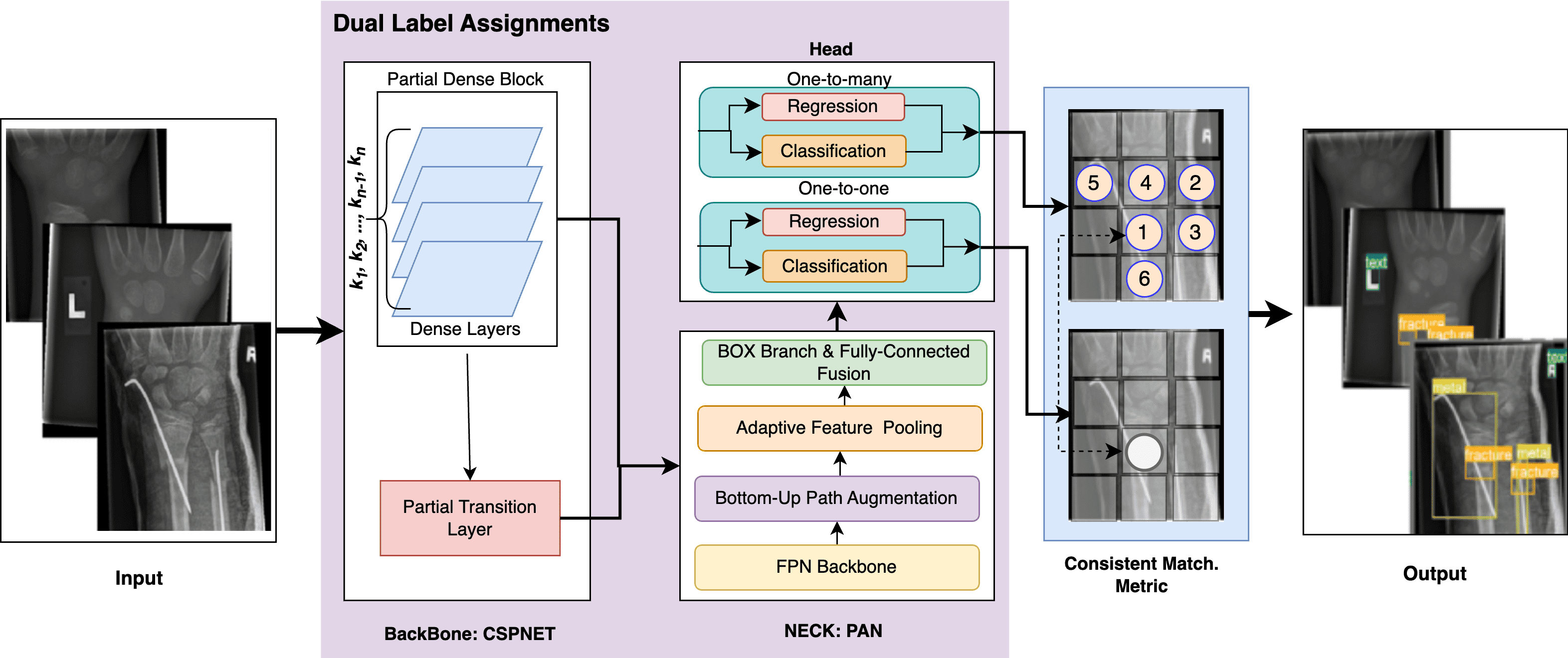
- 训练并评估多种YOLOv10变体(N、S、M、L、X)并在GRAZPEDWRI-DX上与YOLOv9基线进行比较。
- 在COCO上进行预训练,然后在数据集分割(train/val/test)上进行微调。
- 使用双标签分配系统来替代训练中的传统NMS。
- 结合架构创新:Compact Inverted Block (CIB)、解耦分类头、空间-通道解耦下采样、秩引导的块设计、大核卷积,以及部分自注意力(PSA)。
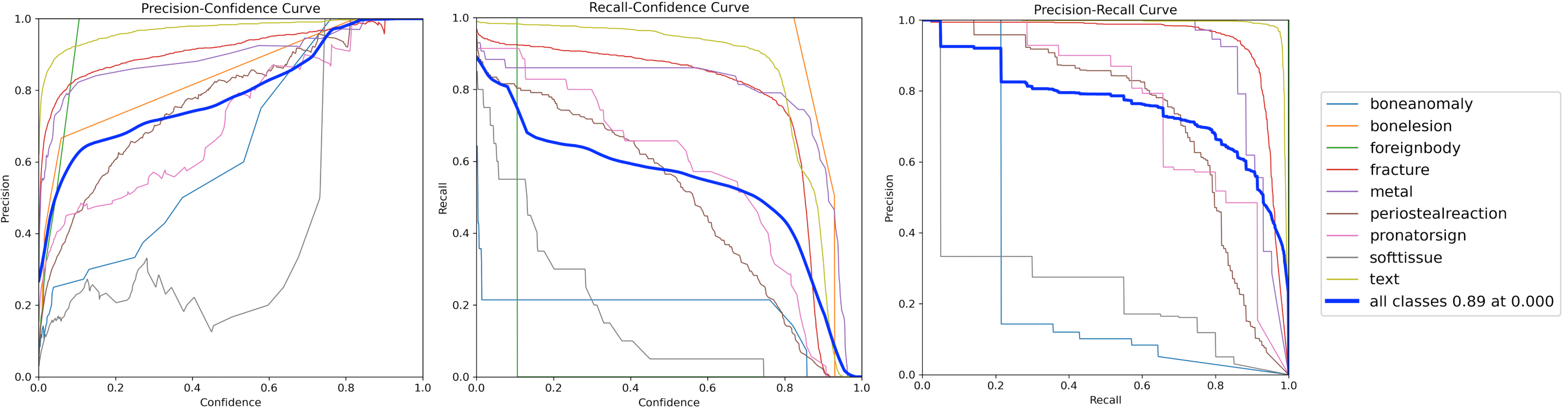
- 通过mAP@50、mAP@50-95、F1、骨折特定指标、Params和FLOPs来评估性能。
实验结果
研究问题
- RQ1YOLOv10变体在GRAZPEDWRI-DX上相对于YOLOv9在儿科手腕骨折检测上的表现如何?
- RQ2增加模型复杂度对骨折检测性能,尤其是mAP@50-95,有何影响?
- RQ3哪个YOLOv10变体在手腕病理检测方面在准确性、效率和资源使用之间提供最佳平衡?
主要发现
- YOLOv10变体通常在所有指标上优于YOLOv9变体,除了Nano变体外,X变体在mAP@50上达到最高(76.2%)。
- YOLOv10-M变体在mAP@50-95(51.9%)和所有类别(包括骨折)的最佳平衡方面表现最佳。
- 对于骨折病理,YOLOv10-M在mAP@50 94.0%、mAP@50-95 58.4%、以及骨折灵敏度92.5%。
- 将模型复杂度提高到M变体之上并不会提升mAP@50-95,反而可能降低它,表明此任务的最优模型大小为M。
- 总体而言,YOLOv10变体在参数和FLOPs较少的情况下提供了更高的性能,为GRAZPEDWRI-DX树立了新的基准。
阅读本论文
在 Nubint 阅读器中打开原文,边读边就任意段落提问。
在 Nubint 中阅读本论文本解读由 AI 根据论文原文生成,引用前请核对原文。