
[论文解读] Perceptive Locomotion through Whole-Body MPC and Optimal Region Selection
本文提出了一个具有洞察力的感知化运动框架,将表面选择与全身MPC解耦,实现50–100 Hz的在线重新规划,并提高对感知错误和打滑的鲁棒性。
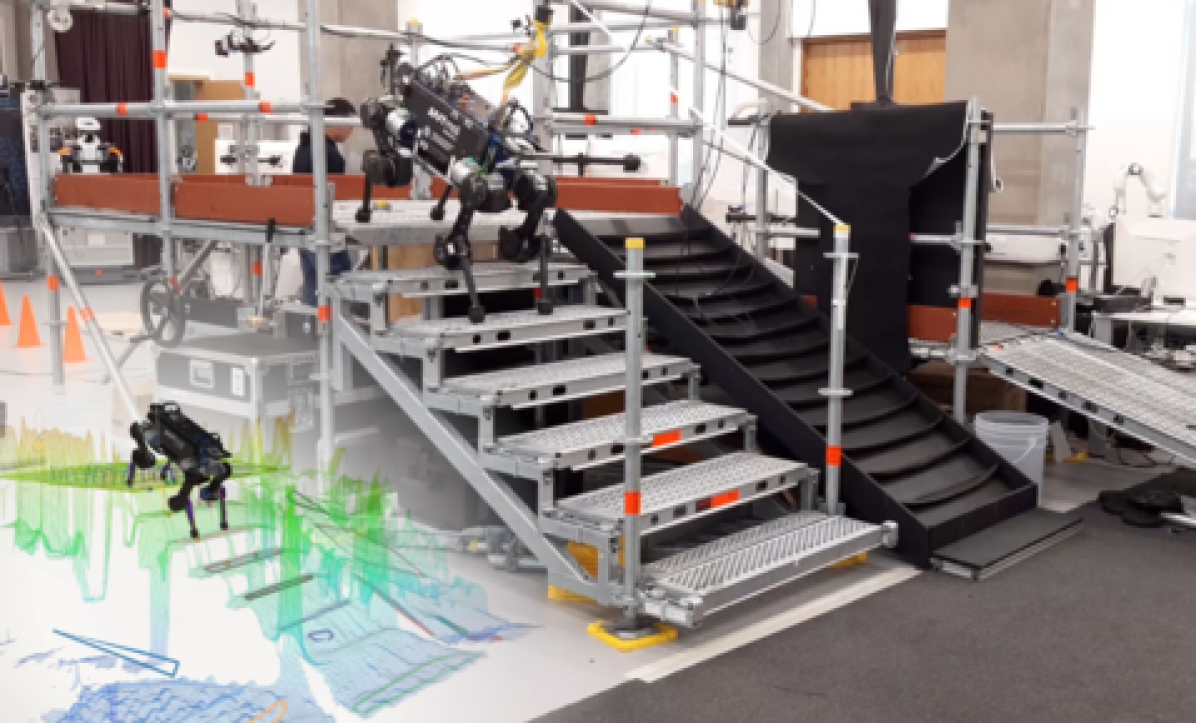
Real-time synthesis of legged locomotion maneuvers in challenging industrial settings is still an open problem, requiring simultaneous determination of footsteps locations several steps ahead while generating whole-body motions close to the robot's limits. State estimation and perception errors impose the practical constraint of fast re-planning motions in a model predictive control (MPC) framework. We first observe that the computational limitation of perceptive locomotion pipelines lies in the combinatorics of contact surface selection. Re-planning contact locations on selected surfaces can be accomplished at MPC frequencies (50-100 Hz). Then, whole-body motion generation typically follows a reference trajectory for the robot base to facilitate convergence. We propose removing this constraint to robustly address unforeseen events such as contact slipping, by leveraging a state-of-the-art whole-body MPC (Croccodyl). Our contributions are integrated into a complete framework for perceptive locomotion, validated under diverse terrain conditions, and demonstrated in challenging trials that push the robot's actuation limits, as well as in the ICRA 2023 quadruped challenge simulation.
研究动机与目标
- 在不确定的工业环境中推动实时、鲁棒的四足行走。
- 将接触规划与全身控制解耦,以实现快速的在线重新规划。
- 将地形感知、凸性表面分割和表面选择与WB-MPC集成。
- 在具有挑战性的地形以及ICRA 2023的四足仿真中演示该方法。
提出的方法
- 在以50 Hz同步更新接触位置与MPC输出的同时,将接触规划与全身MPC解耦。
- 使用一个表面选择MIP为接下来的若干步(6–8步视界)选择凸性接触表面。
- 将表面表示为从地形高程图中提取的凸平面的并集,并通过边界裕度和凸分解进行细化。
- 采用基于Bezier曲线的足端轨迹生成和无碰撞的QP在在线自适应脚步放置。
- 将带IMU、轮速计、LIDAR校正和深度相机的状态估计算整合以在约1 Hz构建高程图。
- 结合带有Riccati增益的控制器与WB-MPC在扭矩限制下综合运动。
实验结果
研究问题
- RQ1将表面选择从WB-MPC解耦是否能够在不影响可行性的前提下实现更高频率的重新规划?
- RQ2在3–5 Hz的在线表面选择与50 Hz的MPC下,鲁棒性对感知错误和接触打滑有何影响?
- RQ3凸性表面处理和边界裕度在具有挑战地形上的可靠脚步放置中扮演何种角色?
- RQ4将WB-MPC反馈纳入是否优于简化动力学方法在感知驱动运动中的表现?
主要发现
- 在50 Hz更新的表面重新定位模块为感知错误和打滑提供鲁棒性。
- 3–5 Hz的表面规划器有效地为多步未来步骤选择可行的凸表面。
- 该完整框架在具有挑战性的地形和ICRA 2023仿真中展示了最先进的运动控制。
- 凸分解和安全裕度降低了规划复杂度并提高了脚步放置的安全性。
- 带有扭矩限制和末端执行器跟踪的WB-MPC相比基线方法在抑制扰动方面表现更佳。
阅读本论文
在 Nubint 阅读器中打开原文,边读边就任意段落提问。
在 Nubint 中阅读本论文本解读由 AI 根据论文原文生成,引用前请核对原文。