
[论文解读] Performance of the low-latency GstLAL inspiral search towards LIGO, Virgo, and KAGRA's fourth observing run
本文评估了低时延GstLAL流水线在LIGO、Virgo和KAGRA第四次观测运行期间探测引力波信号的性能。结果表明,该流水线在估计啁啾质量方面具有极高精度,尤其针对双中子星和中子星-黑洞系统,平均误差低于10^{-3};同时,结束时间恢复精度达到亚毫秒级,可支持快速后续观测。
GstLAL is a stream-based matched-filtering search pipeline aiming at the prompt discovery of gravitational waves from compact binary coalescences such as the mergers of black holes and neutron stars. Over the past three observation runs by the LIGO, Virgo, and KAGRA (LVK) collaboration, the GstLAL search pipeline has participated in several tens of gravitational wave discoveries. The fourth observing run (O4) is set to begin in May 2023 and is expected to see the discovery of many new and interesting gravitational wave signals which will inform our understanding of astrophysics and cosmology. We describe the current configuration of the GstLAL low-latency search and show its readiness for the upcoming observation run by presenting its performance on a mock data challenge. The mock data challenge includes 40 days of LIGO Hanford, LIGO Livingston, and Virgo strain data along with an injection campaign in order to fully characterize the performance of the search. We find an improved performance in terms of detection rate and significance estimation as compared to that observed in the O3 online analysis. The improvements are attributed to several incremental advances in the likelihood ratio ranking statistic computation and the method of background estimation.
研究动机与目标
- 评估GstLAL流水线在LIGO、Virgo和KAGRA第四次观测运行期间的低时延检测性能。
- 量化关键引力波参数(包括啁啾质量、有效旋进自旋、质量比和并合结束时间)的参数估计精度。
- 通过提供瞬态引力波事件的准确初始参数估计,支持快速后续观测。
- 通过分析搜索结果导出的先验质量,为后续贝叶斯参数估计流水线(如Bilby)提供信息支持。
提出的方法
- 本研究使用大规模模拟引力波注入,覆盖双中子星(BNS)、中子星-黑洞(NSBH)和双黑洞(BBH)参数空间。
- 采用2.31 × 10^{-5} Hz的误报率(FAR)阈值,筛选显著触发事件,以评估检测性能。
- 通过比较注入值与GstLAL流水线恢复值,量化参数估计精度,误差指标定义为(恢复值 - 注入值)/注入值(适用于参数),以及结束时间的绝对差值。
- 分析包括注入值与恢复值的散点图,以及估计误差的直方图,以可视化偏差与不确定性。
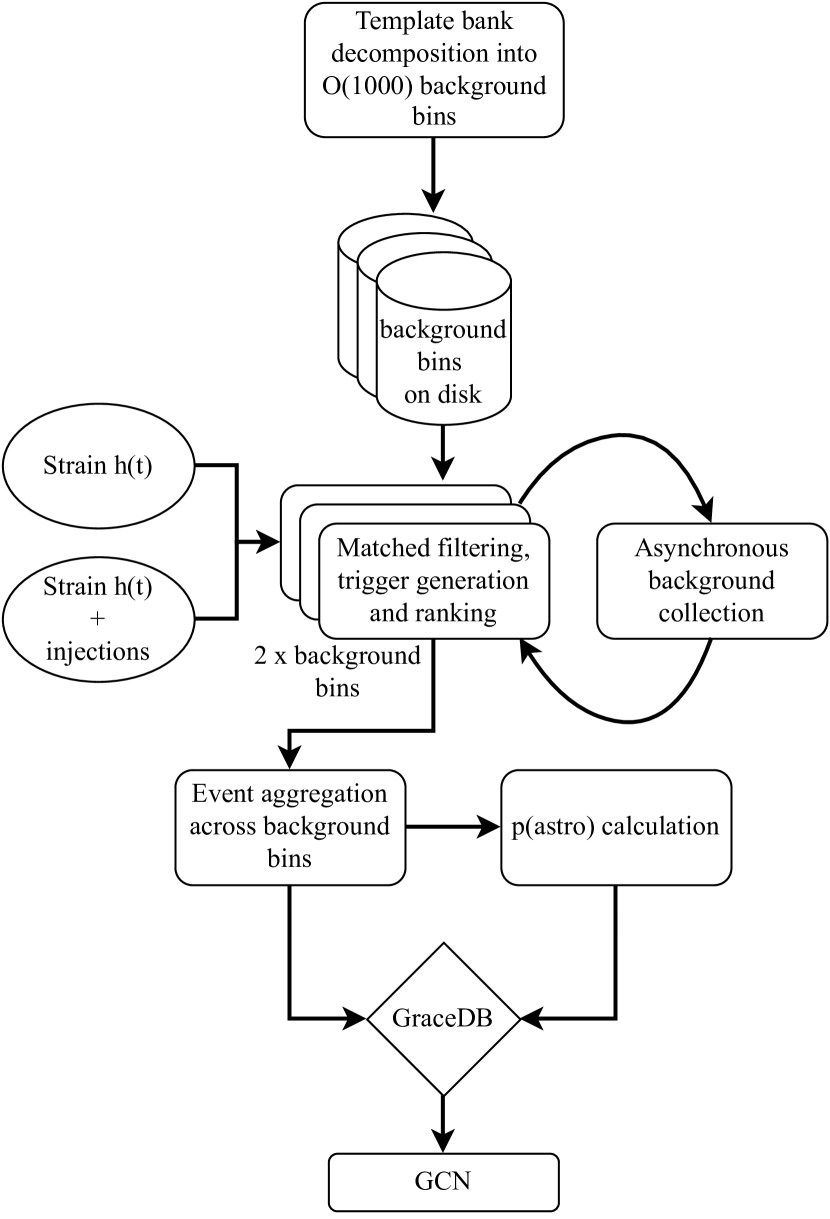
- 流水线采用匹配滤波技术,结合模板波形库,在LIGO、Virgo和KAGRA的实时数据流中识别触发事件。
- 计算各类注入与各探测器之间误差的均值与标准差,以评估结果的一致性与可靠性。
实验结果
研究问题
- RQ1在O4期间,GstLAL流水线对不同双星系统啁啾质量的恢复精度如何?
- RQ2该流水线在BNS、NSBH和BBH注入中估计有效旋进自旋与质量比的性能如何?
- RQ3在LIGO Hanford、LIGO Livingston和Virgo探测器中,并合结束时间的估计精度如何?
- RQ4参数估计误差在信噪比和源类方面如何变化?
- RQ5恢复的参数分布在多大程度上影响下游贝叶斯推断流水线(如Bilby)中先验的选择?
主要发现
- 双中子星系统中,啁啾质量恢复的平均误差为2.06 × 10^{-4},标准差为8.33 × 10^{-4},表明精度极高。
- 中子星-黑洞系统中,啁啾质量平均误差为-2.14 × 10^{-4},标准差为6.26 × 10^{-3},显示中等但可接受的精度。
- 双黑洞系统中,啁啾质量误差最大,平均值为1.54 × 10^{-1},标准差为4.53 × 10^{-1},反映出因质量更高导致的更大不确定性。
- 所有源类与探测器中,恢复的结束时间平均差异为6.23毫秒,且在单个探测器的直方图中观察到亚毫秒级精度。
- 注入值与恢复的有效自旋(χ_eff)和质量比(q)之间相关性极低,表明偏差较小,但这些参数存在中等程度的离散性。
- 参数估计精度支持在Bilby中对BNS和NSBH系统采用窄先验,而BBH系统由于不确定性较大,需采用更宽的先验。
阅读本论文
在 Nubint 阅读器中打开原文,边读边就任意段落提问。
在 Nubint 中阅读本论文本解读由 AI 根据论文原文生成,引用前请核对原文。