
[论文解读] Phase-space analysis of a novel cosmological model in $f(Q)$ theory
该论文提出了一种新颖的 $f(Q)$ 引力模型,采用空间平坦 FLRW 时空中的非零仿射联络,打破了与 $f(T)$ 理论的简并性。通过动力系统相空间分析,识别出晚期加速的稳定 de Sitter 吸引子,以及物质/辐射时期的不稳定不动点,展示了无需标量场的完整宇宙演化序列。
The vanishing affine connections have been used solely while adopting the modified $f(Q)$ gravity theory to the cosmology. Consequently, researchers could not get beyond what is already known in $f(T)$ theory earlier. To alleviate this problem, in the present manuscript we investigate a recently proposed construction of $f(Q)$ theory using non-vanishing affine connection in the spatially flat FLRW spacetime. We then investigate the cosmological solutions of $f(Q)$ theory for a perfect fluid through the phase space analysis. We introduce few variables and dimensionless parameters to construct the corresponding equations suitable for the dynamical system approach. The conservation of the energy-momentum tensor leads to a constraint equation that relates the dynamical variables. Briefly, both unstable and stable de Sitter solutions appear which correspond to early and late times accelerated expansions. Also, unstable points corresponding to the matter dominated and radiation dominated eras have been found which do exist for every $f(Q)$ function. As a result, the present discussion shows that $f(Q)$ gravity endowed by non-vanishing affine connections is capable of explaining a true sequence of cosmic eras.
研究动机与目标
- 为克服现有 $f(Q)$ 宇宙学研究中仅依赖零仿射联络的局限性,后者会重现 $f(T)$ 的结果。
- 提出一种使用非零、无扭转仿射联络(由 $\gamma(t)$ 参数化)的 $f(Q)$ 引力新形式,确保其动力学与 $f(T)$ 理论相区分。
- 利用动力系统理论分析新 $f(Q)$ 模型的宇宙学解,重点关注不动点及其稳定性。
- 证明该模型能够描述完整的宇宙时期序列:早期 de Sitter(暴胀)、物质主导和晚期 de Sitter(暗能量)阶段。
- 表明该模型无需引入辅助标量场,仅通过引力几何修正即可实现上述演化。
提出的方法
- 在空间平坦 FLRW 度规中,使用非零仿射联络 $\Gamma^\lambda_{\mu\nu}$(曲率与扭转均为零),引入时间依赖参数 $\gamma(t)$,构建 $f(Q)$ 引力。
- 从作用量 $\mathcal{L} = \sqrt{-g} f(Q)$ 推导出场方程、能量密度和压强,其中 $Q$ 为非度规性标量。
- 通过强制能量-动量张量守恒,导出关联动力变量的约束方程,从而实现动力系统的闭合。
- 引入无量纲变量 $x_1, x_2, x_3$,将系统转化为适合相空间分析的自治形式。
- 通过识别临界点并利用线性化与特征值分析评估其稳定性,分析所得动力系统。
- 研究特定模型:$f(Q) = \alpha Q^\beta$,$f(Q) = \eta Q + \zeta Q^\sigma$,以及 $f(Q) = \xi e^{\chi Q}$,分别在 $\gamma(t)$ 变化与恒定两种情形下。
实验结果
研究问题
- RQ1在 $f(Q)$ 引力中,非零仿射联络是否能产生与 $f(T)$ 理论不同的宇宙学动力学?
- RQ2所提出的 $f(Q)$ 模型中,依赖 $\gamma(t)$ 的联络是否能在早期和晚期均支持稳定的 de Sitter 解?
- RQ3该模型能否自然地描述宇宙时期序列——辐射主导、物质主导和晚期加速——而无需外部标量场?
- RQ4参数 $\gamma(t)$ 在塑造相空间结构与不动点稳定性方面起什么作用?
- RQ5不同形式的 $f(Q)$ 如何影响不动点的存在性与性质,特别是与加速膨胀相关的不动点?
主要发现
- 采用非零仿射联络的模型产生与 $f(T)$ 理论不同的弗里德曼型方程,打破了先前的简并性。
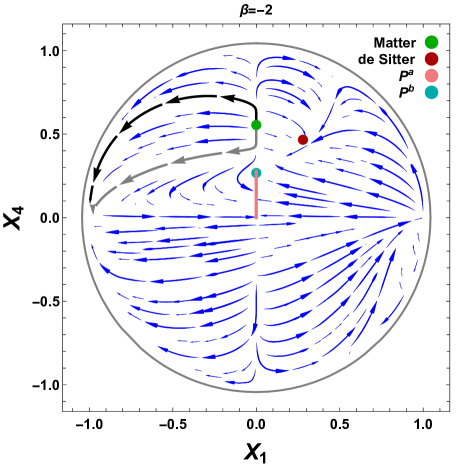
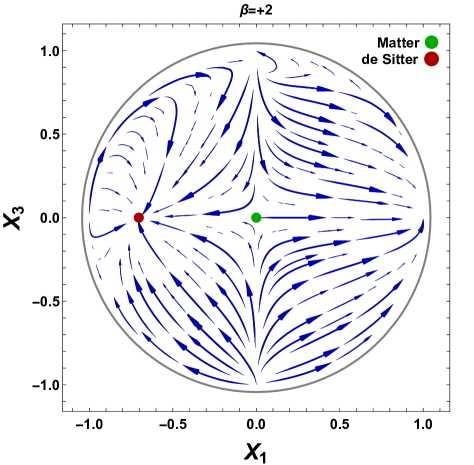
- 对于 $f(Q) = \alpha Q^\beta$,晚期存在稳定的 de Sitter 不动点,早期存在不稳定的物质主导不动点,轨迹从后者演化至前者。
- 在 $f(Q) = \xi e^{\chi Q}$ 模型中,存在两个 de Sitter 不动点:一个不稳定(早期暴胀),一个稳定(晚期加速),支持从早期到晚期 de Sitter 阶段的过渡。
- 在 $f(Q) = \xi e^{\chi Q}$ 模型中,相空间轨迹显示从 $R^{ds}_e$(早期 de Sitter)演化至 $R^{ds}_l$(晚期 de Sitter),且当初始值较小时,晚期 $x_1$ 值接近零。
- 在 $f(Q) = \eta Q + \zeta Q^\sigma$ 模型中,无法支持物质主导不动点,表明与标准宇宙演化不相容。
- 某些模型中存在孤立的稳定不动点,其有效状态方程参数 $w^{\text{eff}} < -1/3$,表明存在加速膨胀,但与物质主导点无连接,暗示存在替代的晚期动力学行为。
阅读本论文
在 Nubint 阅读器中打开原文,边读边就任意段落提问。
在 Nubint 中阅读本论文本解读由 AI 根据论文原文生成,引用前请核对原文。