
[论文解读] Physics-Informed Localized Learning for Advection-Diffusion-Reaction Systems
该论文提出了一种物理信息局部化学习方法,通过学习全局状态变量的局部表示,加速了对对流-扩散-反应系统的代理模型训练。与E2C/E2CO模型相比,其训练速度最高提升18倍——将3D油藏模拟的训练时间从47.2小时缩短至2.6小时,同时在预测压力和饱和度方面保持高精度,平均绝对误差分别为50–125 psi和0.002–0.007(分数)。
The global push to advance Carbon Capture and Sequestration initiatives and green energy solutions, such as geothermal, have thrust new demands upon the current state-of-the-art subsurface fluid simulators. The requirement to be able to simulate a large order of reservoir states simultaneously, in a short period of time, has opened the door of opportunity for the application of machine learning techniques for surrogate modelling. We propose a novel physics-informed and boundary condition-aware Localized Learning method which extends the Embed-to-Control (E2C) and Embed-to-Control and Observe (E2CO) models to learn local representations of global state variables in an Advection-Diffusion Reaction system. Trained on reservoir simulation data, we show that our model is able to predict future states of the system, for a given set of controls, to a great deal of accuracy with only a fraction of the available information. It hence reduces training times significantly compared to the original E2C and E2CO models, lending to its benefit in application to optimal control problems.
研究动机与目标
- 为解决碳捕集与地热能开发中地下流体模拟的计算瓶颈,实现快速、精确的代理建模。
- 在不牺牲预测精度的前提下,缩短基于机器学习的对流-扩散-反应系统代理模型的训练时间。
- 开发一种局部化学习方法,通过聚焦于局部状态表示,高效捕捉非线性动力学。
- 将物理信息损失整合到学习框架中,以提升泛化能力和精度。
- 通过局部化、物理感知的学习,加速推理与训练,实现实时油藏模拟最优控制。
提出的方法
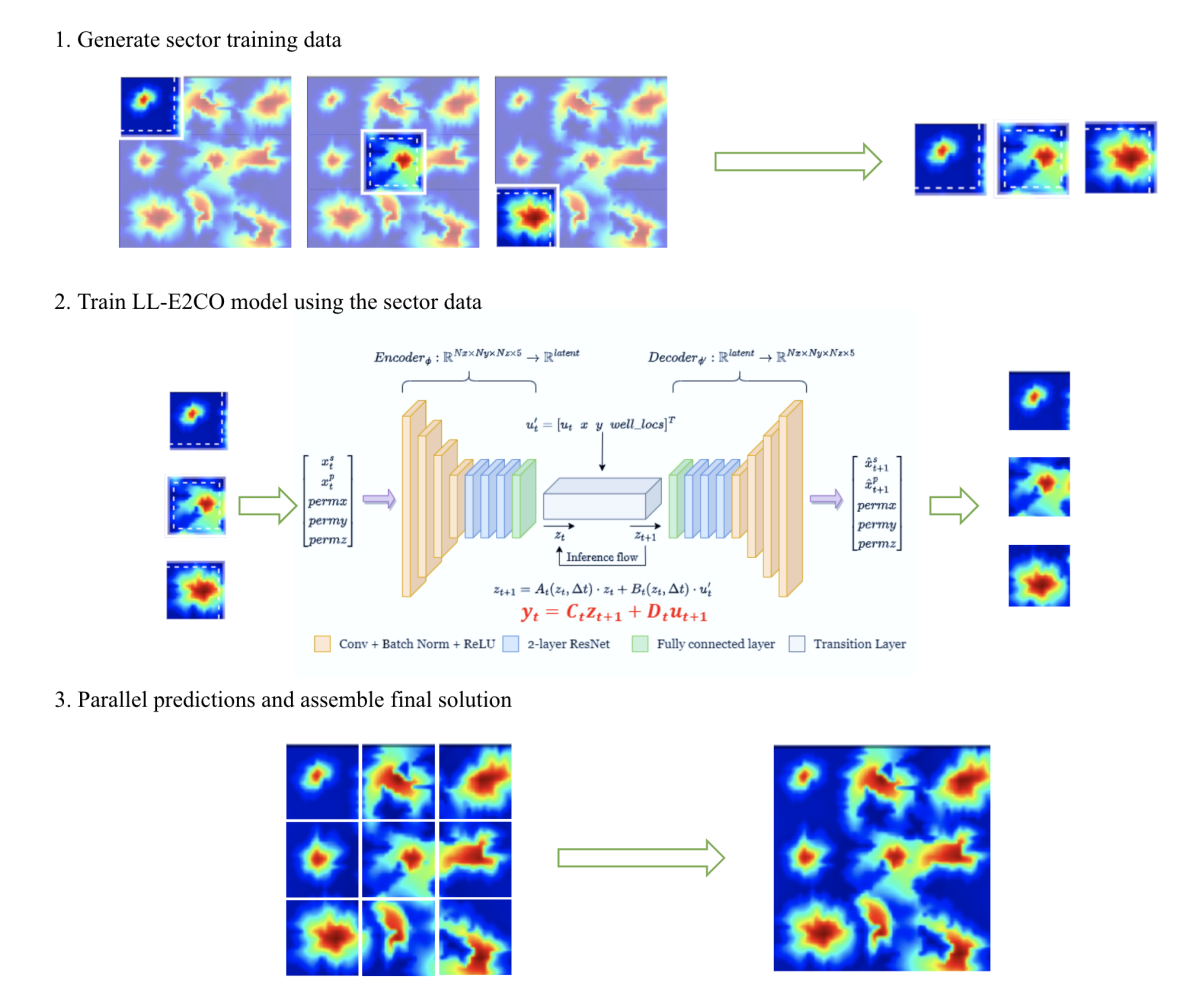
- 该方法在Embed-to-Control (E2C) 和 Embed-to-Control and Observe (E2CO) 的基础上,引入了局部化学习,使模型能够学习对流-扩散-反应系统中全局状态变量的局部表示。
- 采用变分自编码器将全状态场嵌入潜在空间,随后通过局部线性转移模型,从控制输入预测未来状态。
- 引入物理信息损失,以确保与底层ADR偏微分方程的一致性,从而提升泛化能力和精度。
- 模型在油藏模拟数据上进行训练,仅使用可用信息的一小部分来预测系统未来状态。
- 该方法支持批量推理,可在多个控制配置上并行评估,适用于最优控制应用。
- 该方法在包含60×220×40网格的2D和3D ADR系统上进行了评估,采用扇形单元的局部推理策略。
实验结果
研究问题
- RQ1局部化学习是否能在保持预测精度的前提下,缩短对流-扩散-反应系统代理建模的训练时间?
- RQ2物理信息正则化在地下流体模拟中如何提升局部化机器学习模型的泛化能力?
- RQ3在部分数据上训练的模型,能在多大程度上预测对流-扩散-反应系统中全状态的演化?
- RQ4模型在预测压力(全局变量)方面的表现与饱和度(更局部的变量)相比如何?
- RQ5该局部化学习框架是否能通过加速推理与训练,实现实时油藏模拟最优控制?
主要发现
- 3D 60×220×40案例的训练时间从E2C模型的47.2小时缩短至LL-E2C模型的2.6小时,提速18倍。
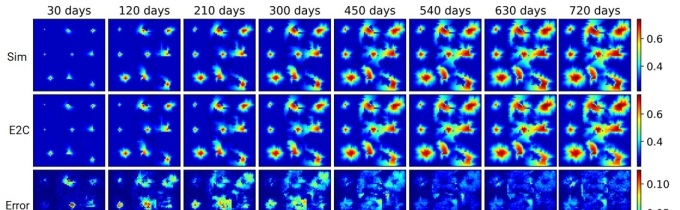
- LL-E2C模型在所有测试案例中对压力的平均绝对误差为50–125 psi,对饱和度的平均绝对误差为0.002–0.007(分数)。
- LL-E2CO模型在所有时间步长内,对场产量的预测误差均控制在模拟器结果的5%以内,即使在后期预测中也保持稳定。
- 物理信息损失显著提升了精度,尤其在高非线性区域(如波前区域)表现突出。
- 与高保真求解器相比,推理速度提升达10^4倍,支持高效批量处理,适用于最优控制问题。
- 模型在饱和度预测上表现优于压力,可能是因为后者是更全局的状态变量。
阅读本论文
在 Nubint 阅读器中打开原文,边读边就任意段落提问。
在 Nubint 中阅读本论文本解读由 AI 根据论文原文生成,引用前请核对原文。