
[论文解读] Pixel-Aware Stable Diffusion for Realistic Image Super-resolution and Personalized Stylization
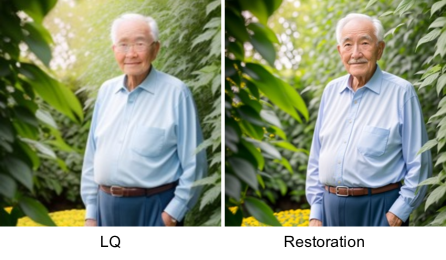
PASD 将像素感知交叉注意力机制与降解移除和高层次语义信号结合起来,利用预训练的扩散先验实现 Real-ISR 和个性化风格化,而无需额外的图像空间训练。
Diffusion models have demonstrated impressive performance in various image generation, editing, enhancement and translation tasks. In particular, the pre-trained text-to-image stable diffusion models provide a potential solution to the challenging realistic image super-resolution (Real-ISR) and image stylization problems with their strong generative priors. However, the existing methods along this line often fail to keep faithful pixel-wise image structures. If extra skip connections between the encoder and the decoder of a VAE are used to reproduce details, additional training in image space will be required, limiting the application to tasks in latent space such as image stylization. In this work, we propose a pixel-aware stable diffusion (PASD) network to achieve robust Real-ISR and personalized image stylization. Specifically, a pixel-aware cross attention module is introduced to enable diffusion models perceiving image local structures in pixel-wise level, while a degradation removal module is used to extract degradation insensitive features to guide the diffusion process together with image high level information. An adjustable noise schedule is introduced to further improve the image restoration results. By simply replacing the base diffusion model with a stylized one, PASD can generate diverse stylized images without collecting pairwise training data, and by shifting the base model with an aesthetic one, PASD can bring old photos back to life. Extensive experiments in a variety of image enhancement and stylization tasks demonstrate the effectiveness of our proposed PASD approach. Our source codes are available at \url{https://github.com/yangxy/PASD/}.
研究动机与目标
- 推动 Real-ISR 在不产生来自 GAN 基方法的伪影的情况下恢复感知上真实的纹理。
- 利用预训练的扩散先验(如 Stable Diffusion)进行鲁棒的图像恢复和风格化。
- 通过像素感知交叉注意力模块引入像素级引导以保留结构。
- 通过降解去除模块缓解未知的真实世界降解。
- 证明通过替换基础扩散模型,PASD 支持个性化风格化。
提出的方法
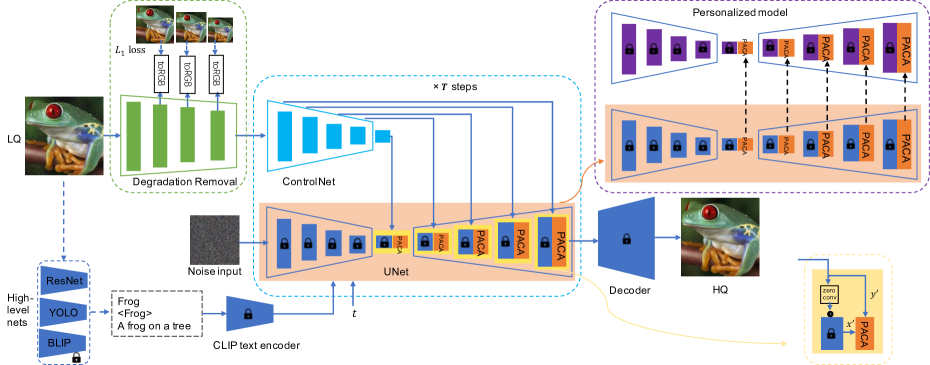
- 引入 Pixel-Aware Cross Attention (PACA),将条件输入的像素级信息传递给扩散 UNet,且不使用跳过连接。
- 添加降解去除模块,使用带有 toRGB 监督和多尺度的 L1 损失(L_DR)的金字塔特征提取器。
- 结合高层信息提取(分类/检测/字幕)和基于 CLIP 的文本引导,并使用无分类器引导进行条件化。
- 通过优化扩散损失 L_DF 及辅助的 L_DR 损失来训练;冻结预训练的 SD,训练新增模块(PACA、降解去除、ControlNet)以及高层信息路径。
- 通过将基础扩散模型替换为个性化模型(无需额外训练)来实现个性化风格化,作为一种风格迁移。
- 在推理阶段可选地使用负提示以改善模式覆盖。
实验结果
研究问题
- RQ1通过 PACA 的像素级条件是否可以在不增加图像空间训练伪影的情况下提升 Real-ISR 输出的保真度?
- RQ2在现实世界降解下,降解鲁棒特征提取是否能提升基于扩散的恢复?
- RQ3高层次语义信号(字幕/检测/分类)是否能进一步提升 Real-ISR 的性能?
- RQ4仅通过更换基础扩散模型,PASD 是否能够实现有效的个性化风格化?
- RQ5在感知指标上,PASD 相比基于 GAN 的和其他基于扩散的 Real-ISR 方法表现如何?
主要发现
- PASD 在 RealSR 和 DRealSR 上,於 MUSIQ 及其他感知指标上,达到比基于 GAN 的 Real-ISR 方法更强的感知质量。
- PASD 在大多数感知指标上优于竞争的基于扩散的 Real-ISR 方法,并在测试数据集上获得最佳的 MUSIQ 分数。
- 消融实验表明 PACA 对保持像素精确的结构和纹理至关重要;移除它会降低颜色/结构保真度。
- 降解去除和高层信息提升结果;移除它们会导致输出更为污浊且指标更差。
- 通过切换到个性化扩散模型,PASD 实现个性化风格化,保留像素级细节比某些基线更好。
- 用户研究表明更偏好 PASD 的 Real-ISR 和风格化任务。
阅读本论文
在 Nubint 阅读器中打开原文,边读边就任意段落提问。
在 Nubint 中阅读本论文本解读由 AI 根据论文原文生成,引用前请核对原文。