
[论文解读] Posterior Collapse and Latent Variable Non-identifiability
论文证明在变分自编码器中的后验塌陷等价于潜变量的不可识别性,并引入潜变量可识别的 VAE(lidvae),使用 Brenier 映射和输入凸神经网络来确保可识别性,同时不改变 VAE 的目标函数。
Variational autoencoders model high-dimensional data by positing low-dimensional latent variables that are mapped through a flexible distribution parametrized by a neural network. Unfortunately, variational autoencoders often suffer from posterior collapse: the posterior of the latent variables is equal to its prior, rendering the variational autoencoder useless as a means to produce meaningful representations. Existing approaches to posterior collapse often attribute it to the use of neural networks or optimization issues due to variational approximation. In this paper, we consider posterior collapse as a problem of latent variable non-identifiability. We prove that the posterior collapses if and only if the latent variables are non-identifiable in the generative model. This fact implies that posterior collapse is not a phenomenon specific to the use of flexible distributions or approximate inference. Rather, it can occur in classical probabilistic models even with exact inference, which we also demonstrate. Based on these results, we propose a class of latent-identifiable variational autoencoders, deep generative models which enforce identifiability without sacrificing flexibility. This model class resolves the problem of latent variable non-identifiability by leveraging bijective Brenier maps and parameterizing them with input convex neural networks, without special variational inference objectives or optimization tricks. Across synthetic and real datasets, latent-identifiable variational autoencoders outperform existing methods in mitigating posterior collapse and providing meaningful representations of the data.
研究动机与目标
- 澄清变分自编码器中后验塌陷与潜在变量不可识别性之间的联系。
- 证明后验塌陷不仅在神经网络增强的 VAE 中出现,在具有精确推断的经典模型中也可能出现。
- 提出并验证潜在可识别的 VAE(lidvae),在不修改变分目标的前提下强制可识别性。
- 证明 lidvae 在合成数据和真实数据上保持数据保真度的同时减缓后验塌陷。
提出的方法
- 形式化地定义后验塌陷和潜在变量不可识别性,并证明它们的等价性(定理 1)。
- 论证可识别性取决于模型和数据,而不仅仅取决于推断或优化。
- 通过使用参数化为输入凸神经网络(icNN)的 Brenier 映射来强制注入性来构建 lidvae,使 p(x|z) 的映射具有可识别性。
- 使用带有对角线-零一矩阵的两步 Brenier 映射组合来构建 p(x|z) 的注入映射。
- 表明 lidvae 以与经典 VAE 相同的推断过程(ELBO 优化)保持不变,同时保证可识别性(命题 2)。
- 将 lidvae 扩展到潜在可识别混合模型(lidmvae)和顺序变体(lidsvae),并具有类似的注入映射。
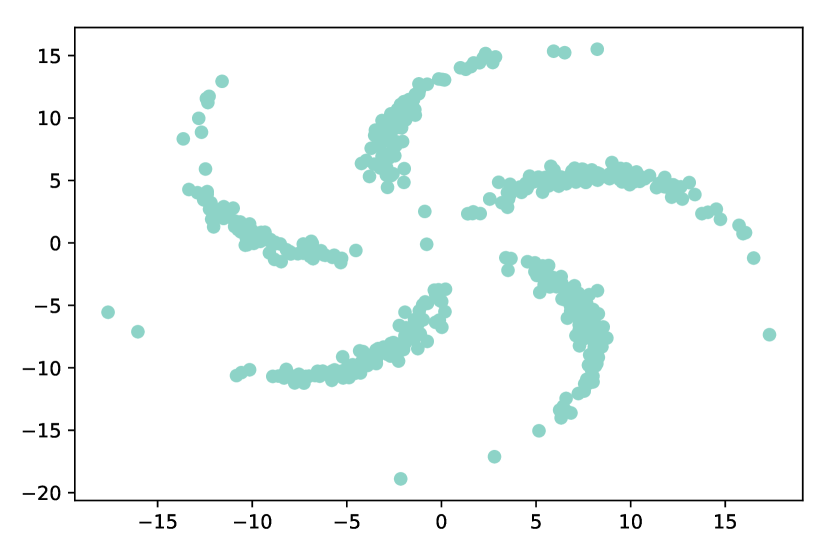
实验结果
研究问题
- RQ1后验塌陷是否本质上与生成模型中的潜在变量不可识别性相关?
- RQ2是否可以在不改变 VAE 目标或推断过程的情况下实现潜在变量的可识别性?
- RQ3潜在可识别的 VAE(lidvae)在保持或提升数据保真度的同时是否能减缓后验塌陷?
- RQ4Brenier 映射和输入凸神经网络是否提供一种可行且可扩展的途径以在 VAE 中实现可识别性?
- RQ5可识别的混合模型和顺序 VAE 的变体(lidmvae、lidsvae)是否将可识别性益处推广到标准 VAE 之外?
主要发现
- 如果且仅如果生成模型中的潜在变量不可识别,则会发生后验塌陷(定理 1)。
- 潜在可识别的 VAE(lidvae)通过使用由输入凸神经网络参数化的 Brenier 映射构造一个注入的似然,从而保证潜在变量的可识别性。
- lidvae 在避免后验塌陷的同时保留标准 VAE 推断目标和能力,代价是增加了计算复杂度。
- 诸如 lidmvae 和 lidsvae 的潜在可识别变体将可识别性益处扩展到混合和顺序 VAE。
- 实证结果表明 lidvae 在合成数据和真实数据集上缓解后验塌陷方面优于现有 VAE,同时不牺牲对数据的拟合。
阅读本论文
在 Nubint 阅读器中打开原文,边读边就任意段落提问。
在 Nubint 中阅读本论文本解读由 AI 根据论文原文生成,引用前请核对原文。