
[论文解读] Pre-optimizing variational quantum eigensolvers with tensor networks
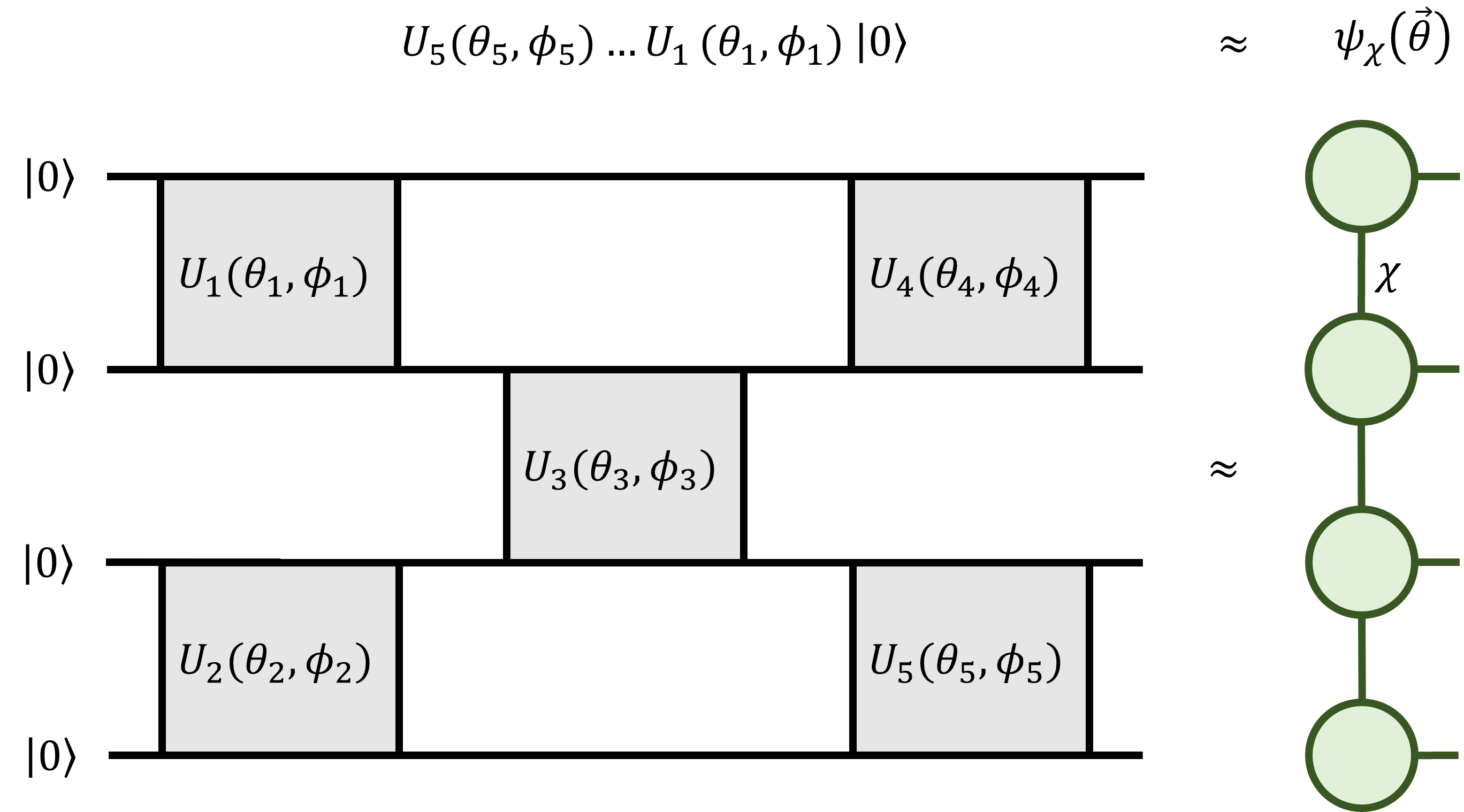
本论文引入 VTNE,一种对 VQE 的经典前优化,其中将参数化量子电路近似为矩阵乘积态以找到良好初始参数,然后用于在量子硬件上对一维和二维费米哈德模型的 VQE 进行初始化。
The variational quantum eigensolver (VQE) is a promising algorithm for demonstrating quantum advantage in the noisy intermediate-scale quantum (NISQ) era. However, optimizing VQE from random initial starting parameters is challenging due to a variety of issues including barren plateaus, optimization in the presence of noise, and slow convergence. While simulating quantum circuits classically is generically difficult, classical computing methods have been developed extensively, and powerful tools now exist to approximately simulate quantum circuits. This opens up various strategies that limit the amount of optimization that needs to be performed on quantum hardware. Here we present and benchmark an approach where we find good starting parameters for parameterized quantum circuits by classically simulating VQE by approximating the parameterized quantum circuit (PQC) as a matrix product state (MPS) with a limited bond dimension. Calling this approach the variational tensor network eigensolver (VTNE), we apply it to the 1D and 2D Fermi-Hubbard model with system sizes that use up to 32 qubits. We find that in 1D, VTNE can find parameters for PQC whose energy error is within 0.5% relative to the ground state. In 2D, the parameters that VTNE finds have significantly lower energy than their starting configurations, and we show that starting VQE from these parameters requires non-trivially fewer operations to come down to a given energy. The higher the bond dimension we use in VTNE, the less work needs to be done in VQE. By generating classically optimized parameters as the initialization for the quantum circuit one can alleviate many of the challenges that plague VQE on quantum computers.
研究动机与目标
- 解决在 NISQ 设备上的 VQE 优化时的挑战(梯度荒原、噪声、收敛缓慢)。
- 提出 VTNE,用张量网络在经典层面对 PQCs 进行预优化。
- 在 1D 和 2D 费米哈德模型上演示该方法,量子比特数达 32 个。
- 量化 MPS 纽带维数(bond dimension)如何影响经典预优化以及量子资源的节省。
提出的方法
- 用 TEBD 收缩将参数化量子电路(PQC)表示为固定结合维 chi 的矩阵乘积态(MPS)。
- 对哈密顿量使用矩阵乘积算符(MPO)来计算近似能量 E_chi(theta) = <psi_chi(theta)|H|psi_chi(theta)>。
- 通过一个路径计算近似梯度,该路径使用两次电路评估来更新 L 和 R MPS 因子(式(7-11)),并在递归过程中截断到 bond dimension chi。
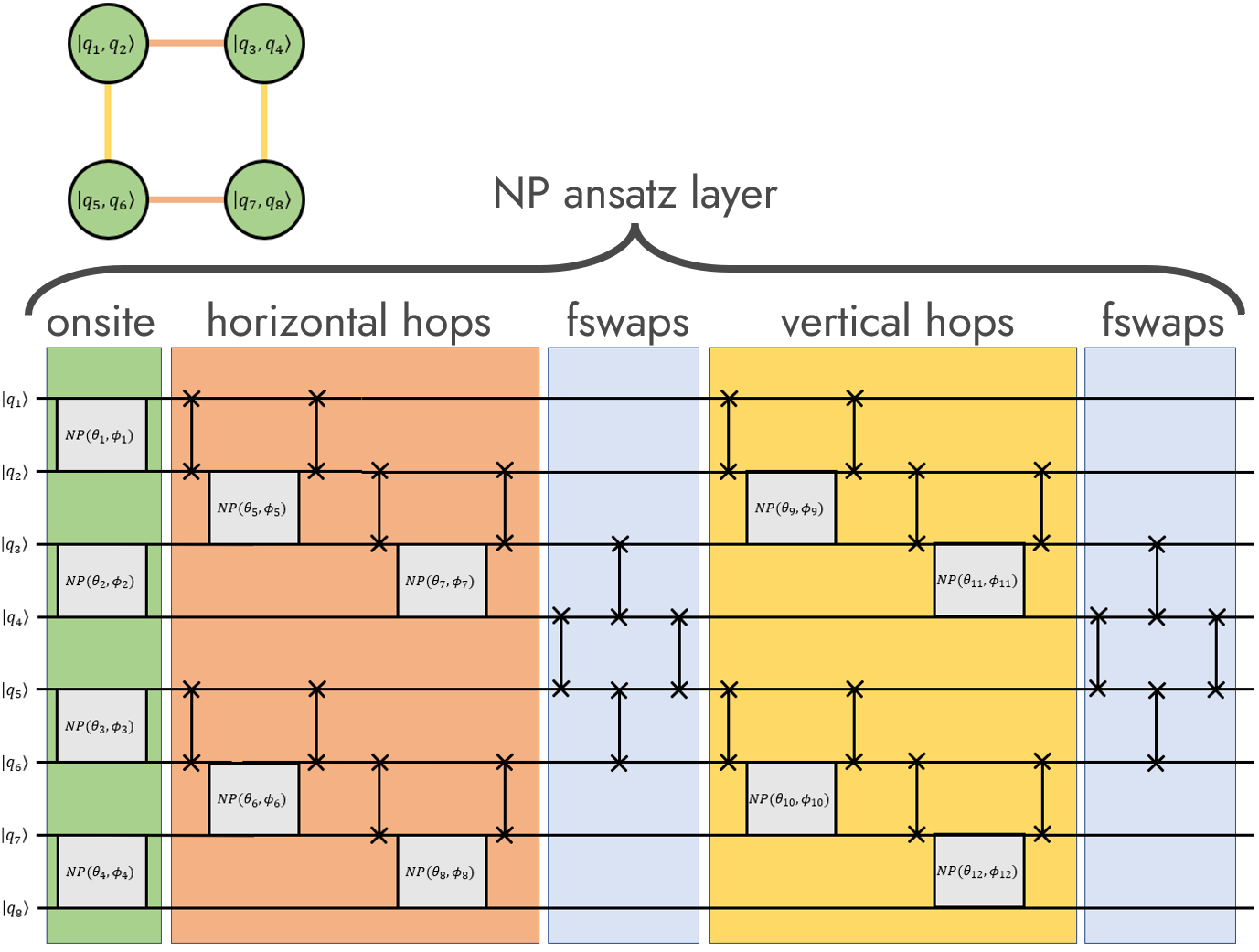
- 从非相互作用(U=0)的优化参数初始化进入相互作用(U=2)的优化,以助收敛。
- 使用 ITensor 实现张量网络计算。
- 将 PTNE 预优化参数与在 Adam 优化下的 VQE 随机初始化进行对比。
实验结果
研究问题
- RQ1经典 VTNE 预优化是否能够为在量子硬件上的 VQE 提供高质量的初始参数?
- RQ2MPS 结合维数 chi 如何影响 VTNE 预计算参数的精度以及随后的 VQE 能量?
- RQ3VTNE 初始化的 VQE 运算是否比随机初始化需要更少的量子资源(门操作)以达到目标能量?
- RQ4VTNE 在 1D 与 2D 费米-哈伯模型上的表现有何差异?
- RQ5VTNE 结果与这些系统的既定经典基准(例如 DMRG)之间的关系是怎样的?
主要发现
- 在 1D 中,VTNE 在适用参数下可实现相对于基态的能量误差在 0.5% 以内。
- 在 2D 中,VTNE 推导的参数比随机起始的能量显著更低,且预优化减少后续 VQE 的工作量。
- 增加 MPS 的结合维数 chi 会降低能量误差以及 VQE 需要的梯度评估次数。
- 对于 1D 系统,达到 32 个量子比特时,chi_b = 16 的相对能量误差为 ≲3%。
- 从经经典优化的 VTNE 参数开始的 VQE 比从随机参数开始需要显著更少的梯度评估(在给定案例中约节省 ~400-1000 步)。
- 在 VQE 过程中使用更大的 MPS 结合维数进行收缩(chi_a > chi_b)可得到与 chi_b 相当甚至更好的能量,表明在硬件上运行时可能获得收益。
阅读本论文
在 Nubint 阅读器中打开原文,边读边就任意段落提问。
在 Nubint 中阅读本论文本解读由 AI 根据论文原文生成,引用前请核对原文。