
[论文解读] Pre-Trained Large Language Models for Industrial Control
该论文研究在 BEAR 中将 GPT-4 作为无训练成本的 HVAC 控制器,表现与 PPO 和 MPC 相当,且数据需求低,并对演示和提示设计进行了广泛消融研究与提示设计。
For industrial control, developing high-performance controllers with few samples and low technical debt is appealing. Foundation models, possessing rich prior knowledge obtained from pre-training with Internet-scale corpus, have the potential to be a good controller with proper prompts. In this paper, we take HVAC (Heating, Ventilation, and Air Conditioning) building control as an example to examine the ability of GPT-4 (one of the first-tier foundation models) as the controller. To control HVAC, we wrap the task as a language game by providing text including a short description for the task, several selected demonstrations, and the current observation to GPT-4 on each step and execute the actions responded by GPT-4. We conduct series of experiments to answer the following questions: 1)~How well can GPT-4 control HVAC? 2)~How well can GPT-4 generalize to different scenarios for HVAC control? 3) How different parts of the text context affect the performance? In general, we found GPT-4 achieves the performance comparable to RL methods with few samples and low technical debt, indicating the potential of directly applying foundation models to industrial control tasks.
研究动机与目标
- 使用基础模型实现低样本、低负债的工业任务控制的动机。
- 证明一个预训练的大语言模型能够在不同建筑与天气条件下通过少量演示来控制 HVAC。
- 设计演示选择、翻译器和提示生成机制以实现上下文控制。
- 分析演示类型和数量如何影响 GPT-4 的控制性能。
- 提供消融分析以指导未来使用大语言模型的低负债工业控制。
提出的方法
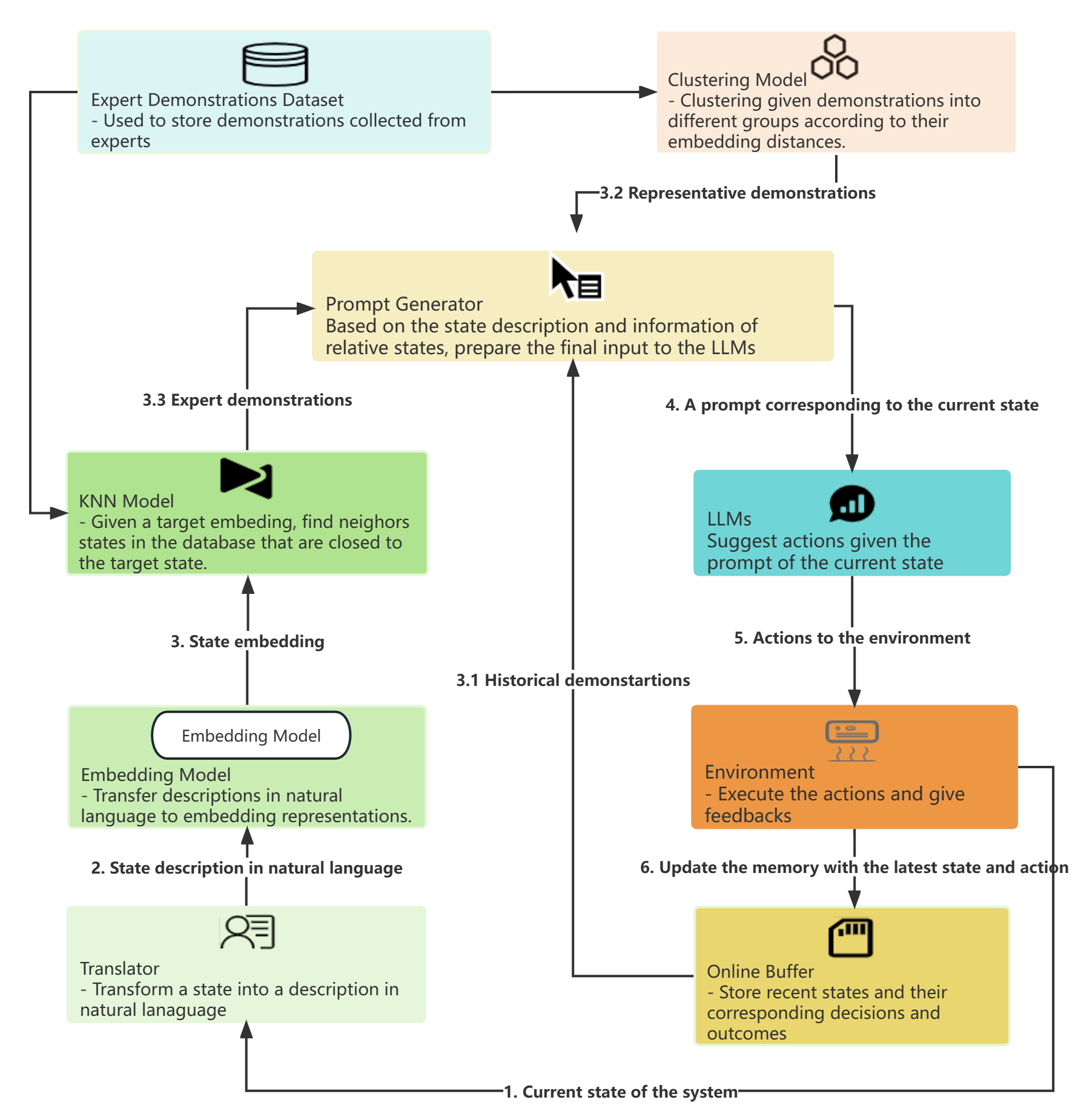
- 将 GPT-4 用作决策者,在 BEAR 环境中控制 HVAC。
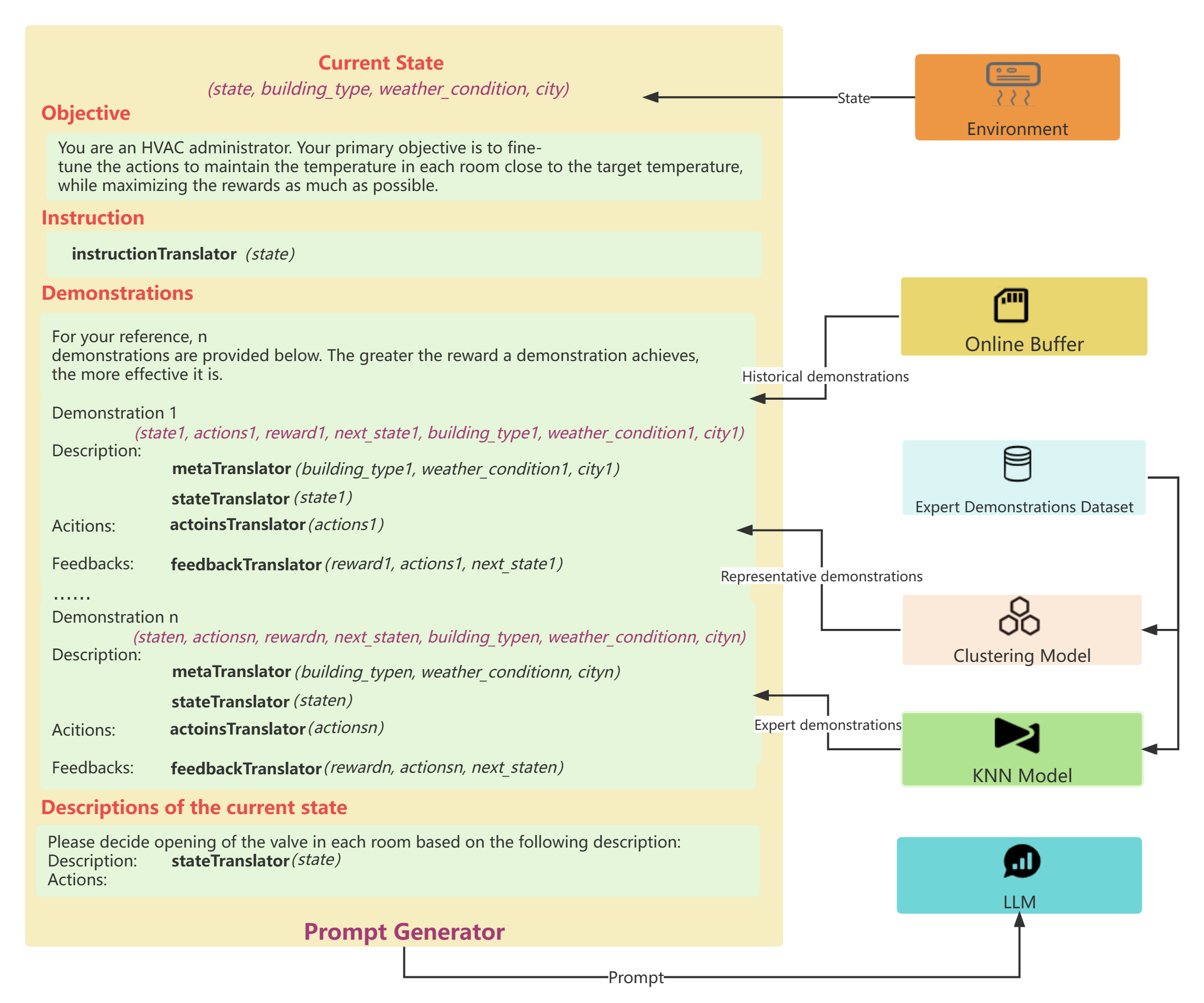
- 引入翻译器栈,将数值状态/动作转换为自然语言以供 LLM 使用。
- 实现在线演示缓冲区和提示生成器,从演示和当前状态中构建提示。
- 利用专家演示、历史交互和聚类来选择具代表性的提示。
- 将 GPT-4 与 MPC 和 PPO 基线进行比较,并对演示类型和提示设计进行消融分析。
实验结果
研究问题
- RQ1GPT-4 在演示较少的情况下,能否与传统强化学习方法在 HVAC 控制上相提并论?
- RQ2GPT-4 在不同建筑和天气条件下对 HVAC 控制的泛化能力如何?
- RQ3演示类型和提示设计对 GPT-4 控制性能的影响是什么?
- RQ4无训练成本、基于提示的方法在样本效率和负债方面与 MPC、PPO 相比如何?
主要发现
- GPT-4 在测试场景中获得的奖励与 PPO 相当,且显著优于随机策略。
- 当演示包含同一建筑或同一天气条件时,性能提升,表明与相关先验相关的泛化有益。
- 来自不同建筑和天气条件的演示仍可实现强控制,当目标相关演示可用时,结果更好。
- 即使没有专家演示,GPT-4 通过基于提示的控制也能获得最佳结果,依赖于其在线交互。
- 在多个组别中,基于 GPT 的策略在奖励方面接近甚至超过传统基线,且样本需求和技术负债相对较低。
阅读本论文
在 Nubint 阅读器中打开原文,边读边就任意段落提问。
在 Nubint 中阅读本论文本解读由 AI 根据论文原文生成,引用前请核对原文。