
[论文解读] Precise radial velocities of giant stars VIII. Testing for the presence of planets with CRIRES Infrared Radial Velocities
本研究通过对比利克天文台提供的高精度光学径向速度(RV)与甚大望远镜(VLT)上CRIRES光谱仪获取的近红外(H波段)径向速度,检验了20颗明亮G型和K型巨星中径向速度信号的行星起源。在八个关键系统中,两个波段的径向速度振幅保持一致,证实这些信号最可能源于环绕的系外行星,而非恒星活动或脉动。
We have been monitoring 373 very bright (V < 6 mag) G and K giants with high precision optical Doppler spectroscopy for more than a decade at Lick Observatory. Our goal was to discover planetary companions around those stars and to better understand planet formation and evolution around intermediate-mass stars. However, in principle, long-term, g-mode nonradial stellar pulsations or rotating stellar features, such as spots, could effectively mimic a planetary signal in the radial velocity data. Our goal is to compare optical and infrared radial velocities for those stars with periodic radial velocity patterns and to test for consistency of their fitted radial velocity semiamplitudes. Thereby, we distinguish processes intrinsic to the star from orbiting companions as reason for the radial velocity periodicity observed in the optical. Stellar spectra with high spectral resolution have been taken in the H-band with the CRIRES near-infrared spectrograph at ESO's VLT for 20 stars of our Lick survey. Radial velocities are derived using many deep and stable telluric CO2 lines for precise wavelength calibration. We find that the optical and near-infrared radial velocities of the giant stars in our sample are consistent. We present detailed results for eight stars in our sample previously reported to have planets or brown dwarf companions. All eight stars passed the infrared test. We conclude that the planet hypothesis provides the best explanation for the periodic radial velocity patterns observed for these giant stars.
研究动机与目标
- 区分行星伴星与恒星活动(如黑子、脉动)作为演化G型和K型巨星中周期性径向速度变化的原因。
- 检验在光学波段观测到的相同径向速度信号在近红外波段是否保持一致,因为恒星活动效应在该波段预计更弱。
- 通过长期光学监测确认此前被识别出具有周期性RV信号的恒星中是否存在行星伴星。
- 通过应用关键的近红外一致性检验,提高对演化恒星周围系外行星探测结果的信心。
- 验证CRIRES在明亮巨星上进行高精度近红外径向速度测量的适用性。
提出的方法
- 利用甚大望远镜(VLT)上的CRIRES光谱仪,对利克天文台巡天中的20颗G型和K型巨星获取高分辨率H波段光谱。
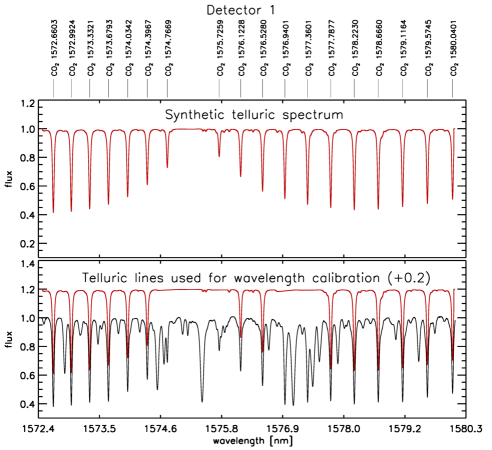
- 利用H波段中深度且稳定的地表CO2吸收线进行精确波长定标,最大限度减少仪器和大气系统误差。
- 使用LBLRTM代码和HITRAN数据库构建合成地表光谱,结合实时大气条件,建模并去除地表污染。
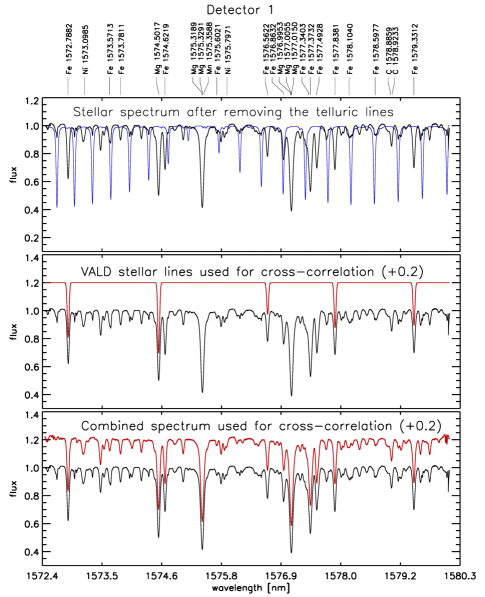
- 通过将观测光谱与基于理论VALD波长和实测谱线轮廓构建的无噪声恒星掩模进行互相关,推导径向速度。
- 对于晚型K型巨星,将多个历元的数据合并为一个信噪比高的主恒星模板,以提高RV精度和可靠性。
- 将近红外RV振幅与利克巡天提供的光学RV振幅进行比较,以检验一致性;对两组数据均拟合开普勒轨道模型。
实验结果
研究问题
- RQ1在光学数据中显示周期性的G型和K型巨星的径向速度信号,在近红外波段是否也表现出一致的振幅?
- RQ2近红外径向速度测量能否区分行星伴星与恒星活动(如黑子或g模脉动)?
- RQ3对于疑似存在行星伴星的恒星,其径向速度信号振幅在光学与近红外波段是否保持一致?
- RQ4CRIRES仪器能否实现足够高的径向速度精度(≤35 m s⁻¹),以对明亮巨星执行可靠的波段一致性检验?
- RQ5对于光学RV信号存在歧义的恒星,红外数据是否支持或反驳行星假说?
主要发现
- 所有20颗观测恒星的CRIRES近红外径向速度与利克天文台提供的光学径向速度高度一致。
- 对于此前报告存在行星或褐矮星的八颗恒星——HIP 5364(η Cet)、HIP 20889(ε Tau)、HIP 31592(7 CMa)、HIP 34693(τ Gem)、HIP 37826(β Gem)、HIP 60202(11 Com)、HIP 88048(ν Oph)和HIP 114855(91 Aqr)——其近红外RV振幅与光学振幅一致。
- 这八颗恒星的近红外与光学RV振幅比值(κ)均接近于1,其中HIP 31592的κ = 1.04 ± 0.24,表明信号强度无显著差异。
- 无任何系统表现出光学与红外RV振幅之间的差异,这本应表明信号源于恒星活动。
- 该方法成功恢复了G8 III–K1 III型巨星的可靠RV结果,且通过主模板技术,也成功应用于标准互相关失效的更晚型K型巨星(K2 III)。
- 研究结论认为,行星假说最能解释这些演化恒星中周期性RV变化,因为恒星活动效应无法在光学与红外波段产生一致的信号。
阅读本论文
在 Nubint 阅读器中打开原文,边读边就任意段落提问。
在 Nubint 中阅读本论文本解读由 AI 根据论文原文生成,引用前请核对原文。