
[论文解读] Predicting the Geolocation of Tweets Using transformer models on Customized Data
该论文提出了一种基于 BERT 的多任务学习框架,通过文本内容和元数据预测推文地理定位,采用高斯混合模型(GMM)进行回归以提高空间精度。在全球范围内,其中位误差低于 30 公里,在美国范围内低于 15 公里,通过在 GMM 协方差上施加新型下界约束,稳定了训练过程并提升了地理空间性能。
This research is aimed to solve the tweet/user geolocation prediction task and provide a flexible methodology for the geotagging of textual big data. The suggested approach implements neural networks for natural language processing (NLP) to estimate the location as coordinate pairs (longitude, latitude) and two-dimensional Gaussian Mixture Models (GMMs). The scope of proposed models has been finetuned on a Twitter dataset using pretrained Bidirectional Encoder Representations from Transformers (BERT) as base models. Performance metrics show a median error of fewer than 30 km on a worldwide-level, and fewer than 15 km on the US-level datasets for the models trained and evaluated on text features of tweets' content and metadata context. Our source code and data are available at https://github.com/K4TEL/geo-twitter.git
研究动机与目标
- 开发一种灵活的端到端 NLP 框架,仅使用文本和元数据特征预测推文地理定位。
- 通过微调 BERT 模型和多任务学习,提升全球和美国层面数据集的地理定位精度。
- 通过在 GMM 协方差参数上引入下界,解决训练过程中概率损失的不稳定性问题。
- 评估基于 GMM 的概率输出在建模不确定性及提升回归性能方面的有效性。
- 探索基于分布建模的推文级预测在用户家乡定位预测中的可迁移性。
提出的方法
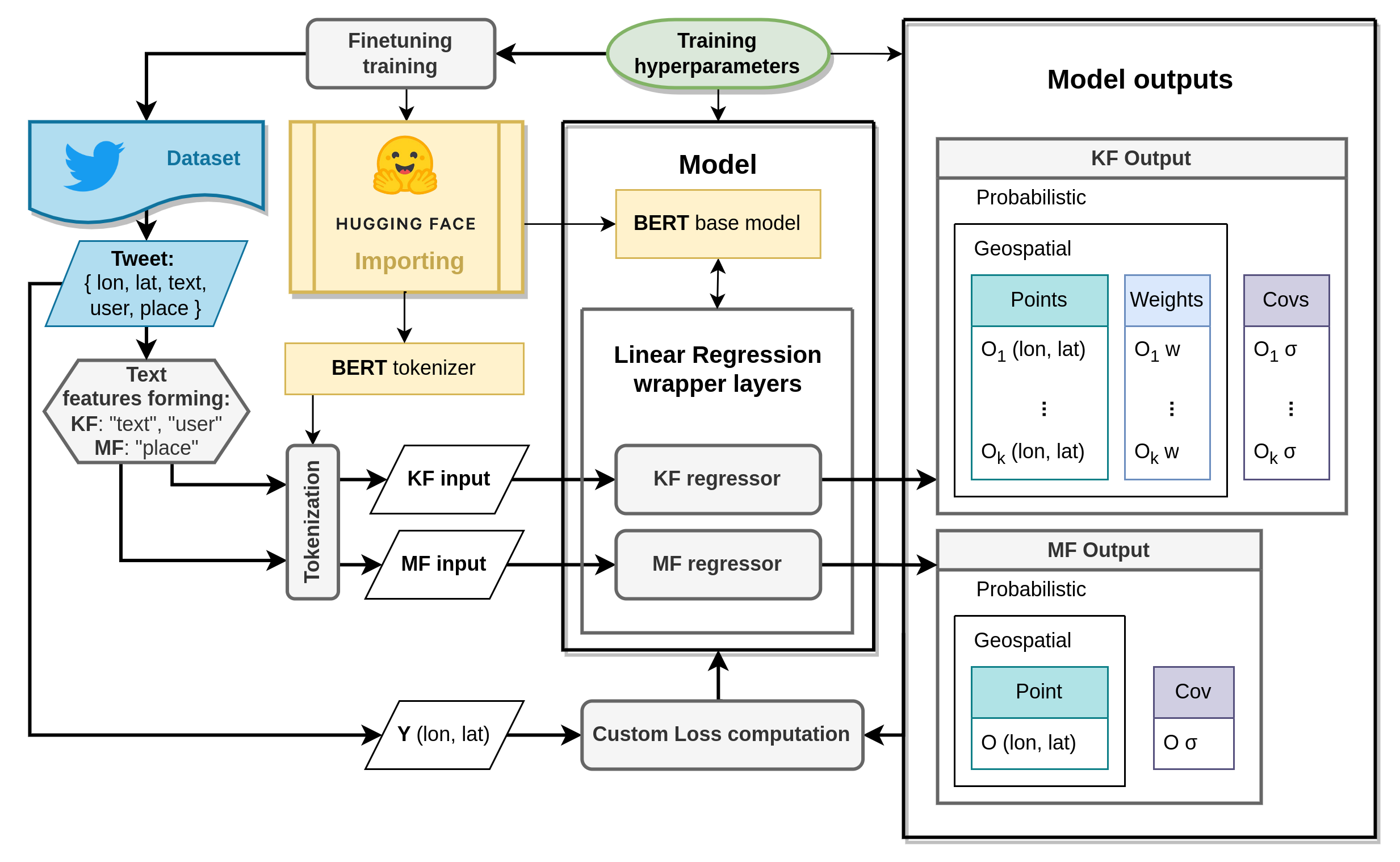
- 在包含推文文本和元数据的自定义 Twitter 数据集上微调基于 BERT 的模型,用于地理定位回归任务。
- 采用多任务学习设置,共享 BERT 编码器,并为回归(纬度/经度)和 GMM 参数预测分别设置独立的头。
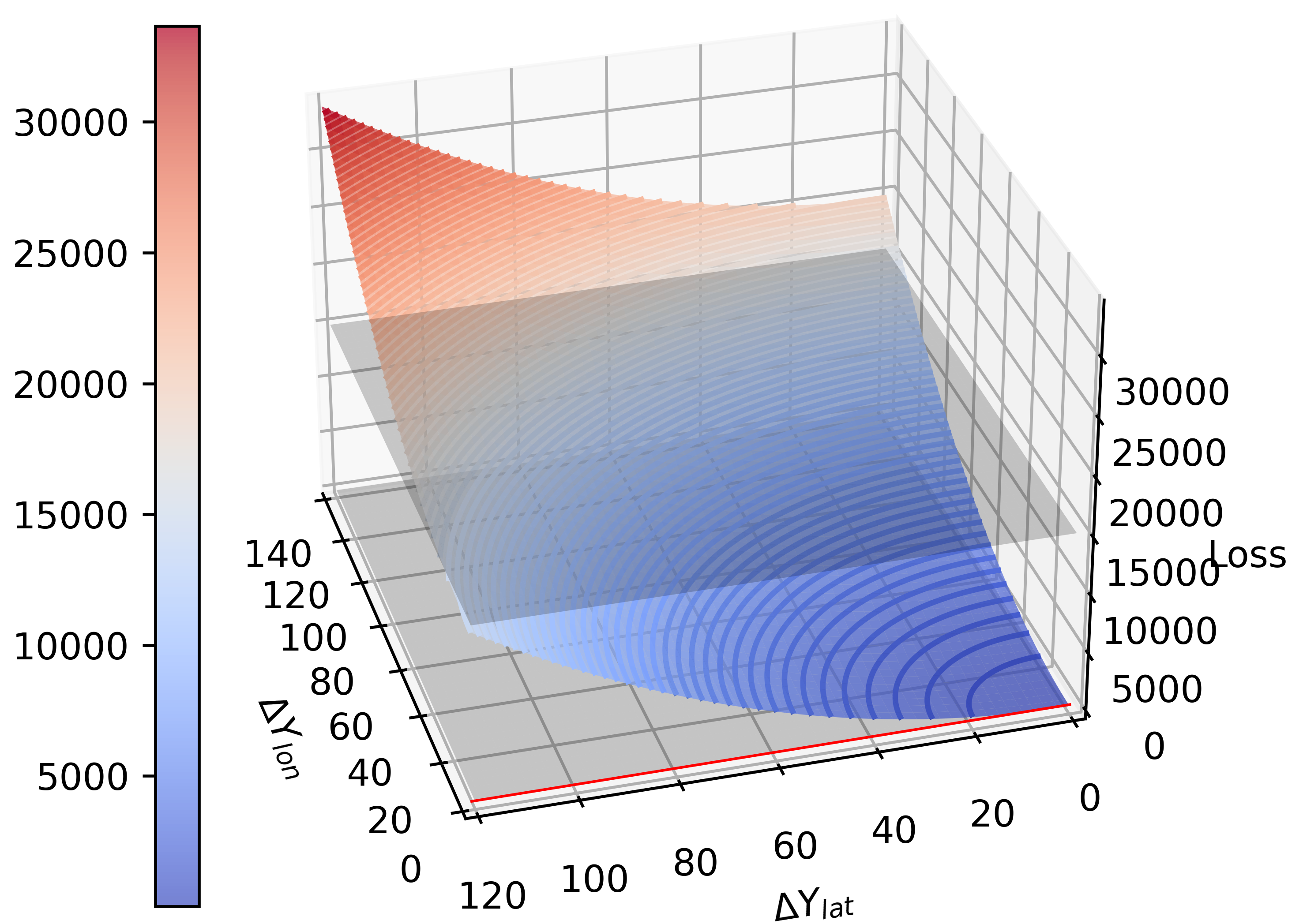
- 在 GMM 输出层施加约束,将最小标准差设为 $\frac{1}{2\pi}$,以防止概率密度函数值超过 1 并避免损失函数不稳定。
- 使用联合损失函数,平衡 L2 回归损失(欧几里得距离平方)和真实位置在预测 GMM 下的负对数似然。
- 通过线性头将 BERT 池化器输出(768 维)转换为两个连续坐标,分别用于回归任务和 GMM 参数预测。
- 通过在全球和美国特定子集数据集上的中位误差指标验证性能,对比不同数据划分和模型变体。
实验结果
研究问题
- RQ1基于自定义 Twitter 数据微调的 BERT 模型能否仅使用文本和元数据实现高精度的推文地理定位预测?
- RQ2与标准回归基线相比,采用 GMM 输出的多任务学习在地理定位精度方面有何提升?
- RQ3对 GMM 协方差参数施加约束对训练稳定性及空间预测性能有何影响?
- RQ4在多大程度上可以将单条推文的预测结果聚合,以实现比直接单条推文预测更高的用户家乡定位精度?
- RQ5不同数据划分和元数据可用性水平如何影响模型在全球和区域地理定位任务中的泛化能力?
主要发现
- 该模型在全球数据集上的地理定位中位误差少于 30 公里,在美国数据集上低于 15 公里。
- 提出的 GMM 协方差下界($\sigma_{\widehat{c}} \geq \frac{1}{2\pi}$)有效防止了负对数似然损失的不稳定,并提升了空间精度。
- 联合回归与 GMM 输出的多任务学习显著提升了性能,尤其在元数据可用时效果更明显。
- 用户级家乡定位预测任务在空间精度上优于单条推文预测,表明对同一用户多条推文进行分布建模可增强推理能力。
- 包含完整元数据(如本地复现数据)的数据集显著优于元数据缺失(如 GeoText 数据集)的数据集。
- 该模型在不同地理尺度下表现出鲁棒性,并可通过可定制的模型适配支持灵活的地理粒度。
阅读本论文
在 Nubint 阅读器中打开原文,边读边就任意段落提问。
在 Nubint 中阅读本论文本解读由 AI 根据论文原文生成,引用前请核对原文。