
[论文解读] Predicting the Initial Conditions of the Universe using a Deterministic Neural Network
本文提出了一种确定性卷积神经网络(V-Net),能够从红移 z=0 时的非线性状态准确预测宇宙N体模拟的初始线性位移场,尽管由于非线性引力坍缩导致逆问题具有固有的多对一映射关系,该方法在 k ≈ 0.8–0.9 Mpc⁻¹h 以内仍保持低于 1–2% 的误差。该方法通过利用宇宙模拟的确定性特性,优于复杂的生成模型,并在宇宙学参数分布外的情况下表现出良好的泛化能力。
Finding the initial conditions that led to the current state of the universe is challenging because it involves searching over an intractable input space of initial conditions, along with modeling their evolution via tools such as N-body simulations which are computationally expensive. Recently, deep learning has emerged as a surrogate for N-body simulations by directly learning the mapping between the linear input of an N-body simulation and the final nonlinear output from the simulation, significantly accelerating the forward modeling. However, this still does not reduce the search space for initial conditions. In this work, we pioneer the use of a deterministic convolutional neural network for learning the reverse mapping and show that it accurately recovers the initial linear displacement field over a wide range of scales ($<1$-$2\%$ error up to nearly $k\simeq0.8$-$0.9 ext{ Mpc}^{-1}h$), despite the one-to-many mapping of the inverse problem (due to the divergent backward trajectories at smaller scales). Specifically, we train a V-Net architecture, which outputs the linear displacement of an N-body simulation, given the nonlinear displacement at redshift $z=0$ and the cosmological parameters. The results of our method suggest that a simple deterministic neural network is sufficient for accurately approximating the initial linear states, potentially obviating the need for the more complex and computationally demanding backward modeling methods that were recently proposed.
研究动机与目标
- 为解决从 z=0 时观测到的非线性结构重建宇宙初始条件的逆问题,该问题由于高维、难以处理的搜索空间而计算成本极高。
- 克服基于采样的方法(如哈密顿蒙特卡洛)的局限性,后者每个后验样本需要数千 CPU 小时。
- 探究简单的确定性神经网络是否能够近似N体模拟的逆映射,从而避免使用复杂的生成模型(如扩散网络)。
- 评估模型在 Quijote 模拟套件中分布外宇宙学参数下的泛化性能。
- 证明确定性神经网络可作为后续高精度基于采样逆建模方法的高效、可靠的黑箱先验。
提出的方法
- 训练一种 V-Net 架构,将 z=0 时的非线性位移场和宇宙学参数映射到相应的线性 Zel’dovich 近似(ZA)位移场。
- 模型在通过神经网络模拟器生成的大规模 N 体模拟数据集上进行训练,输入为非线性位移,输出为线性位移。
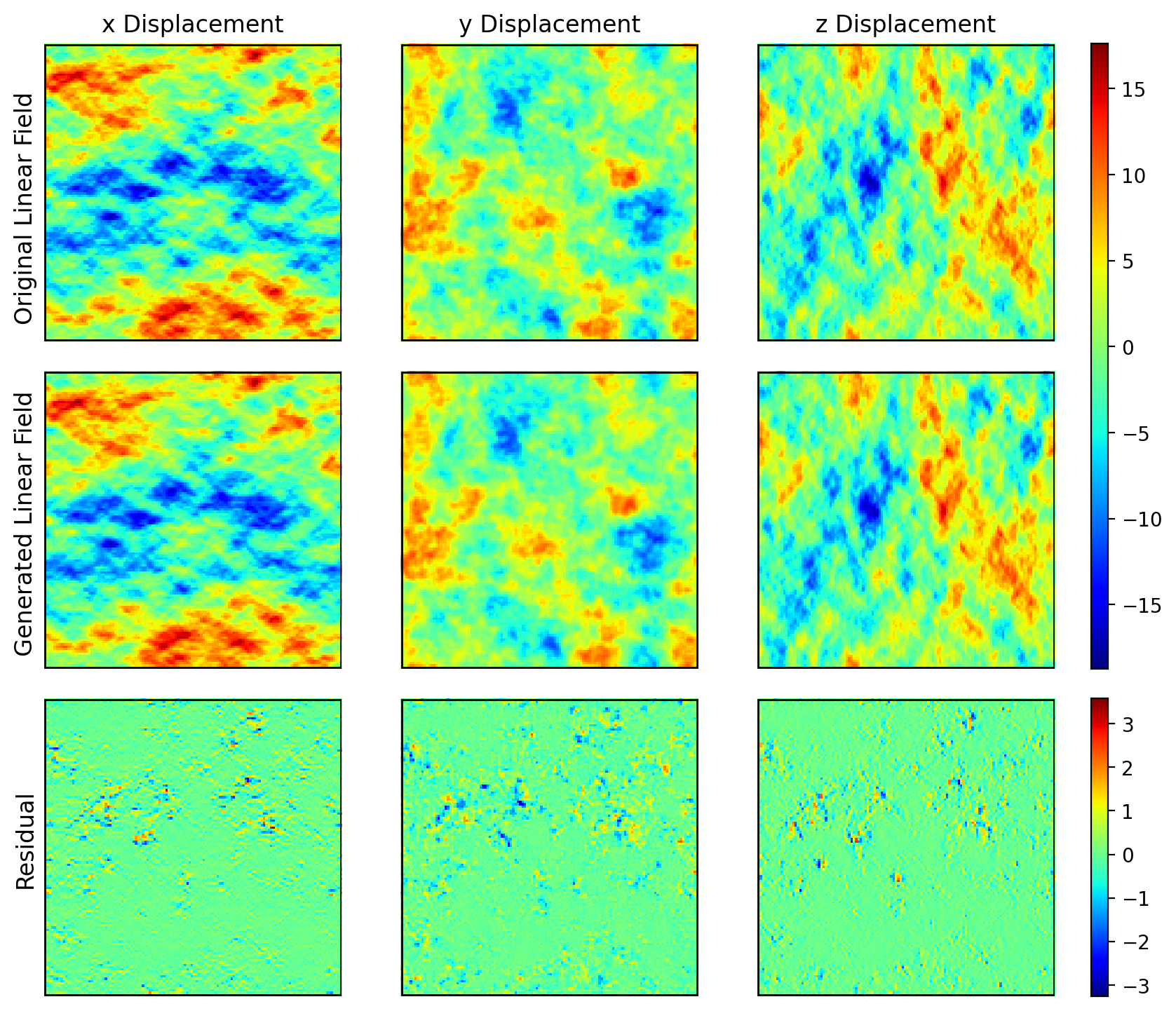
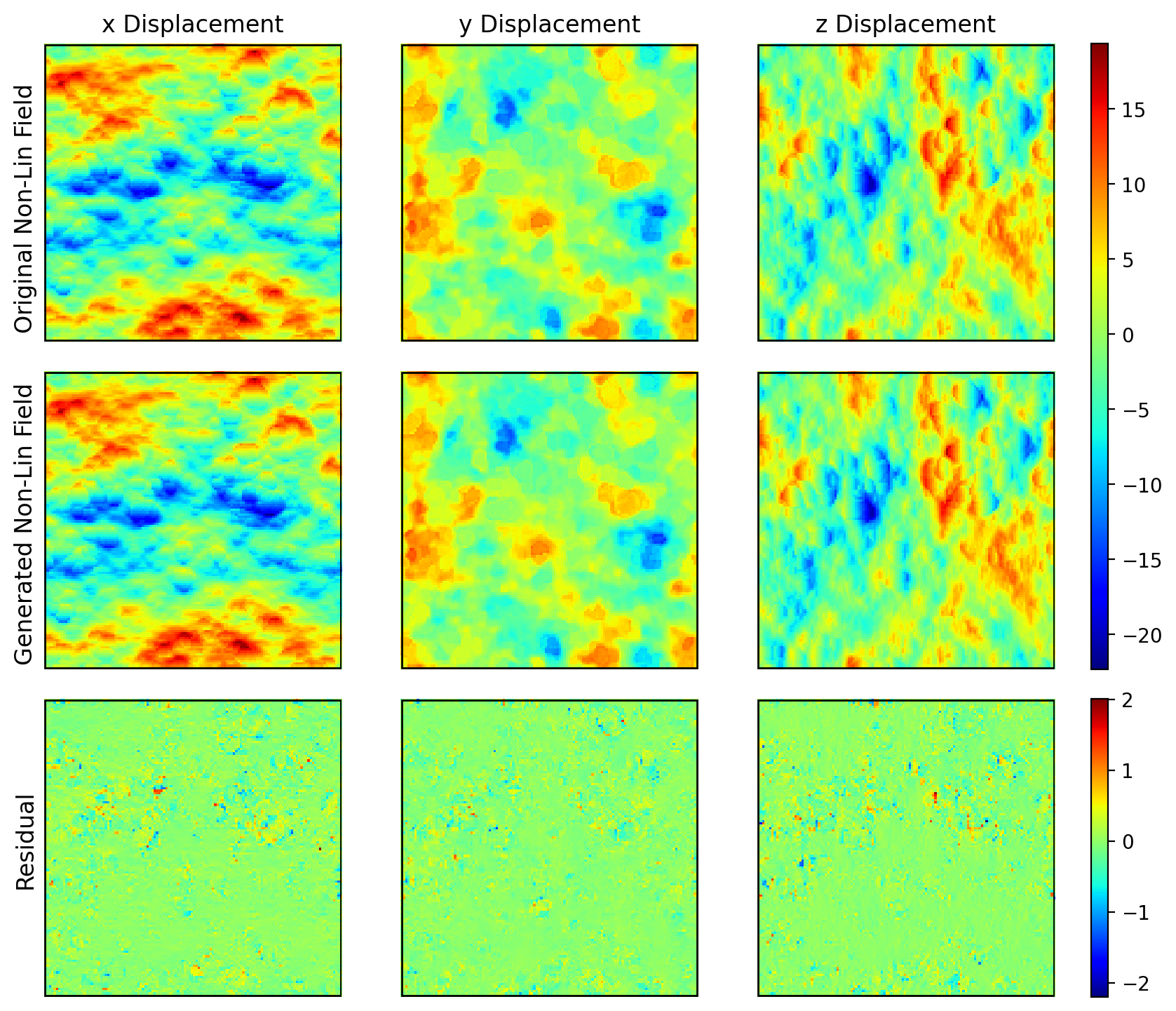
- 通过使用相同的模拟器从预测的线性场重新生成非线性场,验证正向过程的一致性,确保预测与实际非线性输出之间的一致性。
- 通过基于宇宙学参数差异性(Ωₘ, σ₈)对模拟进行排序,在 Quijote 模拟套件中评估模型的泛化性能,覆盖从第 0 个百分位到第 100 个百分位的性能表现。
- 通过功率谱比较、两点相关函数以及位移场在不同尺度上的一点统计量来量化性能。
- 不确定性量化将作为未来扩展方向,潜在方法包括高斯负对数似然损失、贝叶斯神经网络或置信预测。
实验结果
研究问题
- RQ1确定性卷积神经网络能否从N体模拟的最终非线性状态准确恢复初始线性位移场?
- RQ2该模型在训练分布外的宇宙学参数(尤其是 Quijote 模拟套件中)的泛化性能如何?
- RQ3在小尺度(k > 0.1 Mpc⁻¹h)下,当非线性引力动力学占主导时,模型是否仍能保持高精度?
- RQ4预测的初始条件能否作为后续高精度基于采样逆建模方法的有效先验?
- RQ5对于此逆问题,简单的确定性网络是否足够,还是需要更复杂的生成模型(如扩散模型)?
主要发现
- 该模型在广泛尺度范围内预测线性位移场的误差低于 1–2%,且在 k ≈ 0.8–0.9 Mpc⁻¹h 以内保持高精度。
- 该模型在分布外宇宙学参数上表现出有效的泛化能力,性能在 Quijote 模拟套件的百分位排序中从第 0 个到第 100 个百分位逐渐下降。
- 预测场与真实场的功率谱和两点相关函数表现出高度一致,尤其在大尺度和中等尺度(k < 0.5 Mpc⁻¹h)更为明显。
- 从预测线性场再生的非线性场与真实非线性场高度吻合,证实了模型在正向方向上的一致性和可靠性。
- 与 BORG 等复杂基于采样的方法相比,该模型在速度和计算成本方面表现更优,同时保持了具有竞争力的精度。
- 结果表明,确定性神经网络足以完成初始条件重建,可能在此背景下无需使用昂贵的生成模型。
阅读本论文
在 Nubint 阅读器中打开原文,边读边就任意段落提问。
在 Nubint 中阅读本论文本解读由 AI 根据论文原文生成,引用前请核对原文。